.webp)




.svg)

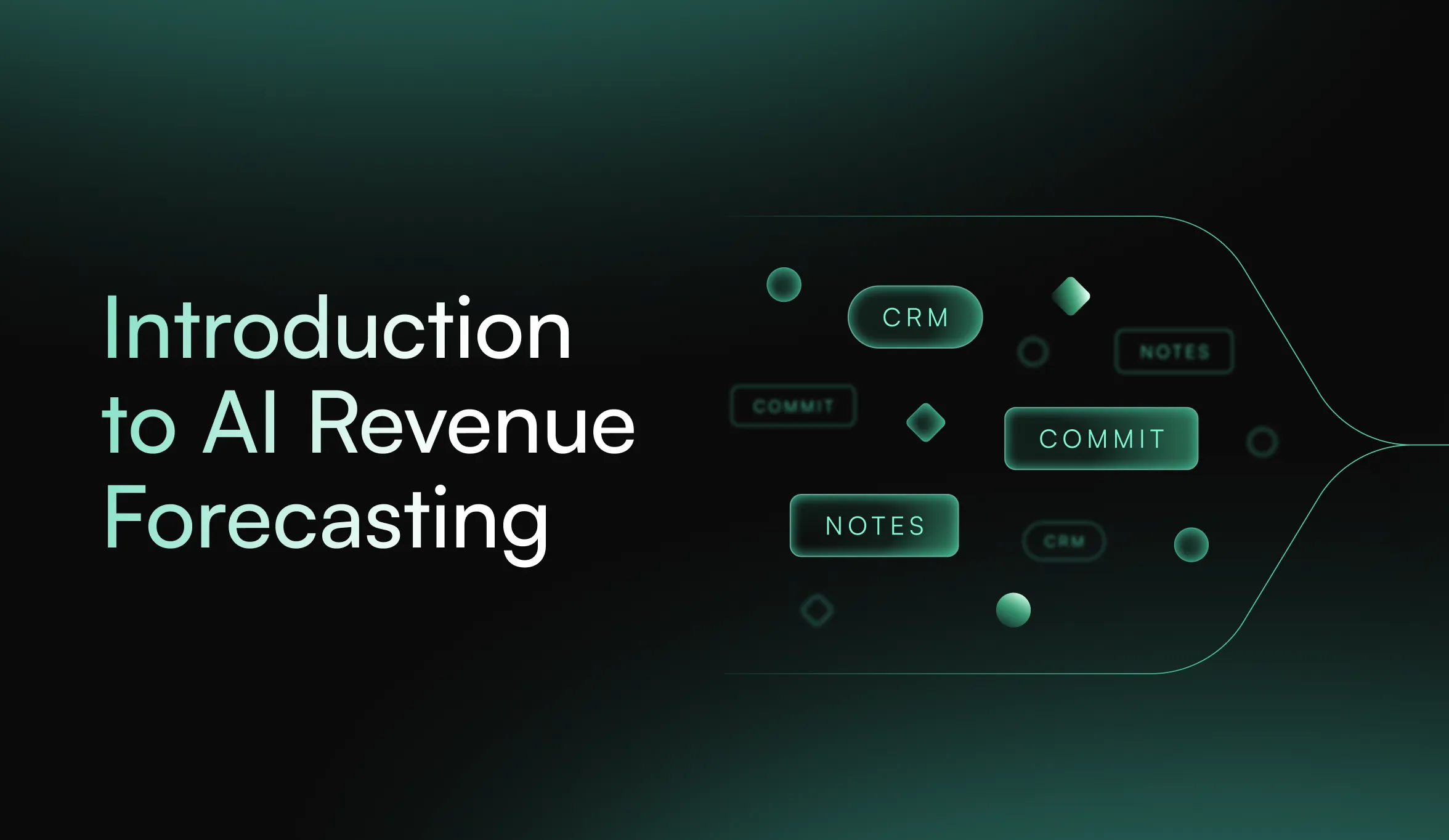
Forecasting used to be a CRM exercise. Stage math. Rep commit. Manager override.
That does not hold up as well anymore.
Sales cycles are stretching. Buyers want clearer proof. Pricing is getting harder to model too. According to Salesforce’s state of sales report, 57% of sellers said customers now take longer to decide, 69% said measurable ROI matters more than it did a year ago, and 76% of sales leaders said usage pricing matters more to customers now than last year. The same report found that 40% of teams with usage pricing say forecasting revenue is a challenge.
That changes the forecasting job. It is not just about calling whether a deal will close. It is about reading what revenue is actually likely to show up, when it will show up, and how much of that depends on what happens after signature.
CRM fields still matter. So do stage changes and rep judgment. But on their own, they miss too much. A lot of the real signal shows up somewhere else first. In calls. In product usage. In stakeholder movement. In the smaller changes that tell you a deal is moving, slowing down, or starting to slip.
That is where AI forecasting starts to matter. Not as a replacement for judgment. As a way to catch more of the signal while there is still time to act.
Why Forecasting Changed and Why AI Started Mattering in 2026
If you have been running forecast for a while, you have probably felt the shift already.
Forecasting got harder because more of the real signal stopped living in the CRM. Buying groups changed, champions left, and more revenue started depending on what happened after the deal closed, especially around usage, adoption, and expansion.
That changed the job.
It was no longer enough to look at stage changes, collect commits, and trust that the number would hold. That process can still give you a forecast, but it does not always give you a clear read on what is actually happening in the business.
That is why AI started to matter more. Not because it was new. Because the revenue motion got harder to track by hand.
The more your business depends on buyer engagement, product usage, stakeholder movement, and repeatable patterns across accounts, the harder it gets for managers and RevOps to piece it all together manually every week.
That is where AI forecasting fits. It does not replace judgment. It helps teams catch more of the signal earlier, while there is still time to act.
What AI Revenue Forecasting Actually Is
Here’s the simple version:
AI revenue forecasting is a constantly-updating prediction of revenue based on how deals actually behave, not how they are supposed to behave.
It looks at patterns in:
- buyer engagement
- product usage
- deal momentum
- stakeholder involvement
- historical conversion behavior
…..and adjusts in real time as those signals change.
Think of it as the forecasting partner who never gets tired, never forgets a signal, and never overstates the size of a deal because they “have a good feeling about it.”
The best part?
It doesn’t replace human judgment it simply grounds it in reality :)
Where AI Sees What Humans Don’t
Every revenue leader has lived these moments:
A rep swears a deal is fine.
An enterprise buyer says “Let’s regroup next week.”
A renewal looks stable…. until usage quietly drops 40%.
Humans catch some of this. but AI catches all of it.
1. Seasonality with nuance
Humans say: “Q4 is always big.”
AI says: “Q4 is big when the early quarter pipeline is strong and expansion usage hits a certain threshold.”
2. Silent pipeline decay
Reps keep deals green until the last moment.
AI sees 10 days of no responses and slows its probability down long before the forecast call.
3. Champion risk
Humans may not notice a new stakeholder entering late in the cycle.
AI sees the shift in email patterns and meeting dynamics.
4. Usage-driven churn or expansion
Humans read renewal signals mostly from relationship quality.
AI evaluates real-time usage curves against historical churn patterns.
This is the magic -
AI doesn’t work because it’s smart it works because it pays attention to everything humans don’t have time to track.
When AI Forecasting Works and When It Doesn’t
Let’s be honest AI forecasting only works if your motion produces enough repeatability and enough signal.
If you have meaningful deal volume, at least a year of consistent data, and a revenue process that repeats quarter after quarter, AI can dramatically improve accuracy.
If you’re early stage, still figuring out ICP, or dealing with chaotic CRM data… the model is only as strong as the inputs. You’ll be better served with simplified stage-weighted forecasting and scenario planning until your foundation stabilizes.
Here’s the gut-check most RevOps leaders use:
- Do we have enough data for the model to learn anything useful?
- Is our sales motion repeatable, or are we reinventing the wheel every quarter?
- Are we willing to let the model be a second opinion not a replacement for human judgment?
If the answer is “yes” then AI isn’t just helpful; it becomes a competitive advantage.
The Data That Actually Matters (And the Stuff Everyone Overthinks)
You don’t need perfect data. You need consistent data.
The fundamentals still hold: amount, stage, owner, product, close dates, deal age. But what separates good forecasts from great ones are engagement and usage signals that tell the real story of the deal.
- If a buyer hasn’t replied in two weeks, the model sees it.
- If the champion isn’t on renewal calls, the model registers it.
- If usage is dipping ahead of QBRs, AI takes note.
This is the kind of data humans intend to track but rarely do.
Usage is becoming the new pipeline, especially in consumption and expansion-heavy SaaS motions. A model that can read those patterns has a real shot at predicting renewals and expansions without the optimism tax.
If you have at least 12 months of good history and a clean segmentation structure, you’re already ahead of most teams.
Choosing a Forecasting Approach That Fits Your Motion
Not every business forecasts the same way and that’s a good thing. The key is choosing a method that matches your reality, then letting AI enhance it rather than bulldoze it.
Here’s how operators think:
1. If you’re SMB or PLG
Volume and velocity matter more than individual deals. AI shines by catching seasonal spikes, usage-driven buying behavior, and momentum trends you’d never see manually.
2. If you’re enterprise
Deals are fewer, larger, and full of stakeholders. AI helps track the pace, engagement, and politics that stage fields ignore. Deal inspection matters but AI makes inspection honest.
3. If you’re consumption-based
AI becomes almost unfair. Usage curves reveal more about renewal likelihood and expansion potential than any self-reported data.
The point is simple - AI works best when it enhances your current process, not replaces it.
The Forecast Integrity Loop: How Great Operators Keep Forecasts Honest
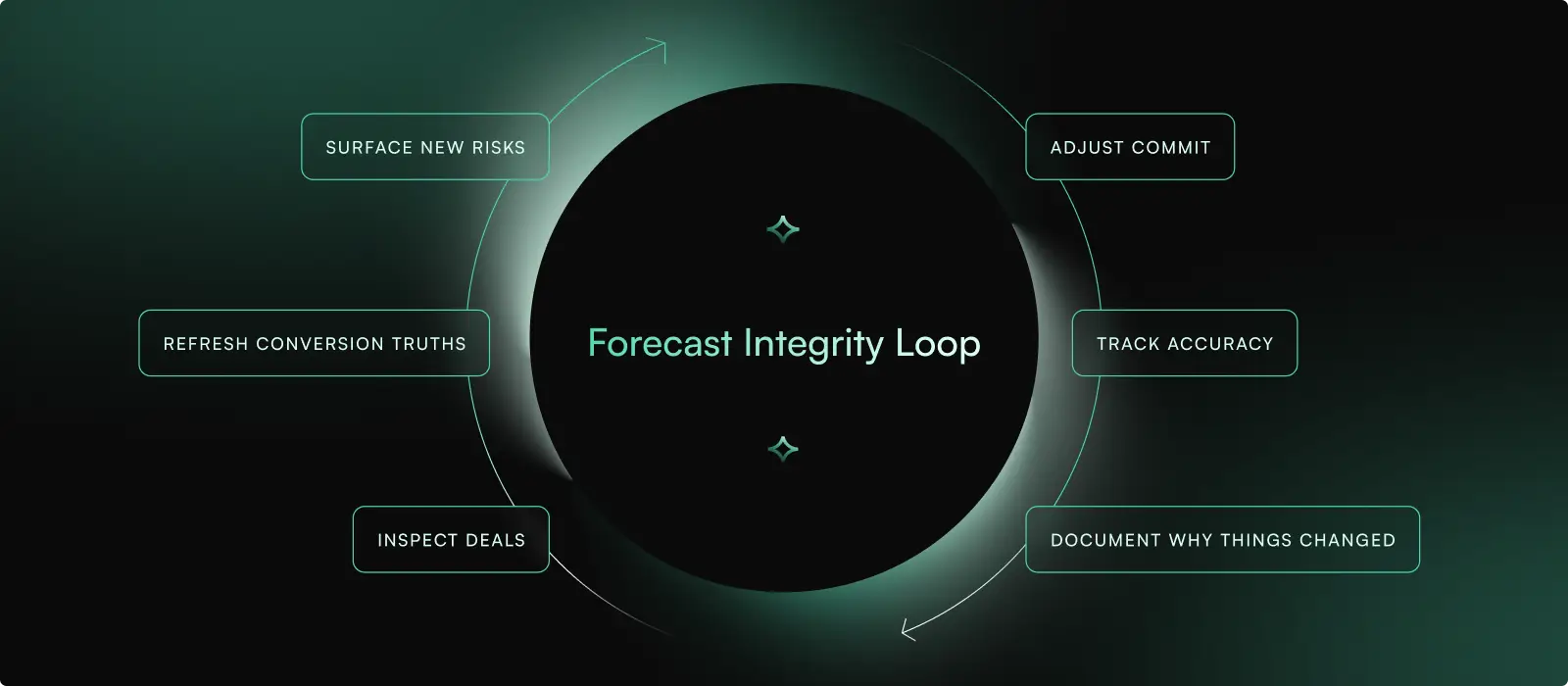
Every strong forecasting culture shares one habit they run a consistent loop.
We call it the Forecast Integrity Loop, and it looks like this:
- Inspect the deals that matter
- Refresh conversion truths (not assumptions)
- Surface new risks
- Adjust commit
- Track accuracy
- Document why things changed
Most orgs skip steps four through six and that’s why their accuracy swings wildly.
AI tools like ForecastIQ reinforce this loop by making it nearly impossible to ignore the signals that matter. It’s not magic; it’s discipline supported by technology.
The Weekly Rituals That Make or Break Accuracy
The truth nobody likes to admit is Forecast accuracy is less about intelligence and more about habits.
The teams that nail consistency:
- Inspect deals even when the number “looks fine”
- Remove deals from commit if they’re missing next steps
- Keep stage hygiene tight so the model can learn
- Update scenarios as behavior changes
- Don’t treat week-over-week movement as optional
This is why AI doesn’t replace people it keeps them honest.
When a deal hasn’t moved in 21 days, the model doesn’t shrug. It asks, “Do you really believe this is closing?”
And that question alone saves "quarters".
What Good Actually Looks Like (No Sugarcoating)
If you’re forecasting enterprise deals, a 15–25% in-quarter error rate is normal. Anything better is exceptional.
If you’re SMB or velocity, 10-15% is excellent.
Bias is the real enemy. Consistently over-forecasting erodes trust. Consistently under-forecasting destroys planning. Teams that monitor both WAPE and bias tend to stabilize faster and deliver more predictable revenue.
Over time, what feels like “accuracy” is simply this:
Your forecast stops surprising you. :)
Backtesting: The Part Everyone Forgets
Backtesting sounds complicated, but it’s really a post-game review.
You look at the last few quarters, compare what you predicted to what actually happened, and uncover the patterns your brain smoothed over.
Backtesting exposes the uncomfortable truths:
- Your win rates aren’t what you think
- Some segments convert very differently
- Your commit criteria isn’t real
- Your stage definitions encourage bad behavior
It’s humbling and liberating. It sets the stage for everything that follows.
Explainability: The Non-Negotiable Requirement
No CRO will trust a model that cannot explain itself. Explainability has become essential. It is the difference between a forecast that earns confidence and one that feels like a mysterious black box handing down numbers from above.
A good forecasting system should feel like a conversation, not a verdict. Leaders should quickly understand what changed since last week, which signals drove that shift, and what assumptions were updated.
They should also be able to see whether a probability drop came from declining engagement or simply from stage aging.
This level of transparency is what allows leaders to trust the forecast, challenge it when needed, and ultimately improve their process. ForecastIQ is built around this philosophy. AI insights matter only when leaders can interpret them clearly and confidently.
How Forecasting Differs Across Industries
Forecasting is not a one size fits all discipline. It looks very different across SaaS subscription businesses, consumption models, hybrid hardware motions, and services organizations.
Subscription SaaS depends heavily on adoption and stakeholder engagement. These signals often determine renewal and expansion long before a contract is up for review.
Consumption SaaS is shaped by acceleration or slowdown in usage, which tends to predict renewal outcomes more accurately than CRM fields ever can.
Hybrid hardware plus SaaS introduces deployment complexity and technical readiness, something most forecasting systems were never built to interpret.
Services teams operate in an entirely different rhythm, where resource allocation, delivery milestones, and stakeholder satisfaction determine outcomes.
AI does not erase these nuances. What it does is finally give companies a way to model them accurately.
A Real World Example: What It Looks Like When This Actually Works
A publicly traded SaaS company, roughly six hundred million in annual revenue, reduced its forecast error from thirty four percent to twelve percent in a single quarter. This improvement did not come from a radical transformation or a complicated technical overhaul.
It came from consistency.
The team cleaned up segmentation and tightened its exit criteria. They enforced next step discipline, ensuring every deal had real momentum. They tracked executive access, recognizing how important it is for enterprise selling.
They refreshed win rates monthly instead of relying on outdated assumptions. They adopted ForecastIQ to surface risk earlier and bring objectivity to deal inspection. And only once this operational foundation was solid did they layer in AI driven signals.
The result was a forecast that finally matched reality. Trust in the process grew, and the AI amplified that trust even further.
The Problems That Sabotage Forecasts (And How to Fix Them)
Every RevOps leader has seen the same issues repeat themselves. Stages drift out of alignment with what is actually happening. Close dates slip week after week without accountability. Large deals distort the forecast. The model feels confusing or unpredictable. Managers push back against AI scores because they conflict with their intuition.
Fortunately, the fixes are straightforward. They begin with strong operational habits.
Make next steps and activity updates mandatory so deals stop sitting idle. Require clear reasons for date changes to eliminate sandbagging and optimism bias. Use scenario ranges to reduce volatility created by a few oversized deals.
Introduce AI gradually and explain how it reads signals. Treat its recommendations as a second opinion rather than a final ruling.
These practices are not new, but AI reinforces them by making it impossible to ignore the truth inside the pipeline.
Which Tools Work Best (Honest, Not Political)
Choosing a forecasting tool is not about comparing feature checklists. It is about understanding the needs of your revenue engine and matching them with the right system.
MaxIQ, which brings together ForecastIQ, InspectIQ, and EchoIQ, is ideal for teams that want forecasting grounded in real buyer signals, simple governance, and a connected workflow that does not require heavy operational overhead.
Clari is a strong fit for large organizations with complex roll up structures and multiple forecasting layers.
Aviso works exceptionally well for companies with deep data science maturity that want heavy machine learning modeling behind their forecasts.
BoostUp is a good choice when email and activity insights are as important as pipeline dynamics.
Salesforce Einstein offers convenience for teams that want native predictions directly inside their CRM, though it typically provides less signal depth than specialized forecasting platforms.
No tool can save a broken process. But when paired with strong habits, the right system accelerates forecasting maturity dramatically.
How to Roll Out AI Forecasting in Four Weeks
This process doesn’t need to take quarters. Most teams get to a stable flow in a month.
Week 1: Align on goals, definitions, commit rules, and fields
Week 2: Clean up data and recalc win rates
Week 3: Run a trial on last quarter’s activity
Week 4: Go live and freeze logic
After that, the habits take over.
How MaxIQ's ForecastIQ Brings It All Together
ForecastIQ isn’t just a model it’s the forecasting system RevOps leaders wish existed years ago.
It brings together:
- Real buyer signals from EchoIQ
- Deal inspection with InspectIQ
- Honest stage calibration
- Built-in best/base/worst scenarios
- Accuracy dashboards
- A complete “who changed what, when, why” history
And it lets teams grow into AI rather than being forced into a black-box model on day one.
That’s the part revenue leaders appreciate most: You stay in control. The AI just keeps everything honest.
Every capability walked through one by one, with screenshots from real calls.
.avif)


.webp)