.webp)




.svg)

Key Takeaways (TL;DR)
Revenue intelligence platforms in 2026 fall into three camps: conversation-first, forecast-first, and connected revenue systems. The real mistake is not picking the wrong vendor. It is picking the wrong category for the problem your team actually has.
- MaxIQ: Best when you want one connected system instead of separate tools for calls, forecasting, and post-sales.
- Gong: Best when the biggest blind spot is what buyers are actually saying in calls, and managers need better coaching and deal review signals.
- Clari: Best when forecast governance, pipeline inspection, and weekly forecast discipline are the main problems.
- People.ai: Best when CRM activity data is incomplete, rep logging is unreliable, and reporting is hard to trust.
- Salesforce Sales Cloud: Best when the team wants revenue intelligence to stay close to Salesforce data, workflows, and governance.
- Outreach: Best when the priority is rep execution, follow-up consistency, and keeping pipeline motion from slowing down.
- Salesloft: Best when seller workflow, coaching, and productivity at scale matter more than deep forecast governance.
Most revenue intelligence tool comparisons are written by people who've never sat through a Monday forecast call in their life.
You can tell. They read like 10 product brochures stapled together.
But not this one, and I'll tell you why in a second.
First, the short version for the skimmers.
Revenue intelligence platforms in 2026 fall into three camps -
First, Conversation-first tools like Gong, Second, forecast-first tools like Clari and Outreach, and the third, a unified revenue systems like MaxIQ that connect deal inspection, forecasting, conversation signals, and post-sales context in one place.
This guide compares 7 of them: MaxIQ, Gong, Clari, People.ai, Salesforce Revenue Intelligence, Outreach and Salesloft.
Now, the why.
I'm the CEO of MaxIQ. Which means twice a week, I'm in a deal where someone's ripping out one of these tools or deciding between them. I've heard every complaint, every "yeah but," every reason a six-figure contract turned into shelfware.
So no, I'm not neutral. But I'm closer to the truth than a listicle written off seven pricing pages.
Truth be told: most teams don't buy the wrong tool. They buy the wrong category.
They buy Gong when their real problem is forecast governance. They buy Clari when their reps' CRM hygiene is the actual fire. Then they spend two quarters and a renewal cycle wondering why nothing changed.
That's the mistake this guide exists to prevent.
If you'd rather trust a vendor-free comparison from G2, cool by me. But if you want the version with the complaints I actually hear in deals, keep reading.
Table of Content:
- Best revenue intelligence platforms at a glance
- What is a revenue intelligence platform?
- 7 Best Revenue Intelligence Platforms in 2026
- What makes the Best Revenue Intelligence platform in 2026?
- Which revenue intelligence platform is right for your team?
- What to validate in every demo?
- Why MaxIQ is built as a full revenue intelligence platform?
Best revenue intelligence platforms at a glance
Every tool in this category sounds identical on a demo. "AI-powered insights." "Single source of truth." "Predictable revenue."
Sure.
Here's the same seven tools, minus the demo voice. What each one is actually best at, and the situation where shortlisting it makes sense.
One honest note before the table: Outreach and Salesloft aren't pure revenue intelligence platforms. They're sales engagement tools that have grown intelligence features. I've kept them in because buyers constantly cross-shop them with this category, and sometimes a sales execution problem is what you actually have.
If a tool on this list made you nod, jump straight to its section below. If you're still not sure which problem you actually have, the next section sorts that out first.
What is a revenue intelligence platform?
A revenue intelligence platform is software that analyzes signals across your CRM, sales calls, emails, meetings, and buyer activity to show which deals are actually progressing and which are quietly stalling. Instead of relying on what reps enter into the CRM, it reads what's really happening in the deal.
That's the textbook version. Here's what it actually does, mechanically:
- It captures what your team never logs. Every email, every meeting, every call gets recorded and matched to the right deal automatically. No rep behavior change required. This alone is why most teams buy: industry estimates put unlogged sales activity at well over half of what actually happens.
- It reads the signals inside that activity. Who's on the calls (and who's missing). How fast the buyer replies. Whether pricing came up and what happened next. Whether the deal has a scheduled next step or is just... open.
- It compares every deal against patterns. Deals that closed looked like X at this stage. This deal looks like Y. That's where the this deal is at risk score comes from. It's not magic, it's pattern matching against your own history.
- It rolls that up into a forecast you can defend. Not reps say $2.1M commit, but based on actual deal behavior, expect $1.6M, and here are the four deals making up the difference.
Just as important, here's what revenue intelligence is not, because vendors blur these lines on purpose:
It's not a call recorder. Recording is table stakes; the intelligence is what gets extracted from the calls. It's not a BI dashboard either. Tableau on top of Salesforce just visualizes the same self-reported data faster.
And it's not sales engagement. Outreach and Salesloft help reps do the activity; revenue intelligence tells you what that activity means. (Yes, every one of these tools now claims to do all of it. That's why this guide exists.)
One more thing nobody selling this software will tell you
You might not need it yet.
If you're running 15 deals a quarter, you don't need pattern detection. You need to look at your 15 deals.
A founder who knows every deal personally has better revenue intelligence than any platform. This category earns its cost when the pipeline outgrows one person's head: roughly when you have multiple reps, a forecast someone above you actually depends on, and deals dying for reasons nobody can name until the post-mortem.
If that's where you are, the question becomes which slice of the problem to fix first. That's where the seven platforms split apart.
7 Best Revenue Intelligence Platforms in 2026
Every platform below follows the same structure. What it actually does, where it's genuinely strong, where it falls short (straight from user reviews, not my opinion), what it costs, and who should buy it.
Two ways to use it:
Know your problem? Jump straight to the platform that matches it. Forecast chaos, go to Clari. Call blind spots, Gong. Tool sprawl, MaxIQ.
Don't know your problem yet? Read the "falls short" parts first. How a tool fails tells you more than how it demos.
Let's go.
1) MaxIQ: One revenue system instead of three tools
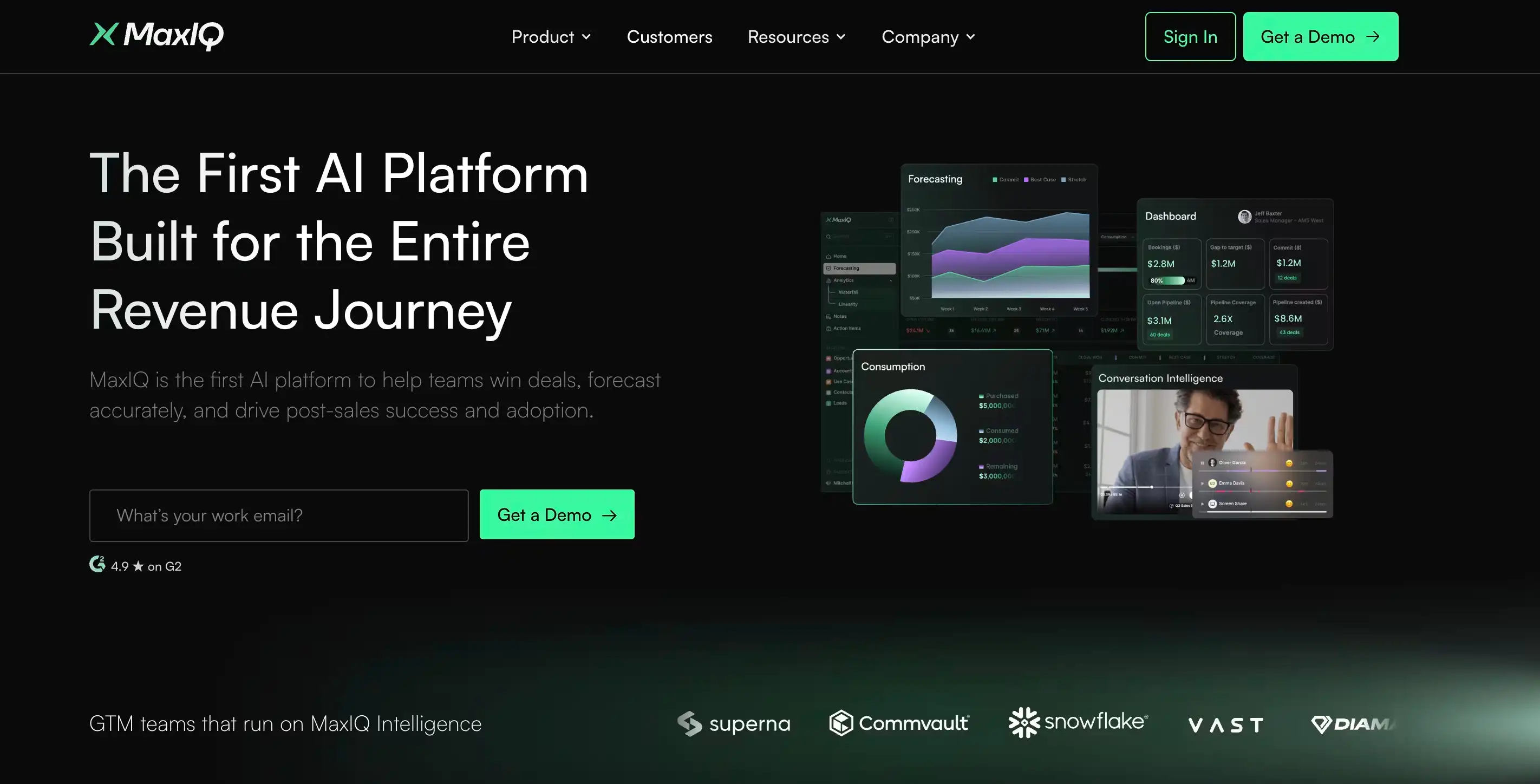
What it is. MaxIQ is a revenue intelligence platform built around one idea: the customer journey doesn't end at closed-won, so the intelligence shouldn't either. It connects four pieces that usually live in separate tools into one system: deal inspection, forecasting, post-sales success and adoption, and conversation intelligence. Context carries from first call to renewal.
Where it wins. The handoff problem. In a typical stack, Gong knows what the buyer said, Clari knows what the forecast says, and your CS platform knows none of it. The commitments your AE made on a sales call vanish at closed-won, and CS rediscovers them six months later as a churn reason.
MaxIQ keeps that thread intact. The same signals that scored deal risk during the sale follow the account into onboarding and expansion. Signals it reads instead of trusting stage fields:
- Economic buyer engagement, or the lack of it on every call
- Reply speed and meeting momentum, not "stage updated"
- Slipped close dates and stalled next steps
- Onboarding commitments made during the sale, carried into post-sales
No acquisition seams, either. This is a 2022-built product. No bolted-on AI, no two products stapled together.
Where it falls short. Straight from our own G2 reviews: new teams report a learning curve, and some users flag limited customization and occasional integration issues. All fair. Two more I'll add myself: we're the youngest platform on this list. If you want a decade of enterprise deployments and 6,000 reviews, that's Gong or Clari, not us. And if all you need is call recording with transcripts, MaxIQ is more system than your problem requires.
Pricing. Custom, based on team size and modules. Request pricing here. (I know, I know - nobody in this category has one)
Choose MaxIQ if you're running a call tool, a forecast tool, and a CS spreadsheet that don't talk to each other, and you're tired of being the integration. Skip it if you need one narrow job done and the incumbents' depth in that single lane matters more than connected context.
"MaxIQ takes the guesswork out of forecasting... instead of just depending on deal stages, it looks at real buyer signals like activity, momentum, and engagement." — G2 reviewer
2) Gong: Best for conversation driven deal truth and coaching
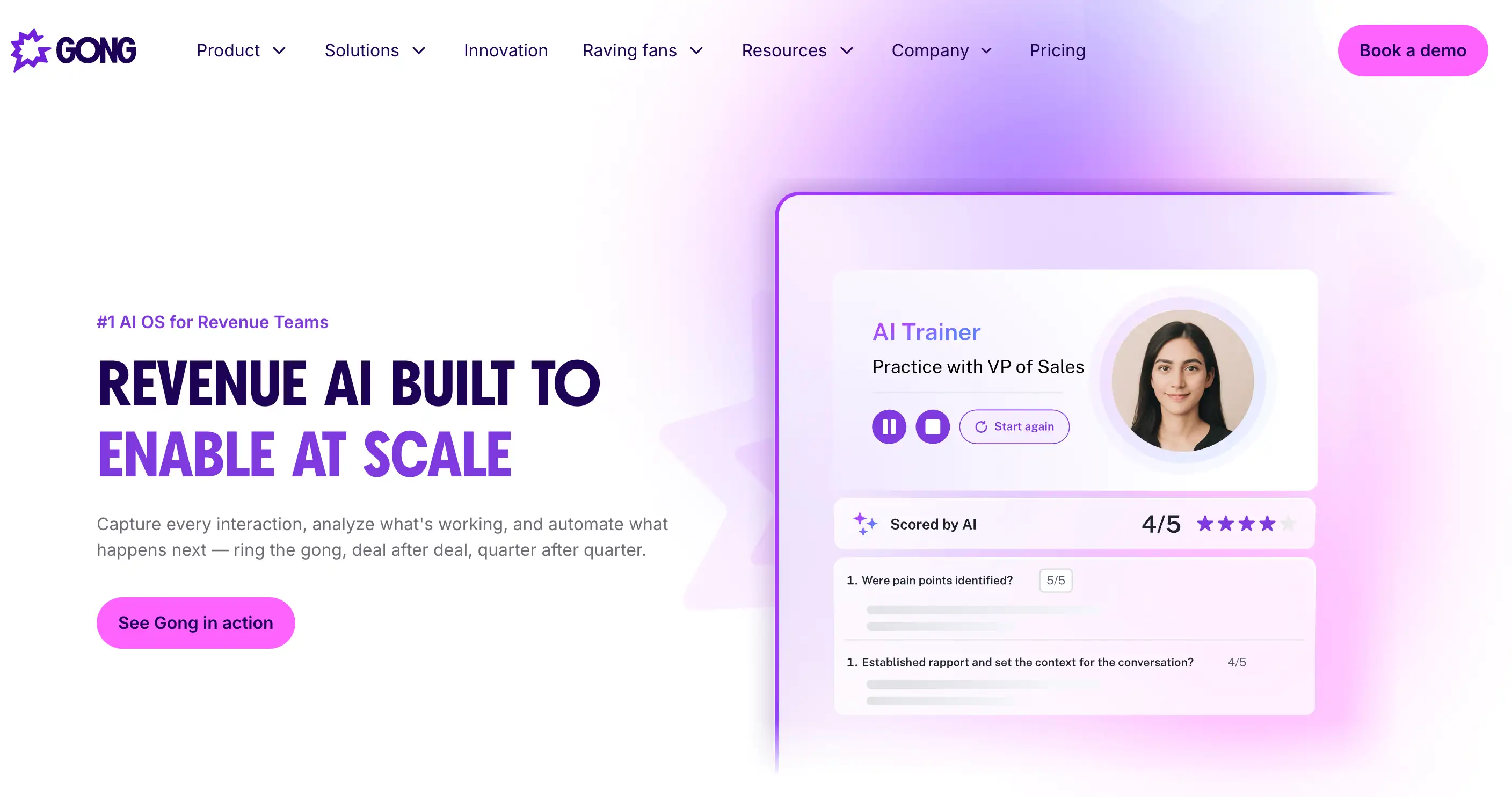
Best for teams trying to understand what is really happening inside live deals.
Where it wins
Gong excels at surfacing risk patterns, buyer behavior, and coaching insights directly from conversations. When managers use it consistently, it fundamentally improves deal reviews.
Where it is weaker
Many teams underuse it. Without a strong manager cadence, it often becomes a call library instead of an operating system, a concern frequently raised by practitioners.
Choose it if your biggest blind spot is deal reality and you want conversations to drive coaching and inspection.
3) Clari: Best for forecast governance and pipeline inspection
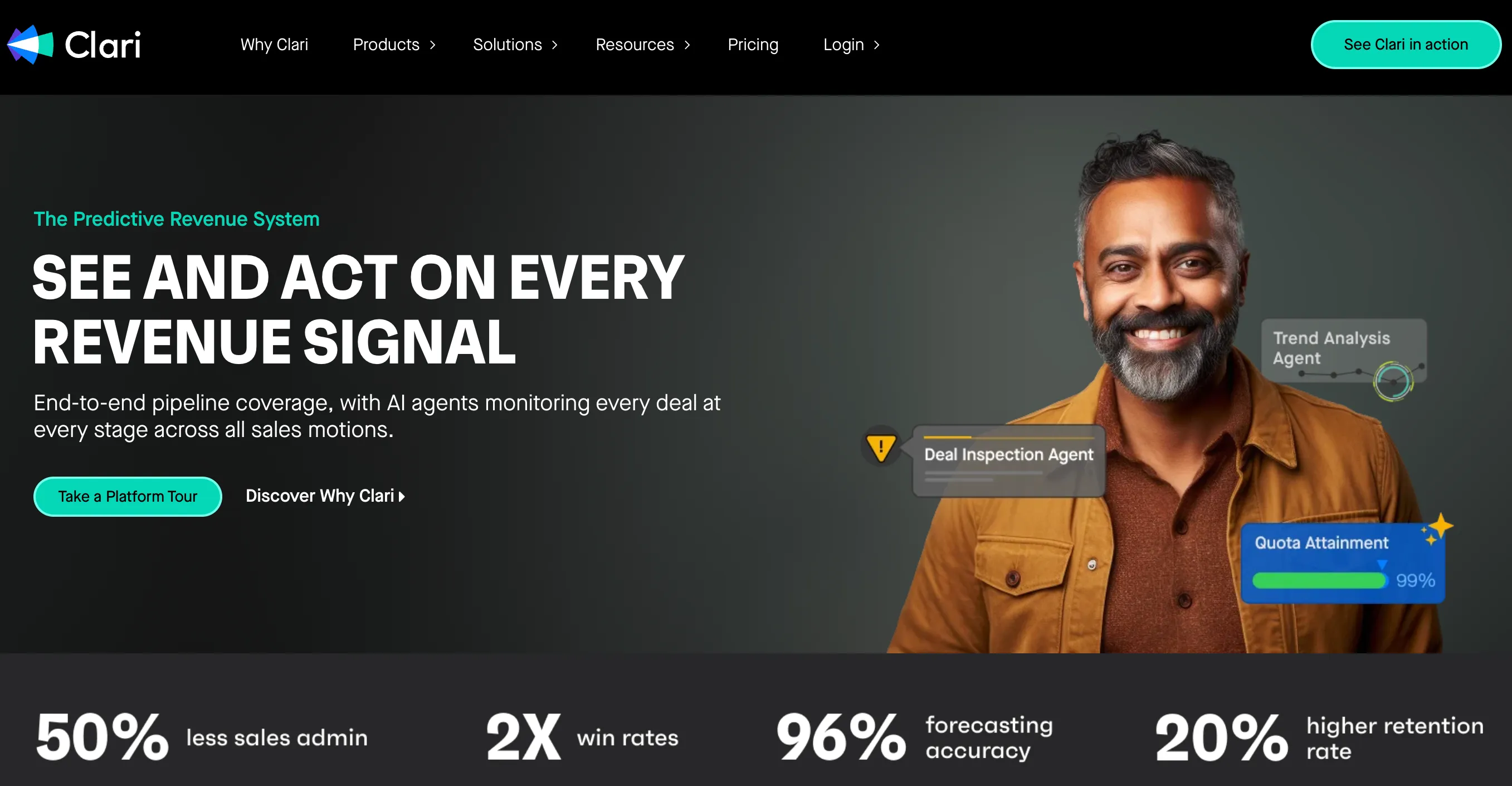
Best for leadership teams under board pressure to improve predictability.
Where it wins
Clari is strong at forecast rollups, inspection discipline, and running a consistent weekly forecast cadence. It gives RevOps and executives a shared view of the number.
Where it is weaker
It does not fix messy CRM data on its own. Without process and hygiene, it simply governs unreliable inputs.
Choose it if forecast accuracy and inspection rigor are your top priorities and you already run a structured forecast rhythm.
4) People.ai: Best for CRM truth through activity capture
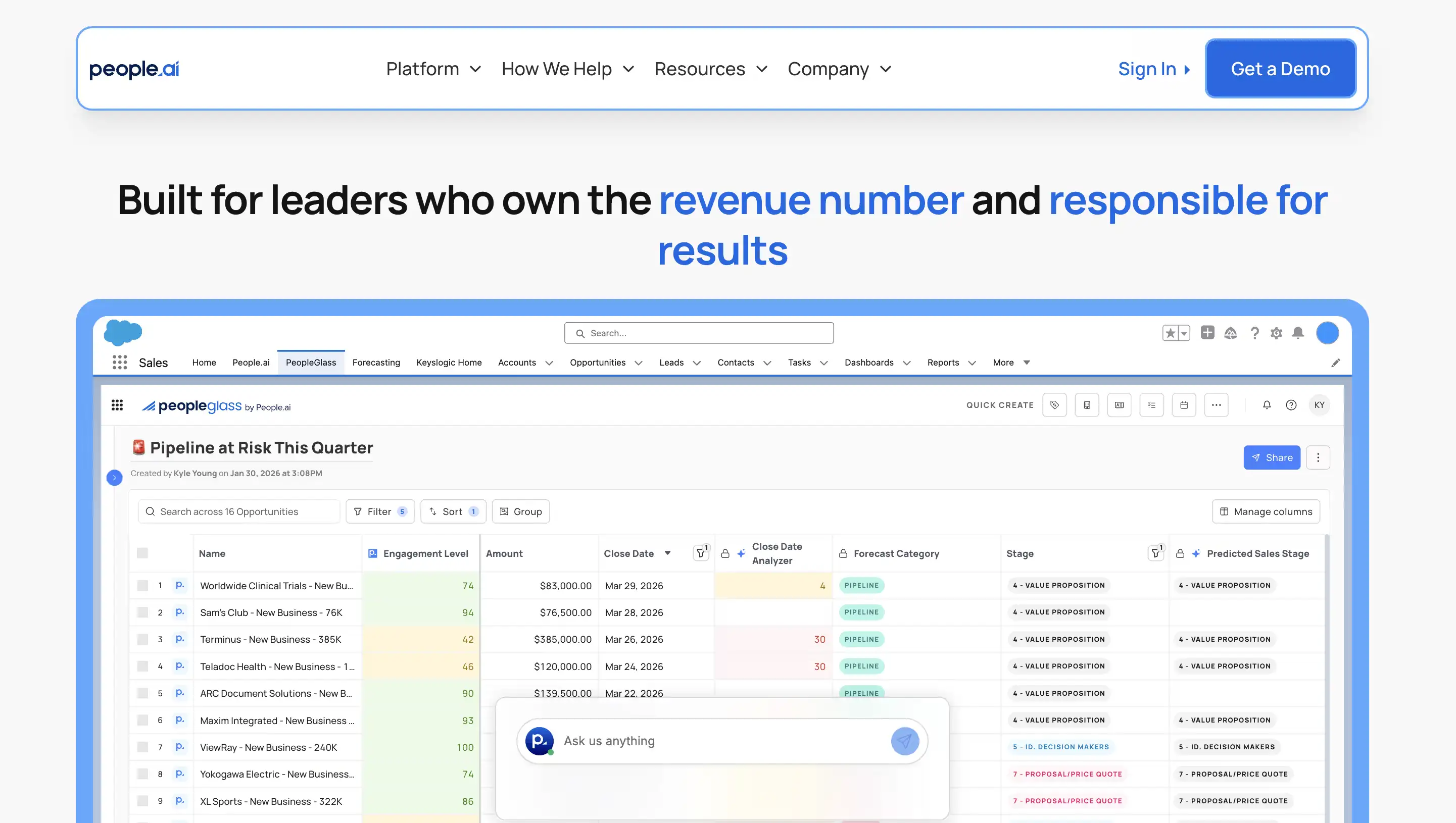
Best for organizations struggling with incomplete or unreliable CRM activity data.
Where it wins
People.ai closes the gap between what reps actually do and what gets logged. Activity capture is automated so reporting reflects reality.
Where it is weaker
Configuration and governance matter. Without them, teams risk introducing noise instead of clarity.
Choose it if unreliable CRM activity data is the root cause of reporting and forecast issues.
5) Outreach: Best for execution and pipeline motion
Best for engagement led sales organizations.
Where it wins
Outreach drives consistent follow up, rep workflows, and execution. It excels at turning intent into action.
Where it is weaker
If forecasting and inspection depth are your main concern, validate how far it goes beyond engagement metrics.
Choose it if your biggest issue is pipeline creation and execution consistency.
6) Salesloft: Best for seller workflow and coaching at scale
Best for teams focused on repeatable execution and coaching.
Where it wins
Salesloft is strong in rep productivity, manager coaching, and workflow consistency.
Where it is weaker
It is not designed to be a forecast inspection or governance system.
Choose it if you need better execution and coaching rather than forecast analytics.
7) Salesforce Sales Cloud: Best for CRM native governance
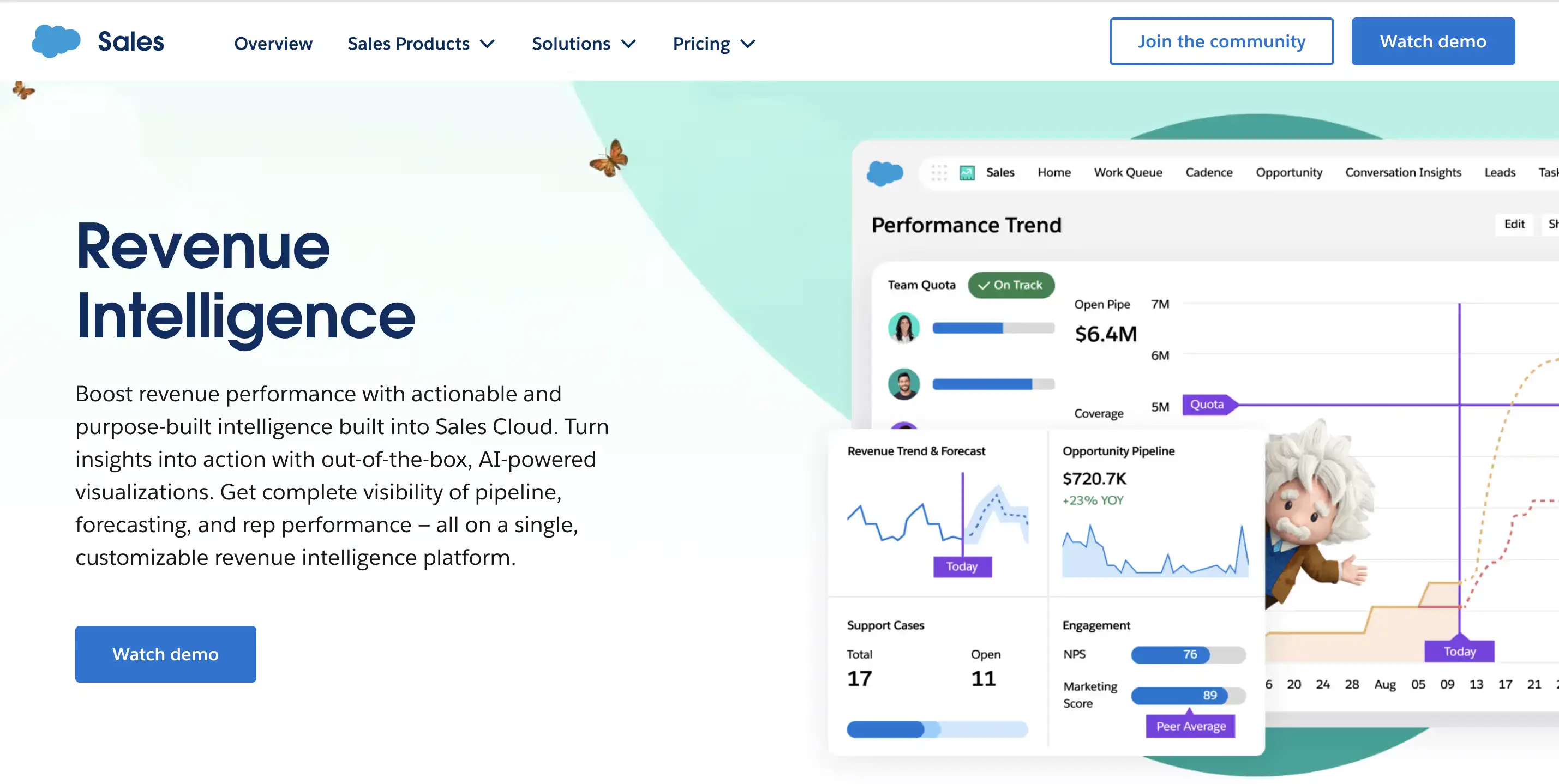
Best for organisations committed to keeping intelligence inside Salesforce.
Where it wins
Native visibility and governance within the Salesforce data model.
Where it is weaker
Outcomes depend heavily on implementation quality and ongoing admin support, a common buyer concern.
Choose it if you have strong ops resources and want intelligence to live entirely inside Salesforce.
What makes the Best Revenue Intelligence platform in 2026?
The best platforms do not just give teams more visibility. They help teams make better decisions faster.
Here’s what separates a strong revenue intelligence platform from a weak one:
- It improves deal judgment, not just reporting.
The platform should help managers understand which deals are real, which ones are soft, and where risk is building. - It connects more than one signal.
CRM data alone is not enough. The strongest platforms combine deal activity, conversations, pipeline movement, and seller behavior. - It helps with forecasting, not just call review.
A good platform should make forecast reviews clearer, faster, and less dependent on rep optimism. - It fits the way managers actually work.
If managers cannot use it in weekly deal reviews, it will become another system the team ignores. - It makes the CRM more trustworthy.
The platform should reduce the gap between what happened in the deal and what got logged in the system. - It gives teams a clear next step.
Insight alone is not enough. The platform should make it easier to inspect, coach, follow up, or adjust forecast confidence.
The best choice usually comes down to this: does the platform help your team run pipeline, forecasting, and deal execution better every week, or does it just give you another layer of information to manage?
Which revenue intelligence platform is right for your team?
Start with the problem you need to solve.
- Choose Clari if your main issue is forecast accuracy, pipeline inspection, and forecast discipline.
- Choose Gong if your biggest blind spot is what is happening inside customer conversations and deal reviews.
- Choose People.ai if weak CRM hygiene, missing activity data, and incomplete rep logging are hurting reporting and forecast trust.
- Choose Outreach if your team needs stronger rep execution, follow-up consistency, and better pipeline motion.
- Choose Salesloft if coaching, seller workflow, and rep productivity are bigger priorities than forecast governance.
- Choose Salesforce native tools if your team is heavily invested in Salesforce and wants reporting and governance to stay close to the CRM.
- Choose MaxIQ if you want a full revenue intelligence platform that connects deal inspection, forecast confidence, conversation signals, and post-sales context in one system.
A quicker way to think about it:
- Conversation intelligence first → MaxIQ or Gong
- Forecast governance first → MaxIQ or Clari
- CRM activity truth first → MaxIQ or People.ai
- Execution and seller workflow first → MaxIQ or Outreach or Salesloft
- Full revenue intelligence platform → MaxIQ
The best choice is usually not the platform with the most features. It is the one that matches the way your team actually runs pipeline, forecasting, and deal execution.
What to validate in every demo?
Do not ask for a feature tour. Ask the vendor to show how the platform works on a real deal.
Validate these five things:
- Can it explain a live deal clearly?
Pick one late-stage opportunity and ask the vendor to show why it looks healthy or risky. - Can it show what changed since last week?
A useful platform should make pipeline movement easy to understand, not force your team to piece it together manually. - Can managers actually use it in forecast reviews?
If the workflow feels too slow, too noisy, or too dependent on admin support, adoption will drop. - Can it work with your CRM the way your team already runs it?
Check custom fields, objects, writeback rules, approvals, and any sales workflow you already depend on. - Can it handle messy data?
A clean demo is not enough. The real test is whether it still helps when your pipeline, call data, and CRM records are imperfect.
One simple rule: if the demo looks good only because the data is clean and the workflow is staged, keep pushing. The platform has to work in the version of your sales process you actually live with.
Why MaxIQ is built as a full revenue intelligence platform?
Most revenue tools solve one part of the problem. Those tools can all be useful, but they still leave revenue teams stitching together different systems to understand one pipeline.
MaxIQ is built differently.
It is a full revenue intelligence platform that connects:
- Deal inspection (InspectIQ)
- Forecast confidence (ForecastIQ)
- Conversation signals (EchoIQ)
- Post-sales context (SuccessIQ)
in one system.
That matters because revenue problems rarely stay in one lane. A weak deal does not just affect a call review. It affects forecast confidence, manager inspection, handoff quality, and what happens after the deal closes.
This is where point tools start to break down. They can show one slice of the picture well, but they still force teams to connect the rest manually.
MaxIQ is the stronger fit when the goal is not just better call insight or tighter forecast rollups, but a clearer view of the full revenue motion from active pipeline through customer handoff and expansion.
See what a full revenue intelligence platform looks like in practice: See MaxIQ in action
Every capability walked through one by one, with screenshots from real calls.
.avif)