.webp)




.svg)

Most enterprise SaaS companies discover churn at the worst possible moment.
The renewal date is 30 days away. The CSM calls to check in. The customer takes two days to respond. When they do, the message is that the contract review is already underway and they are evaluating alternatives.
The churn was not a surprise to the customer. It has been building for months: in usage data that went unread, in support tickets that went unresolved, in a champion who changed jobs six weeks ago. The surprise is yours, because you were not watching.
Churn prediction is the discipline of changing that dynamic: surfacing risk 60, 90, even 120 days before a renewal decision, when intervention is still possible and the relationship can still be saved.
This guide covers the full picture: what churn prediction is, which signals matter most, how the models work, and how to connect churn intelligence to the revenue forecast where it can actually move the number.
Why churn prediction has become the CRO's problem, not just CS's

Data by lightercapital.com
For most of SaaS history, churn prediction lived inside the customer success team. Health scores were CS metrics. Renewal risk was a CS dashboard. The CRO saw renewal ARR as a line item on the forecast, not as a dynamic number that required the same scrutiny as new pipeline.
That divide made sense when new business dominated revenue. It no longer does.
B2B SaaS averaged around 12.5 percent annual churn in 2025. At that rate, a $30M ARR business loses $3.75M per year from its existing base, before accounting for contraction and downgrades. Every 1 percentage point reduction in churn is $300K in retained ARR that does not need to be replaced with new deals.
For companies above $50M ARR, existing customers now generate more than 50 percent of new ARR through expansions and renewals. The CRO who does not own churn prediction is managing half the revenue motion without data.
53 percent of churn in enterprise SaaS traces back to three root causes: inadequate onboarding, poor relationship management, and reactive customer service. All three are predictable with the right signals. None of them require waiting until the renewal conversation to discover.
MaxIQ's SuccessIQ connects customer health signals (health scores, renewal risk, expansion signals) to the same revenue forecasting model as new pipeline. CROs manage the full ARR number from one platform, not three.
The eight signals that predict churn most reliably
Not all signals are created equal. Usage data is the most commonly tracked but not always the earliest indicator. The table below maps the eight most reliable churn signals in enterprise B2B SaaS, their typical lead time before a churned renewal, and the recommended response.
Three signals deserve additional emphasis:
Stakeholder change is the most underrated early warning indicator in enterprise SaaS. When the primary champion changes roles or leaves, the new decision maker has no emotional investment in the product and often inherits a contract rather than choosing it. Research shows that champion departure typically precedes churn by 30 to 60 days, but most teams discover it at the renewal call, not when it happens.
Communication sentiment, detected through AI analysis of emails, calls, and support tickets, can surface relationship deterioration six weeks earlier than product usage data alone. Gainsight's Staircase AI integration, for example, scans all customer communications to detect sentiment shifts and competitive mentions before they appear in health score changes.
Renewal timeline behavior is the most obvious signal that teams still miss. When a customer delays a renewal discussion, asks legal to review the contract unusually early, or declines a QBR two quarters in a row, these are operational signals of disengagement, not just calendar conflicts.
Churn prediction models: how they work and which one to use
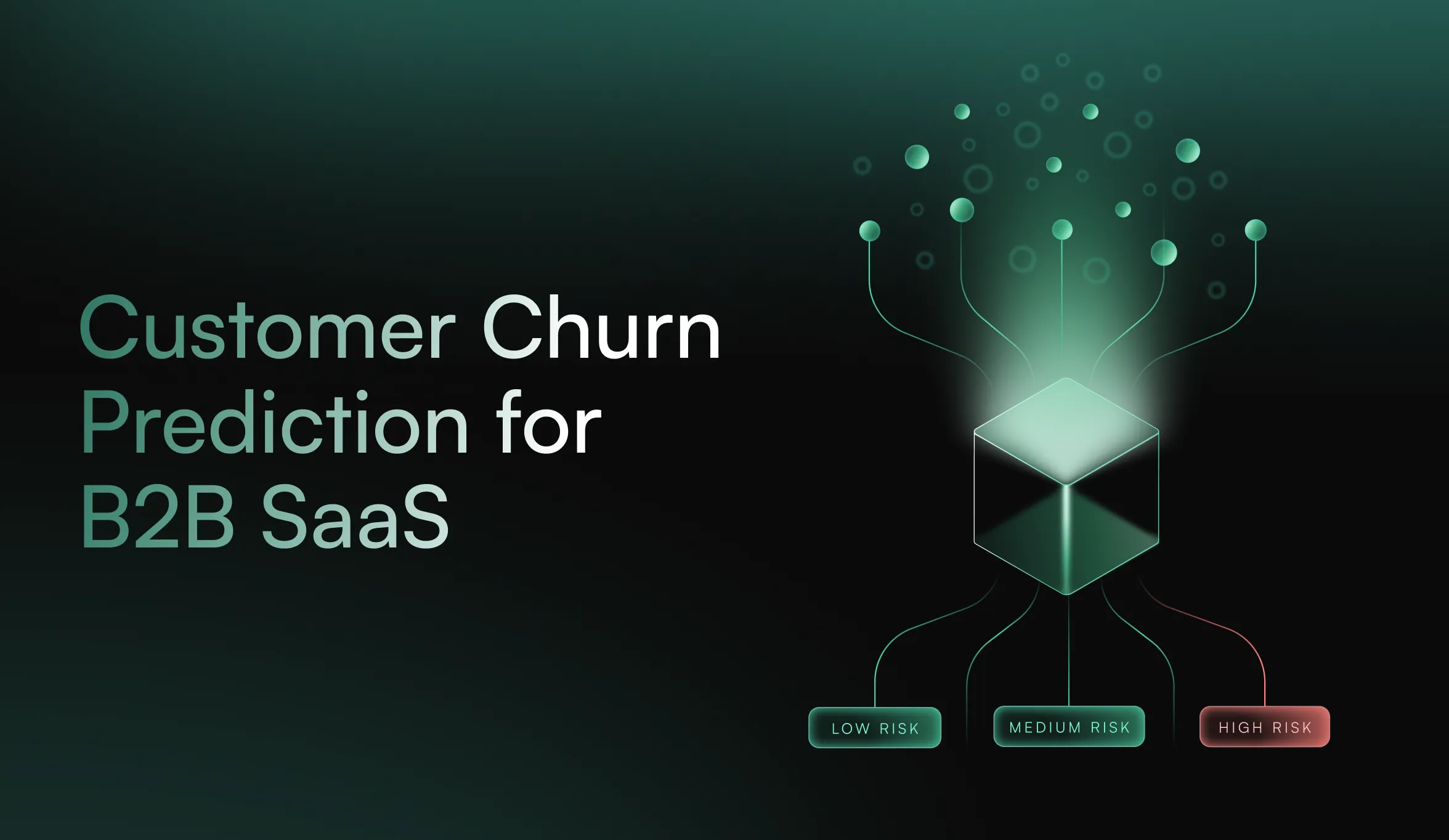
Churn prediction is a machine learning problem given what we know about a customer's behavior and history, what is the probability they will not renew? The models range from simple to sophisticated, and the right choice depends on your data maturity, team capacity, and account volume.
For most B2B SaaS teams, gradient boosting models like XGBoost offer the best starting point: strong accuracy, manageable data requirements, and interpretable enough to explain to leadership. Teams with annual contracts should layer survival analysis on top; it predicts not just whether a customer will churn but when, which is essential for resource planning.
Churn prediction is genuinely important. It lets you see what's coming and address issues before customers walk out the door. In a world where the average annual churn rate in SaaS companies hovers around the low-to-mid teens, being proactive isn't optional anymore.
How to implement churn prediction: a practical sequence
Most churn prediction implementations fail not because of the model but because of the workflow. A risk score in a CS dashboard that nobody acts on is not a churn prediction program. It is a reporting exercise.
The sequence that works:
1) Instrument the signals first: Before building any model, confirm you are capturing the eight signal categories reliably: login frequency, feature adoption, stakeholder mapping, support sentiment, engagement cadence, competitive signals, contract behavior, and expansion reversal. If you cannot capture these reliably from your CRM, product analytics, and CS platform, your model will reflect the data gaps, not the reality.
2) Start with a rule-based health score: Before machine learning, build a weighted composite health score from the signals you have. This gives you immediate visibility into risk, trains the CS team on the workflow, and generates the labeled outcome data that machine learning models need to train.
3) Define and automate the intervention playbooks: For each risk tier (green, yellow, red), define the action: who owns it, what the outreach looks like, what escalation path exists, and what the SLA is. Risk scores without playbooks do not prevent churn. They just surface it faster.
4) Connect risk scores to the revenue forecast: Map health score thresholds to ARR-weighted forecast adjustments. A $500K renewal account at red health score should not appear as $500K in the committed forecast. It should appear as $150–$250K, weighted by churn probability. This is what makes churn prediction a CRO tool, not just a CS tool.
05) Upgrade to machine learning when you have the data: Once you have 12 to 18 months of labeled outcomes (accounts that churned or renewed, with their signal histories), train a gradient boosting model or engage a purpose-built churn prediction platform. The model will identify signal combinations that your rule-based score misses.
6) Add communication sentiment last: AI analysis of emails and calls is the highest-value addition but requires the most data infrastructure. Implement it after the foundation is solid, not as a first step.
The teams that execute this sequence fastest share one characteristic: they connect churn intelligence to the revenue forecast from the beginning, not as an afterthought. When the CRO sees at-risk renewal ARR in the same view as new pipeline, the urgency and resource allocation that churn prevention deserves follows naturally.
The metrics that tell you if your churn prediction program is working
Three metrics that matter:
1) Churn prediction accuracy.
What percentage of churned accounts were in the red tier 60 days before renewal? If your red accounts are renewing and your green accounts are churning, your model needs recalibration. Best-in-class programs flag 80 percent or more of eventual churn 60 days in advance.
2) Intervention success rate.
Of at-risk accounts that receive proactive outreach, what percentage renew? This measures whether your playbooks are actually working, not just whether your model is identifying risk correctly. Track this by risk tier, ARR band, and segment.
3) Forecast accuracy on renewal ARR.
What is the variance between your risk-weighted renewal forecast and actual renewal ARR at quarter close? This is the ultimate test: churn prediction that does not improve forecast accuracy is a CS exercise, not a revenue initiative.
How MaxIQ Makes Churn Prediction a Revenue Motion
Most churn prediction tools stop at the health score. They surface risk inside the CS platform, trigger an outreach sequence, and call it done. The CRO never sees it. The forecast never reflects it. And when a $500K renewal slips, it lands as a surprise on the last day of the quarter.
MaxIQ SuccessIQ is built for a different workflow.
SuccessIQ monitors the eight churn signal categories continuously: product usage, feature adoption, stakeholder changes, support sentiment, engagement cadence, competitive signals, contract behavior, and expansion reversal. It weights each signal by ARR value and produces a live health score per account, updated in real time, not at the end of a weekly batch.
What makes it different is where that score goes next.
Instead of staying in a CS dashboard, SuccessIQ feeds renewal risk directly into the same revenue forecasting model as new pipeline. A red-tier account does not appear as full ARR in the committed forecast. It appears as risk-weighted ARR, flagged alongside your open deals, visible to the CRO in the same view they use to call the quarter.
The result is a revenue motion that covers the full ARR picture: new pipeline, expansion signals, and renewal risk, in one place, with one number.
No separate data science project. No manual health score updates. No end-of-quarter surprises.
See how SuccessIQ connects churn intelligence to your revenue forecast. Book a 20-minute walkthrough.
Every capability walked through one by one, with screenshots from real calls.
.avif)


.webp)