.webp)




.svg)

Why renewal risk is harder to spot than it used to be
Renewal risk used to be loud. A customer would complain, stop showing up, and then you would see the cancellation coming from a mile away.
But in 2026, it’s more slippery.
Budgets are tighter. Every renewal gets a little CFO side eye. Customers want proof, not promises, and they want it in their language. ROI, utilization, outcomes. Not “we love the partnership” type stuff.
When I say “renewal risk indicators,” I’m not talking about the last 30 days before the renewal. That’s basically triage.
What I really mean is all the early warning signs across product usage, sentiment, support, contract behavior, and billing. You know, the stuff that starts popping up months before anyone officially puts “renewal” on the agenda.
This is why RevOps ends up right in the middle of it.
They actually connect the dots across systems. CRM activity and renewal opportunities. Product analytics. Support logs. Billing and invoices. Contract lifecycle management data. Even document activity if you have it. When those signals live in separate tools, renewals feel unpredictable even if the patterns are obvious in hindsight.
In this article, we’re going to look at what these early renewal signals actually are, and how RevOps can use them to spot renewal risks before they turn into real problems.
By understanding these early warning signs, RevOps teams can get way better at predicting and dealing with renewal challenges.
What RevOps should be watching long before the renewal call
To spot churn risk early, RevOps needs a unified customer view. Not a “we think the customer is fine” view. A measurable one.
Here are the core data sources most teams need to pull together:
- CRM: Tracks who owns the account, renewal plans, actions taken, and key contacts.
- Product engagement: Measures how often and how well customers use the product features.
- Support: Monitors support requests, their urgency, and how quickly they are resolved.
- Customer feedback: Collects satisfaction scores and direct customer comments.
- Billing systems: Checks payment issues, overdue bills, and changes in billing contacts.
- Contracts: Keeps track of renewal dates, changes, pricing, and contract progress
When you start connecting all these dots, RevOps can spot potential risks way ahead of time and actually do something about them before they turn into real issues.
10 signs an account is moving in the wrong direction
This is a practical list of the signals that usually show up before an account turns into a real renewal risk.. It’s not theoretical. It’s the stuff that shows up quietly, then becomes obvious later when you do a churn postmortem and feel annoyed.
Two notes before the list.
First, monitor trends, not snapshots.
Second, segment your monitoring. A usage drop means something different for SMB than for enterprise. Same for billing friction, support volume, contract complexity.
For each indicator below, I’ll cover what it is, why it matters, how to detect it, and what action it should trigger.
1) Product usage starts to slip
What it is: Fewer people using the product regularly, using fewer features, missing key tasks, or going inactive for longer periods.
Why it matters: When customers use the product less, it usually means they’re finding less value in it. If they get used to not using it, getting them back can be tough.
How to detect it: Look at product usage data like daily or monthly active users and feature use. Compare this data to similar customers to spot unusual drops.
Action to trigger: Have the Customer Success Manager reach out with a plan to re-engage the customer. Use training and support resources to help them see value again. For big accounts, schedule a detailed call focused on showing product value.
Visualization: Use charts showing usage trends, heat maps of feature use, or compare active users versus seats purchased to easily spot changes.
2) Expansion goes quiet
What it is: Customers reducing their service by cutting down seats, removing add-ons, lowering monthly revenue, or stopping talks about expanding their usage.
Why it matters: This shows the customer might be facing budget issues or doubts internally. They may still like the product but can't spend as much right now. Financial operations signals help spot this because less spending means closer watching of how the product is used.
How to detect it: Look at billing and subscription records, plus sales history in your CRM. Watch for changes in plans, fewer seats, or lost add-ons as important signs.
Action to trigger: Update your forecast for renewal chances right away. Review how the customer is getting value from the product. Think about adjusting their plan size and offering ways to grow again later, like a multi-year deal but only if you can prove strong value first.
3) Support issues start changing the tone
What it is: When customers have lots of support issues, repeated problems, slow fixes, or tickets that keep reopening.
Why it matters: These issues make customers frustrated and tired, which can lead them to leave, even if they still use the product. Support problems often show real frustration better than surveys.
How to detect it: Look at support tickets for repeated problems, how often tickets get escalated or reopened, and how long it takes to fix issues. Also watch if product use drops along with more support requests.
Action to trigger: Set up alerts for these risks and assign both Customer Success Managers and Support leads to handle them. Measure how quickly issues get resolved and always follow up with the customer to explain the fix and prevent future problems.
4) Negative sentiment and feedback trend
What it is: Customers show signs of dissatisfaction, like lower satisfaction scores, negative comments in surveys, blunt feedback during reviews, and a more critical tone in conversations.
Why it matters: People often feel unhappy before they act on it. Noticing these changes early helps you address issues before the customer decides to leave.
How to detect it: Use customer satisfaction scores (NPS) and surveys along with notes from meetings and calls. Quick check-ins or simple sentiment analysis can also reveal how customers really feel.
Action to trigger: Get your executive sponsor involved. Talk about aligning the product roadmap with customer needs. Prepare a summary showing how the product adds value and what’s planned next to keep improving before renewal time.
5) The champion is no longer driving the account
What it is: The main supporter (champion) in the customer’s company changes or disappears, fewer people join meetings, there’s no active executive sponsor, and communication relies on just one person.
Why it matters: Champions help push things forward. Without them, even satisfied customers might leave because no one is fighting to keep the budget.
How to detect it: Look at CRM activity, who attends meetings, email responses, and stakeholder info. Watch for accounts where only one person stays involved for too long.
Action to trigger: Create a plan to connect with more people in the account. Introduce your executive sponsor. Update the success plan to focus on business results, not just product features. Also, identify procurement and finance contacts earlier than usual.
6) The renewal timeline starts to move
What it means: The renewal date becomes unclear, important follow-up dates are missed, regular check-in meetings don’t happen, and there is no clear plan for renewal as the deadline approaches.
Why this matters: When the renewal timeline slips, it often shows the customer isn’t focused on renewing. If they wanted to renew, meetings would be scheduled and decisions made on time.
How to spot it: Use CRM tools to track renewal dates and set up alerts for missing steps. You can score accounts based on how well renewal tasks are being followed.
What to do: Start a plan to speed up the renewal process early. Automatically create tasks and raise alerts for big accounts. The goal is to have a clear, agreed-upon plan well before the renewal date instead of scrambling last minute.
7) Contract issues start showing up early
What it is: Changes or delays in the contract process, such as many amendments, longer legal reviews, price disagreements, or disputes over terms.
Why it matters: Legal involvement usually means the renewal will take longer. Early contract issues often show the customer is reconsidering the deal.
How to detect it: Track contract documents and review timelines. Look for slow responses, stalled edits, or repeated objections.
Action to trigger: Prepare clear renewal offers and standard terms ahead of time. Get Sales, Legal, and Finance teams working together early to avoid last-minute problems.
8) Billing friction
What it is: Problems with paying bills on time, such as missed payments, late invoices, unresponsive billing contacts, delays in purchase orders, or payment times that suddenly take longer than usual.
Why it matters: billing friction can cause involuntary churn, and it can also be a symptom of voluntary churn. Sometimes the customer is avoiding payment because they are debating renewal.
How to detect it: Watch for billing problems like overdue invoices, payment reminders (dunning), and changes in who handles billing or how quickly they respond.
Action to trigger: Work closely with Finance early on. Change payment terms if necessary. Set up reminders and follow-up processes. For big accounts, make sure billing issues don’t get ignored without understanding the situation.
9) Competitive pull becomes easier to spot
What it is: Competitor mentions, security reviews for alternatives, pricing benchmark requests, RFP language, “we are evaluating options.”
Why it matters: Competitive pressure is not always bad, but it changes the renewal motion. The customer needs a reason to stay, not just a reason to not leave.
How to detect it: Look for clues in your customer records, notes, and call transcripts. Even a simple checkbox for "competitive pressure present" can help if your team uses it.
Action to trigger: Show clear reasons why your product is valuable with success stories, usage data, and flexible plans. Make sure the customer sees the benefits clearly and understands that switching would be a logical decision, not just an emotional one.
10) The account gets too quiet
What it is: Fewer emails and meetings, no QBR attendance, low response rates, no recent stakeholder engagement.
Why it matters: Silence is often the last stage before churn, and it’s also the easiest to ignore internally because nobody is complaining.
How to detect it: Check your CRM for activity, review meeting notes, and monitor email responses. Also, track if customers open or review renewal documents—if they don’t, it’s a warning sign that the risk of losing them is increasing.
Action to trigger: Reach out personally, run campaigns to re-engage the customer, and remind them of the value they’ve received using clear data. Make it simple for them to respond by giving a specific next step instead of asking vague questions like “thoughts?”
How to make these signals operational
Start with a retention dashboard that teams actually use. Not a monster dashboard with 47 charts.
Add these core panels to it:
- usage trends by account and segment
- support volume and escalation trends
- NPS and sentiment trend
- billing risk, invoice aging, failed payment events
- contract status, amendment activity, document stage
- renewal timeline milestones and next steps hygiene
Then prioritize churn KPIs. Keep a small must watch set, and define thresholds by segment. SMB vs mid market vs enterprise will have different normal.
Once data quality is stable, then evolve toward predictive analytics or ML. But if your identifiers are messy and your timestamps are unreliable, ML just gives you confident looking noise. Alerting best practices matter more than the scoring math, honestly.
Automate alerts for high risk customers and route them to owners with next steps. Slack notification plus email workflow plus CRM task. And tier alerts by severity so the team doesn’t learn to ignore them.
Finally, close the loop.
A better way to move from signal to owner to next step
A signal without an owner is just trivia. So define ownership clearly:
- Product usage risk usually goes to CSM, sometimes with Product or Enablement support.
- Competitive pressure and pricing packaging usually goes to Sales plus CS leadership.
- Support escalations go to Support lead plus CSM with a joint SLA.
- Billing friction goes to Finance or FinOps with visibility to the account team.
- Contract redlines go to Sales Ops or Deal Desk plus Legal, with RevOps tracking.
Let your customers know you’re watching.
Churn is inevitable, but with the right strategies in place, you can minimize its impact and drive long-term customer success.
How MaxIQ helps teams catch these risk earlier
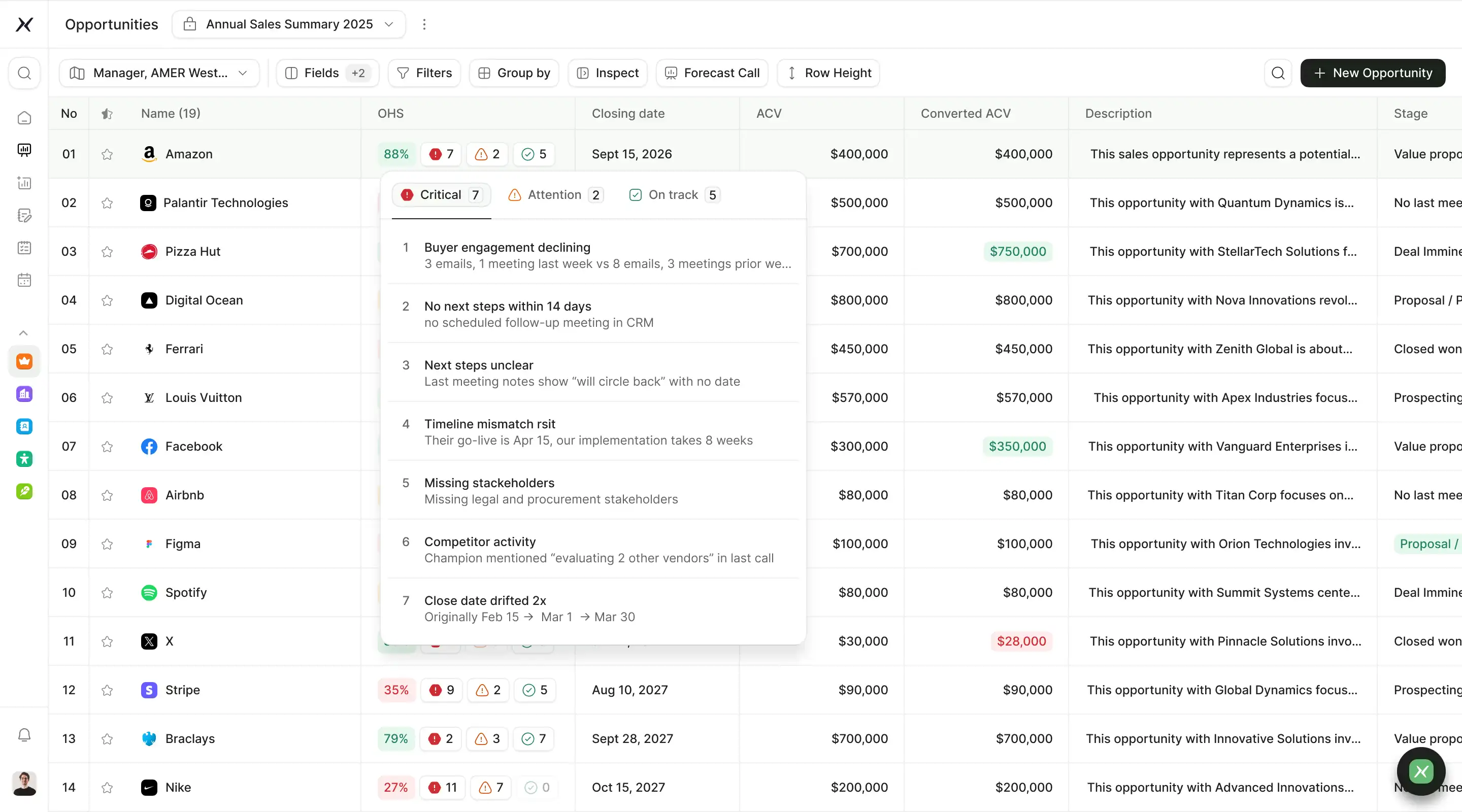
This is the part where a lot of teams realize they don’t actually need more dashboards. They need a layer that turns renewal risk indicators into an actionable customer health system.
MaxIQ is built for that RevOps reality.
MaxIQ Opportunity Health Score (OHS) pulls together the signals that usually sit in different tools: usage data, engagement metrics, support tickets, sentiment, contract status, and billing signals. Instead of forcing RevOps to stitch everything together manually, CHS gives you a unified risk score that is actually usable for churn risk monitoring.
Then SuccessIQ is where the system becomes practical day to day. It highlights accounts drifting off track and helps teams catch at risk accounts before the renewal call. Not after the customer has already decided. You get guided plays, stakeholder visibility, and a cleaner path from signal to owner to next step.
The outcome is what RevOps cares about:
- faster risk identification
- better renewal forecasting
- clearer ownership across CS, Sales, Support, and Finance
- more consistent retention interventions, without relying on heroics
In 2026, renewal risk is less about one big red flag and more about a pattern of small signals.
If RevOps can see the pattern early, route it cleanly, and make it actionable, renewals stop feeling like surprises. They start feeling like a system.
Every capability walked through one by one, with screenshots from real calls.
.avif)