.webp)




.svg)

Most sales teams are making pipeline decisions based on a label someone typed into a CRM field.
Stage 4. Commit. Close date: end of quarter. None of that tells you whether the buyer responded to the last email. None of it tells you the close date moved twice already, or that no one has scheduled a follow-up meeting. The stage is a rep's best guess, logged at the last pipeline call. It is not a signal.
This is the core problem opportunity health scoring solves. It replaces gut feel and stage labels with a calculated score that reflects what is actually happening inside each deal, across buyer engagement, CRM completeness, sales activity, and deal risk indicators, right now.
What is Opportunity Health Scoring (OHS)?
Opportunity health scoring is a method of assigning a numerical score to each deal in your pipeline based on signals that predict whether it will close. Unlike win probability, which estimates outcome, a health score measures the current state of a deal: how engaged the buyer is, how complete the deal data is, how active your team is, and whether risk indicators are accumulating.
A deal with a high health score has an engaged buyer, clean data, recent activity, and no red flags. A deal with a low score has gaps, and the score tells you exactly where they are.
Why CRM stage is not enough
The CRM stage was built for one job: to help teams track where a deal is in the process. It was never designed to tell you whether a deal is actually moving. The problem is that most teams treat it as both.
Stage is a field a rep updates manually, usually after the fact. It reflects the last conversation someone logged, not the current state of the relationship. And it captures almost none of the signals that actually matter: whether the buyer is engaging, whether the right people are involved, whether momentum is building or quietly fading.
This is why relying on stage alone creates a specific kind of blindspot. Everything looks fine on the pipeline report until it doesn't.
What actually predicts deal health?
The signals that matter are already sitting inside your CRM and engagement tools. They just are not connected.
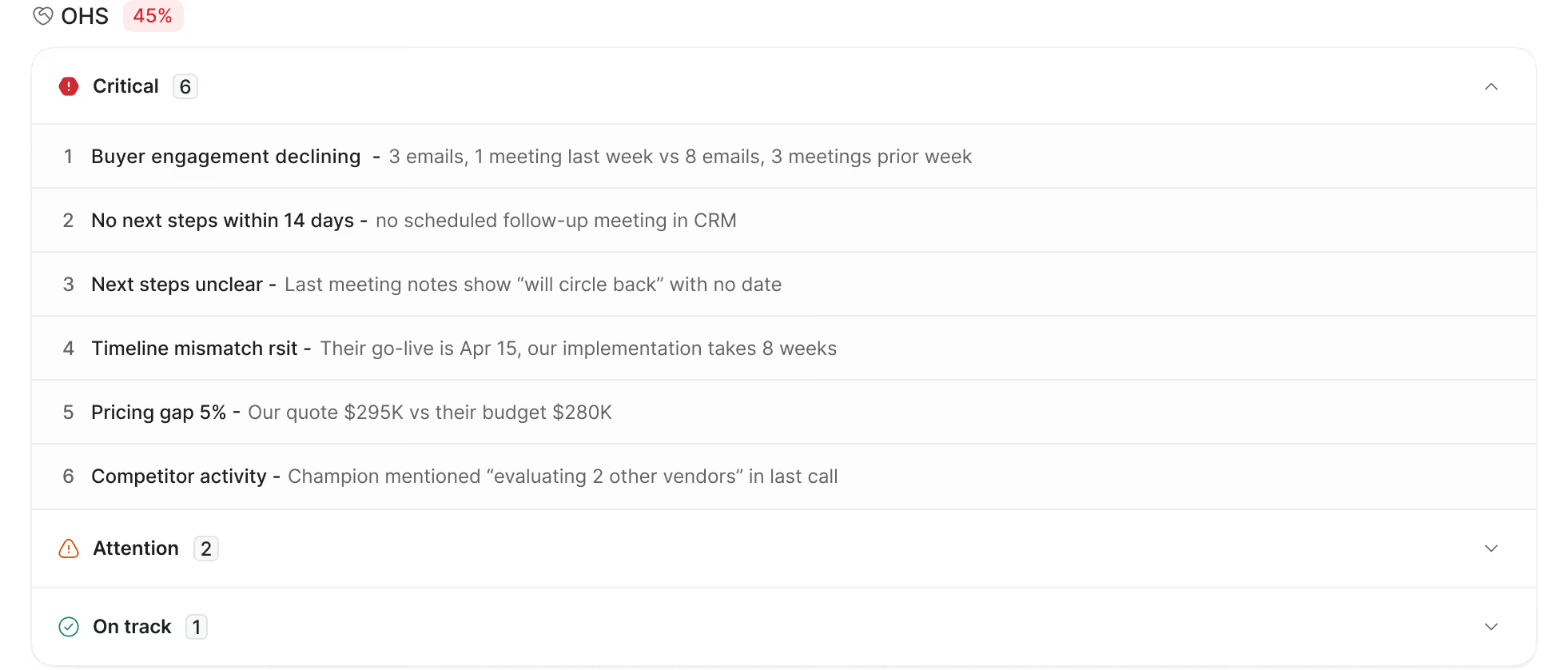
When did the buyer last reply to an email? Is a next meeting on the calendar? How many times has the close date moved? Are decision-makers attached to this stage? When did the rep last add a note? Are there overdue tasks sitting untouched?
None of these live in the stage field. All of them tell you more about where a deal is heading than the stage does.
Opportunity health scoring connects these signals into a single score. It does not replace your sales process or your CRM. It sits on top of them and makes visible what was always there but never organized.
Avoid this mistake: Treating stage movement as deal progress. A deal moving from Stage 3 to Stage 4 means a rep updated a field. It does not mean the buyer moved closer to a decision. These are very different things.
The signals that actually predict deal health
Most of the data you need to assess a deal already exists. It is just scattered across your CRM, your email tool, your calendar, and your activity logs. Health scoring organizes it into four categories, each measuring a different dimension of deal quality.
1. Buyer engagement
This is the highest-weighted category for a reason. Everything else in your CRM can be manually entered. Buyer behavior cannot be faked.
The signals here are straightforward: when did the buyer last send an email, is there a next meeting on the calendar, when was the last meeting held, and has the buyer engaged with any shared collateral. A buyer who has not replied in three weeks and has no meeting scheduled is telling you something. The score reflects that.
2. CRM completeness
Clean data is not just an admin preference. It is a signal that the deal is being actively managed.
This category looks at whether a next step is logged and was updated within the last three weeks, whether a deal amount is recorded, whether decision-makers are attached to the current stage, whether contact roles are defined, and whether required contact fields like name and email are complete. Gaps here do not always mean a deal is at risk, but they do mean someone is not paying close enough attention.
Side note: The next step field is one of the most telling signals in the entire model. A next step that has not been updated in four weeks is not really a next step. It is a placeholder.
3. Sales activity
This category captures what is happening on your side of the deal. Are notes being added regularly, ideally within the last one to two weeks? Are collaborators involved? Are tasks being completed or sitting overdue? Have gaps in the deal been identified and logged?
These signals matter because they reflect how much active thinking is happening on the opportunity. A deal with fresh notes, a full team, and completed action items is one people are genuinely working. The score rewards that.
4. Deal risk indicators
This is where forward-looking signals come in. Two things matter here: whether a close date exists at all, and whether it has been moved three or more times.
A missing close date means no one has committed to a timeline. A close date that keeps moving is one of the most reliable early warning signs in enterprise sales. It usually means one of three things: the buying committee has not aligned, the budget is not confirmed, or the champion does not have the internal pull they suggested they did.
None of these are reasons to abandon a deal. All of them are reasons to change your approach before the quarter ends.
How the OHS score is calculated?
The health score is a weighted average across four categories. Each category gets a percentage score based on how many of its signals are present and current. Those category scores are then combined using this formula:
OHS = ((p1 x w1) + (p2 x w2) + (p3 x w3) + (p4 x w4)) / (w1 + w2 + w3 + w4)
Where p is the percentage score for each category and w is that category's weight.
The result is a single number between 0 and 100 that reflects the overall health of a deal at that moment.
Why engagement carries the most weight
The default weights are not arbitrary. They reflect what actually drives deals forward.
Engagement carries 45 percent of the total score. Sales activity carries 30 percent. CRM completeness carries 15 percent. Deal risk indicators carry 10 percent.
The reason engagement is weighted highest is simple: everything else in your CRM can be entered manually. A rep can log a note, define a contact role, or update a next step in two minutes. What they cannot do is manufacture a reply from a buyer who has gone quiet, or create a meeting that the buyer did not agree to attend.
Buyer behavior is the one variable in the model that reflects reality independent of what anyone typed into the system. That is why it carries the most weight.
Side note: The weightings are configurable. Different sales motions prioritize different signals. A team running a high-velocity inside sales model might weight CRM completeness more heavily. An enterprise team with long, complex cycles might weight stakeholder engagement higher. The formula stays the same. The weights shift to match how your business actually closes deals.
What the score tells you at a glance
A high score means the deal has an engaged buyer, complete data, active sales effort, and no risk flags accumulating. A low score means at least one of those is missing, and the breakdown by category tells you exactly which one.
That specificity is what makes the score actionable. It is not just a red flag. It is a diagnostic.
How to use the Opportunity Score: a playbook by role
A health score is only useful if it changes what someone does next. Here is how each role should be using it.
For sales reps: a daily priority list
Most reps start the day by opening their pipeline and deciding where to focus based on deal size or close date. Health score gives you a better filter.
Sort your pipeline by OHS at the start of each week. The lowest-scoring deals are not necessarily the ones you spend the most time on, but they are the ones you need to diagnose first. Look at which category is pulling the score down. If it is engagement, the action is clear: get a meeting on the calendar or find a new entry point into the account. If it is CRM completeness, spend fifteen minutes filling the gaps before your next call.
The score also works as a preparation checklist before any customer meeting. If you are walking into a call with an OHS of 38, you already know what is missing before the conversation starts.
For sales managers: a pipeline review that actually surfaces risk
The most common problem with pipeline reviews is that they rely on rep updates. A rep who is optimistic about a deal will give you an optimistic update. A rep who is not paying close attention will not know what they are missing.
Health scores change the dynamic. Instead of asking "how is this deal going," you can look at the score and ask specific questions. Why has the buyer not responded in three weeks? Why is the close date moving for the second time? Who are the decision-makers attached to this stage and when did we last speak to them?
This is not about catching reps out. It is about having better conversations with the data in front of both of you.
Pro tip: In pipeline reviews, filter to deals below a score threshold, say 50, that are closing within the next 45 days. Those are your highest-risk, highest-urgency opportunities. That is where the conversation should start, not with the biggest deal or the most confident rep.
For RevOps: a consistent benchmark across the pipeline
RevOps teams often struggle to compare deal quality across reps, regions, or segments because the underlying data quality varies so much. Health scoring creates a consistent baseline.
When every deal is scored on the same signals and the same formula, you can start asking questions you could not ask before. Which reps consistently have higher engagement scores? Which deal stages correlate with the sharpest score drops? Are deals with low CRM completeness scores more likely to slip?
These are not questions you can answer by looking at stage data. They are questions you can answer when every deal has a health score attached to it.
The score is also configurable. Different teams weight signals differently based on their sales motion, so the formula can be adjusted to reflect how your business actually closes deals rather than a generic default.
What can possibly go wrong?
Health scoring works when it is used as a diagnostic tool. It breaks down when teams start treating the score as the goal.
Reps gaming the score
This is the most common failure mode. Once reps understand what drives the score up, some will optimize for the score rather than the deal. They log a note not because there is anything meaningful to capture, but because the last note was twelve days old. They schedule a meeting they know will not happen just to get the next meeting field populated.
The score goes up. The deal does not move.
The fix is not to hide how the score is calculated. Transparency is important. The fix is to review the quality of activity, not just its presence. A note that says "left voicemail, will follow up" logged three times in a row is not engagement. A manager who looks at the score alongside the actual activity feed will spot the difference quickly.
Over-indexing on the number
A health score is a signal, not a verdict. A deal with an OHS of 72 can still fall apart. A deal with an OHS of 41 can still close, especially if the low score reflects a data completeness gap rather than a disengaged buyer.
The score tells you where to look. It does not tell you what you will find when you get there. Human judgment about the specific context of a deal, the relationship history, the internal politics at the account, the competitive situation, will always matter. The score surfaces deals that need attention. A person still has to decide what to do about them.
Treating it as a one-time setup
Some teams configure a health scoring model, launch it, and never revisit it. That is a mistake. The signals that predict deal health shift as your sales motion evolves. A weight that made sense when you were selling a single product may not reflect reality after you have expanded the portfolio. Scoring criteria should be reviewed at least quarterly against actual closed-won and closed-lost data.
If your highest-scoring deals are not closing at a meaningfully higher rate than your lowest-scoring ones, the model needs to be recalibrated, not abandoned.
Avoid this mistake: Using the score to rank deals by priority and stopping there. The score tells you which deals to look at. The category breakdown tells you what to actually do. Always look at both.
How MaxIQ approaches Opportunity Health Scoring
Most revenue intelligence platforms give you a deal score. What they do not give you is a breakdown of why that score is what it is, or a way to configure it to reflect how your business actually sells.
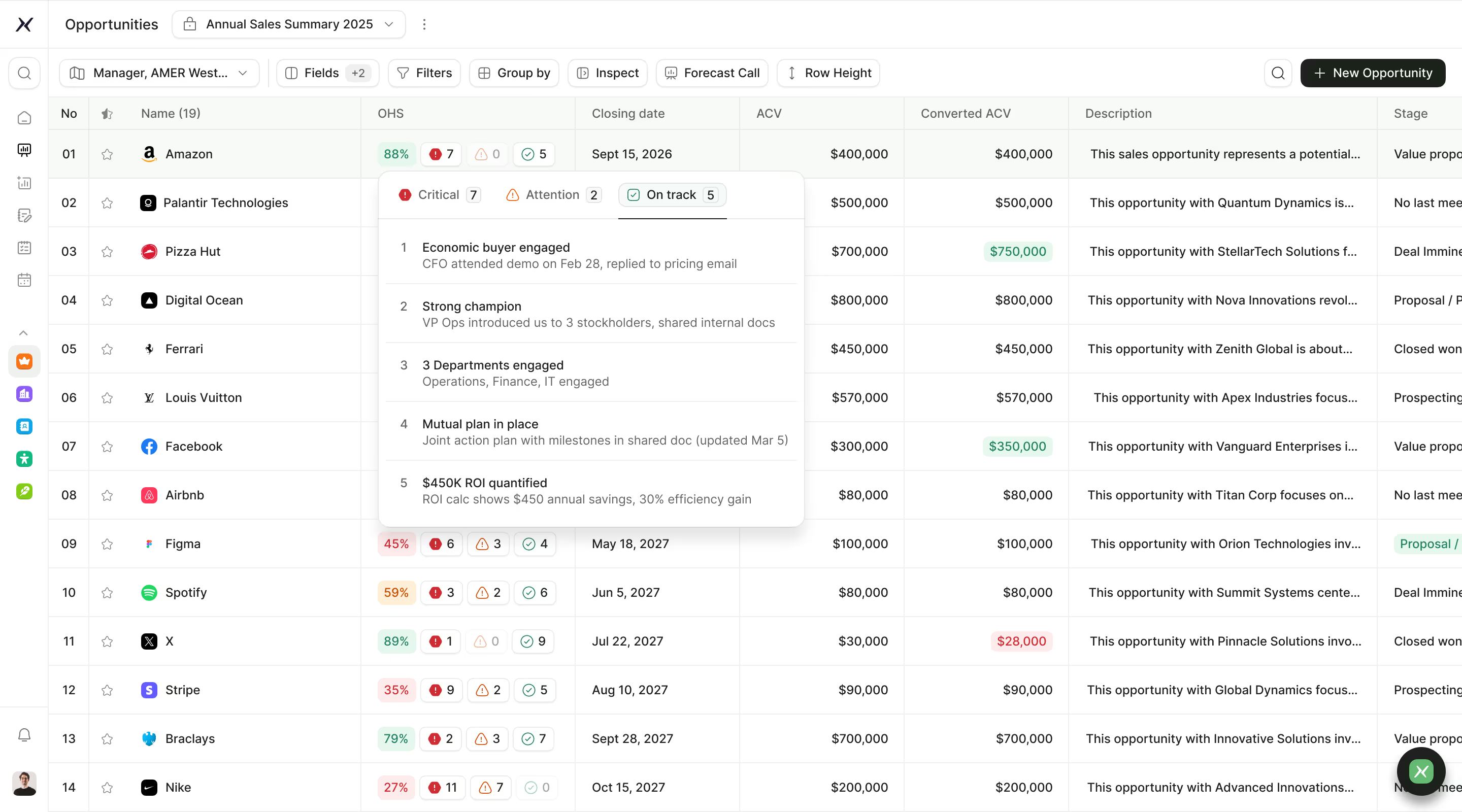
MaxIQ's Opportunity Health Score (OHS) was built differently. It tracks signals across all four categories described above, CRM completeness, buyer engagement, sales activity, and deal risk indicators, and combines them into a single weighted score that updates as the deal evolves. Not a static snapshot. A live read on every opportunity in your pipeline.
What makes it practical is the configurability. The default weightings reflect what predicts deal health across most B2B sales motions. But every team sells differently. A high-velocity inside sales team weights CRM completeness more heavily. An enterprise team running six-month cycles cares more about stakeholder engagement and methodology completion. MaxIQ lets you adjust the weights and the fields to match your actual sales motion, not a generic template.
The score surfaces in three places inside the platform: on the home page in the Key Opportunities view, in the opportunity workspace header so every team member sees it the moment they open a deal, and in the pipeline view as a sortable column. The point is that it is visible where decisions are actually being made, not buried in a report someone pulls at the end of the quarter.
Side note: MaxIQ also tracks sales methodology completion as part of the engagement score. This means the health score reflects not just whether your team is active on a deal, but whether they are working it the right way. A deal can have high activity and low methodology completion. That gap is worth knowing about.
What good looks like when Health Scoring is working
When Opportunity Health Scoring is embedded into how a team actually works, a few things change.
Pipeline reviews get more specific. Instead of relying on rep updates, managers come in with data. The conversation shifts from "how is this deal going" to "the engagement score dropped 15 points this week, what changed." That is a better conversation. It leads to better coaching and faster course correction.
Forecast accuracy improves. Not because the formula is magic, but because the team is making decisions based on current signals rather than last week's stage update. Deals that are deteriorating get flagged before they slip. Deals that are stronger than they look get the attention they deserve.
Reps get better at their own pipeline management. When a score is visible and the category breakdown explains it, reps stop guessing about what to do next. The score tells them. Update the next step. Get a meeting on the calendar. Pull in a collaborator. These are not abstract coaching points. They are specific actions tied to a specific number that the rep can see moving.
None of this happens because of a score. It happens because the score makes existing problems visible early enough to do something about them. That is the whole point.
Opportunity Health Scoring does not change how sales works. It changes how clearly you can see it.
Want to see how MaxIQ's Opportunity Health Score works inside your pipeline? Book a 20 min. demo.
Every capability walked through one by one, with screenshots from real calls.
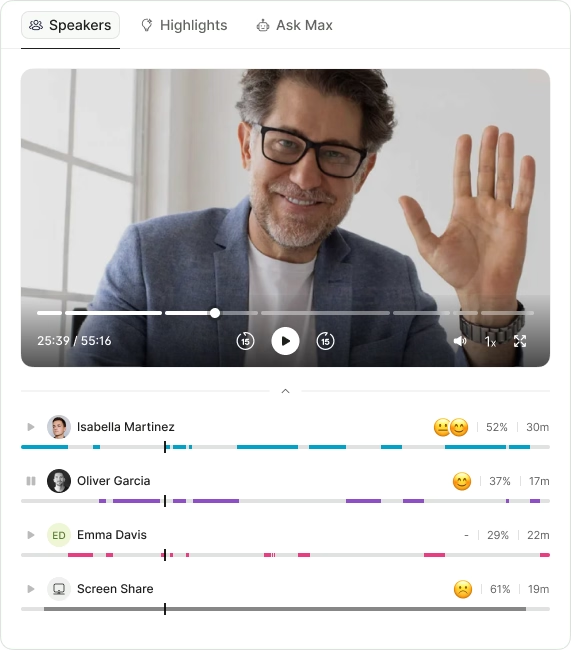
- Call summaries
- Sentiment analysis
- Next steps
- Search any call in seconds
.avif)