.webp)




.svg)

88% of reps with agents say the technology increases their odds of hitting sales targets. This is what it all comes down to: agents helping reps hit their aggressive quotas. When agents handle the friction, reps feel more confident in their ability to close. - Salesforce Sales statistics on AI and agents 2026.
Salesforce is still the system of record for revenue teams. It holds the accounts, opportunities, activities, and forecast fields leadership depends on. But the deal does not always change first in Salesforce.
Salesforce usually gets updated after the signal has already shown up somewhere else. A pricing concern comes up on a call. The buyer asks for security review. The next meeting gets pushed. CS notices low adoption on a new account. None of that is a Salesforce problem. It is a signal problem.
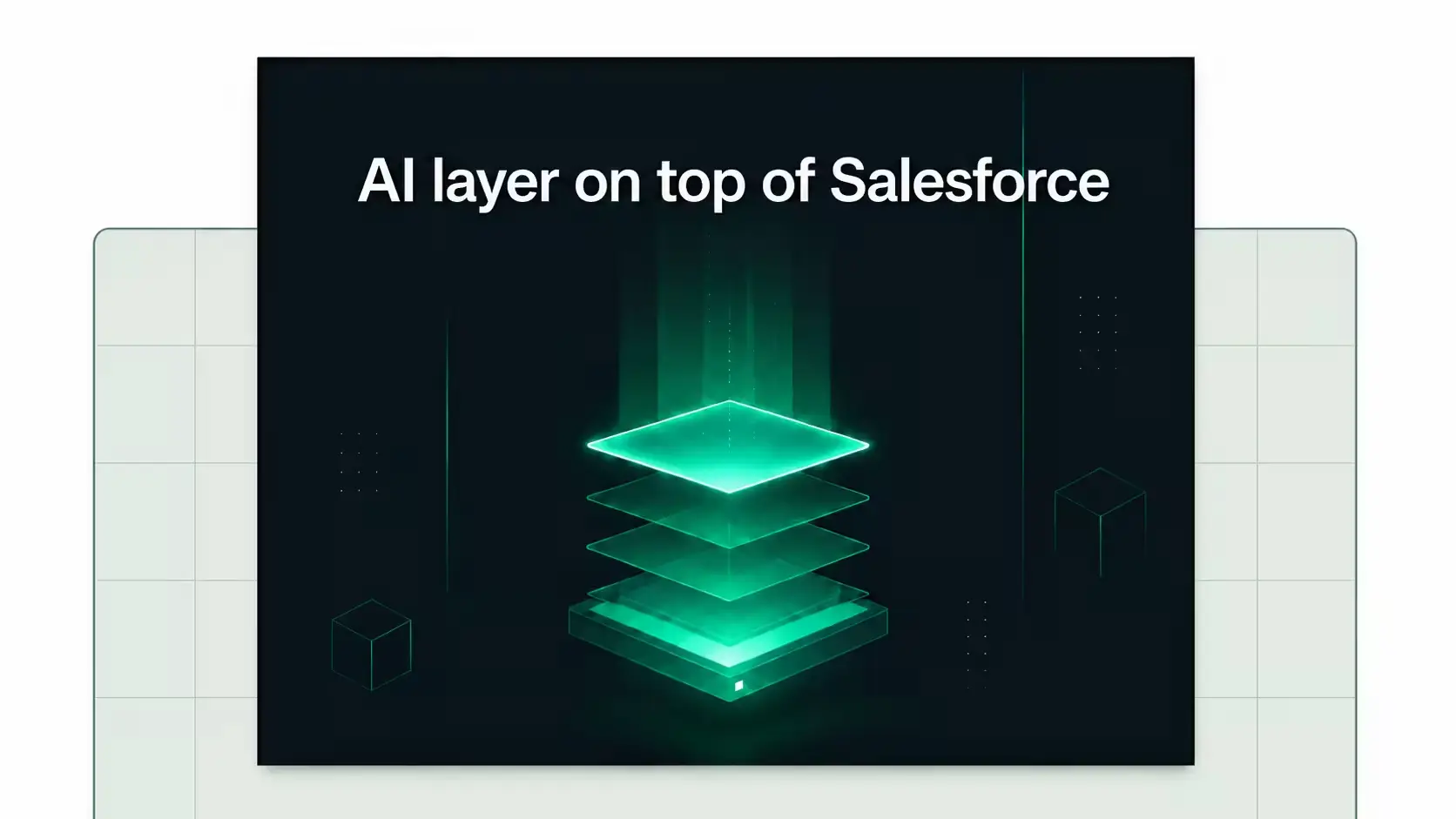
That is why modern sales teams are adding an AI layer on top of SF.
Salesforce says revenue intelligence uses data and AI to uncover risks and opportunities across the sales pipeline, while Salesforce’s own sales research shows reps spend 60% of their time on non-selling work, including manual CRM notes and internal admin. The goal is not to replace Salesforce. It is to help revenue teams inspect deals, understand risk, and act faster with the CRM they already use.
This guide explains what an AI revenue intelligence layer adds on top of Salesforce, why Salesforce + MaxIQ creates a stronger AI revenue stack, and how teams can add that layer without replacing Salesforce.
Table of Contents:
- Why Salesforce alone is not enough for modern reveue teams
- What actually changes whn you add AI to your SFDC stack
- Why Salesforce + MaxIQ creates a stronger AI revenue stack
Why Salesforce alone is not enough for modern revenue teams
Salesforce becomes less useful when the data inside it is technically correct but operationally late.
That is the real issue. The opportunity may have a stage, amount, close date, and owner, but those fields do not always show whether the buyer is still engaged, whether the next step is real, or whether the deal has enough stakeholder support to close.
This creates three problems for revenue teams.
First, pipeline reviews become too dependent on rep judgment. Managers ask what changed, reps explain the deal verbally, and the CRM becomes a reference point instead of the full picture.
Second, forecast confidence becomes hard to defend. A deal can stay in commit even when the last meeting was weak, the buyer has gone quiet, or a blocker came up in conversation.
Third, post-sale risk stays disconnected from the revenue plan. A customer can close, start onboarding poorly, show low adoption, or raise support issues before that risk shows up in a way Sales, CS, and RevOps can all see.
That is the reason teams adding revenue intelligence layer on top of SF to move from “the fields are filled” to “we understand what is really happening across the revenue motion.”
What actually changes when you add AI to your SFDC stack
Adding an intelligence layer around Salesforce is not about creating one more dashboard. Most teams already have enough dashboards. The problem is that the signals behind the number are still scattered.
Here’s what a strong AI intelligence layer should add.
1. Trusting the momentum, not just the data entry
Stage, amount, close date, and commit category are useful, but they do not prove a deal is healthy.
A deal can sit in commit while the buyer has gone quiet. Another can look early-stage but have strong executive engagement and real urgency. AI intelligence helps read the signals around the fields, like activity, buyer engagement, call context, deal movement, and past win patterns.
That gives leaders a better way to judge whether the forecast is backed by real momentum or just a clean SF update.
2. Identifying deal-killers before they hit the forecast
Some risks never start as field changes.
They start as a comment on a call. “We need procurement to review this.” “Budget is tighter than expected.” “We’re also looking at another vendor.” Those moments matter, but they often stay buried in transcripts or meeting notes.
An AI revenue layer can pull those signals into the opportunity view so managers do not have to wait for the rep to remember, interpret, and update the record manually.
3. Pipeline health without constant chasing
Pipeline inspection should not depend on RevOps chasing every stale field.
A good intelligence layer can flag stage aging, missing next steps, close-date movement, low activity, weak engagement, and deals that are sitting too long without progress.
It does not remove rep accountability. It gives managers a cleaner starting point for the review, especially when SF looks complete but the deal motion looks weak.
4. Closing the loop between "Closed-Won" and actual success
Closed-won is not the end of revenue risk.
A customer can onboard slowly, use only part of the product, raise support issues, or lose the original champion. Those signals can affect renewal, expansion, and churn long before the next contract date.
AI revenue intelligence connects post-sale context back into the revenue view, so Sales, CS, and RevOps can see whether booked revenue is turning into healthy customer revenue.
5. Turning "insights" into a bias for action
Insight is useful, but action is where the value shows up.
If a deal goes quiet, the right manager should know. If a call reveals procurement risk, the team should review the forecast. If a handoff is missing context, that gap should get routed before CS inherits the account.
This is where agentic workflows matter. They help teams move from “we found the signal” to “the right person knows what to do next.”
Why Salesforce + MaxIQ creates a stronger AI revenue stack
Salesforce is the foundation. MaxIQ adds the agentic revenue intelligence layer around it. That combination works because the CRM and the intelligence layer do different jobs.
In practice, it looks like this.
When a customer conversation happens, the call does not stay trapped in a transcript. MaxIQ can pull out the objection, next step, stakeholder change, pricing concern, or timing risk, then tie that context back to the right account or opportunity in SF.
When a manager runs pipeline review, the CRM still gives the structured view: stage, amount, close date, owner, and forecast category. MaxIQ adds the read behind that view: whether the deal is healthy, whether buyer engagement is real, and whether the forecast confidence still holds.
When a deal closes, Salesforce keeps the closed-won record. MaxIQ helps preserve the context CS actually needs, including what was promised, who was involved, which risks came up, and what the customer expects next.
That is why Salesforce + MaxIQ go hand in hand. Book a demo to learn how to move your team from manual inspection to automated deal intelligence
The result isnot just another dashboard. It’s a revenue stack that can read signals, explain risk, and help teams act before the number slips.
Every capability walked through one by one, with screenshots from real calls.
.avif)


.webp)