.webp)




.svg)

.webp)
Key Takeaways (TL;DR)
This guide compares 15 AI sales forecasting tools by CRM fit, pricing, setup, and best use case.
- Best overall: MaxIQ
- Best for large enterprises: Clari and Aviso
- Best for conversation-based insights: Gong
- Best for agent-prepared forecasts: Oliv AI
- Best for CRM-native teams: Salesforce, HubSpot, and Forecastio
Sales forecasting tools don’t fix a messy forecast by themselves.
If your CRM is stale, reps are guessing, and managers are still chasing updates before every forecast call, a nicer dashboard won’t magically save the quarter.
But the right tool can help. A lot.
It can show which deals are real, which ones are slipping, and where risk is hiding before it turns into a missed number.
That matters because forecasting has changed. It is no longer just about stages, close dates, and commit categories. Teams now need to understand buyer engagement, deal movement, activity gaps, conversation signals, renewals, expansion, and post-sales risk.
That is where AI sales forecasting tools can help, as long as they are looking at real deal signals and not just dressing up the same CRM data in a new dashboard.
And the pressure is real. Gartner says only 7% of sales teams achieve forecast accuracy of 90% or more, and 69% of sales operations leaders say forecasting is harder than it was three years ago.
The hard part is choosing the right sales forecasting tool.
Some are built for big enterprise forecast calls. Some work better if your team lives in Salesforce or HubSpot. Some lean heavily on AI. Others are better when you need the forecast tied to pipeline reviews, call notes, deal risk, renewals, and what happens after the sale.
In this guide, we’ll look at the best sales forecasting tools in 2026, where each one fits, what they do well, how pricing usually works, and which teams they make the most sense for. We’ll also cover the basics of sales forecasting software first, so you can compare the tools with the right context.
Here's what you'll find:
- Compare the best sales forecasting tools
- What is a sales forecasting tool?
- Why CRM forecasting starts to break
- How AI sales forecasting tools work
- Top 15 AI sales forecasting tools: Complete Review
- How to choose the right sales forecasting tool
- Common mistakes when choosing sales forecasting software
- How to implement sales forecasting software
Compare the best sales forecasting tools
Here’s the quick version before we get into the full reviews.
Use this table to compare starting price, setup effort, and best-fit use case. Pricing is public where available. For quote-based tools, we’ve used estimated ranges so you can get a rough budget sense before talking to sales.
What is a sales forecasting tool?
A sales forecasting tool helps answer the question behind every forecast call: are we going to hit the number, or are we just hoping the pipeline holds?
The CRM can show stage, amount, close date, and commit. That is a start. But those fields only tell you what someone entered. They do not always show whether the buyer is still engaged, whether the deal is actually moving, or whether the close date has quietly gone stale.
That is why sales forecasting software matters. The better tools help teams look past the roll-up and inspect the signals behind it: deal movement, activity gaps, buyer engagement, call notes, email activity, and past win/loss patterns.
Some AI sales forecasting tools go even deeper by connecting CRM data with conversations, pipeline inspection, renewals, and expansion signals. That matters when the forecast is not just about new deals, but about the full revenue picture.
The best sales forecasting tool makes the forecast easier to explain. Not just prettier to present.
Why CRM forecasting starts to break
CRM forecasting works when the team is small, the pipeline is simple, and reps keep every deal clean.
That is a nice world to live in.
Most teams do not live there for long.
As the pipeline grows, the forecast starts depending on too many manual updates. Close dates get old. Stages stop matching reality. Managers chase reps for updates before every call. Finance gets a number, but not much confidence behind it.
The problem is not that Salesforce or HubSpot are useless. They are still the system of record. The problem is that CRM forecasting usually shows what was entered, not what is actually changing.
That gap is where sales forecasting tools become useful. They help teams spot deal risk, track movement, compare forecast changes, and see which opportunities need attention before the number slips.
So if your forecast is mostly a roll-up of stale fields, a better dashboard will not fix it. You need a tool that can show the signals behind the forecast.
How AI sales forecasting tools work
AI sales forecasting tools look at more than the fields inside your CRM.
A normal CRM forecast depends on what reps update: stage, amount, close date, next step, and commit. That data still matters. But it does not tell the whole story.
A deal can be in commit and still be risky. The buyer may have gone quiet. The close date may have moved three times. The rep may feel confident because the last call went well, even though nothing has happened since.
That is the gap AI forecasting tools try to catch.
They look for the same things a good manager would check before a forecast call. Who replied? What changed? Did the next step happen? Was pricing discussed? Is there a real champion? Does this deal look like deals the team usually wins, or does it look like one that slowly disappears?
That is the useful part.
The tool is not just saying, “this deal is in commit.” It is asking whether the deal is acting like a deal that is going to close.
And it can do that across the whole pipeline, not just the five deals someone remembered to inspect before the meeting.
So the forecast call gets better. Less chasing updates. More time spent on the real questions: what changed, what is slipping, where do we need help, and which number can we actually stand behind?
Top 15 AI sales forecasting tools: Complete Review
1. MaxIQ
AI-native Revenue Intelligence Platform that unifies pipeline, forecasting, conversations, and post-sales.
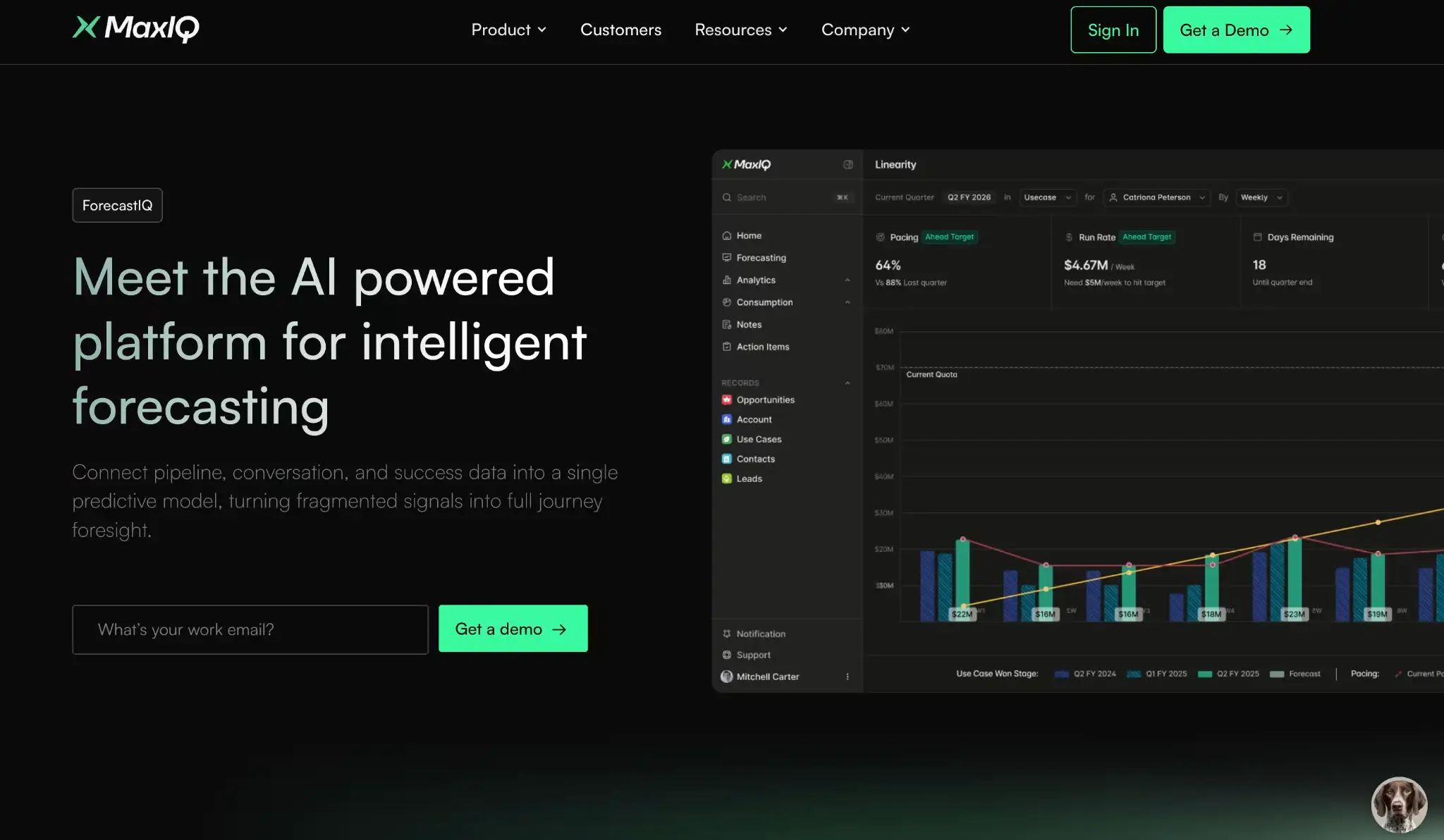
MaxIQ is the first AI-native Revenue Intelligence Platform built for B2B SaaS revenue teams. It helps companies improve forecast accuracy, inspect pipeline risk, capture insights from customer conversations, and connect pre-sales and post-sales execution.
By combining CRM data, meeting activity, and revenue signals, the platform gives teams a clearer view of deal health, customer risk, retention, and expansion opportunities.
Core features:
- ForecastIQ: AI forecasting built on signals rather than stages, with customizable roll-ups for any GTM motion.
- InspectIQ: Pipeline visibility, deal scoring, and gap detection that flag risks before they hit the forecast.
- EchoIQ: Conversation intelligence built on revenue context, auto-updating CRM and syncing call signals to deals.
- SuccessIQ: Post-sales intelligence covering onboarding, adoption, and renewal signals that feed back into the forecast.
- Fast deployment: Salesforce connection in 5 minutes, pipeline views in 10, forecasting workflows live in 3 minutes.
Used by: Snowflake, Commvault, VAST Data. Customers report 15% forecast accuracy improvement and adoption above 95%.
Pricing: Usage-based. No platform fee. Free for early-stage startups via the MaxIQ Startup Program.
Trial: Book a demo.
2. Clari
Enterprise revenue intelligence and forecasting platform for large sales organizations.
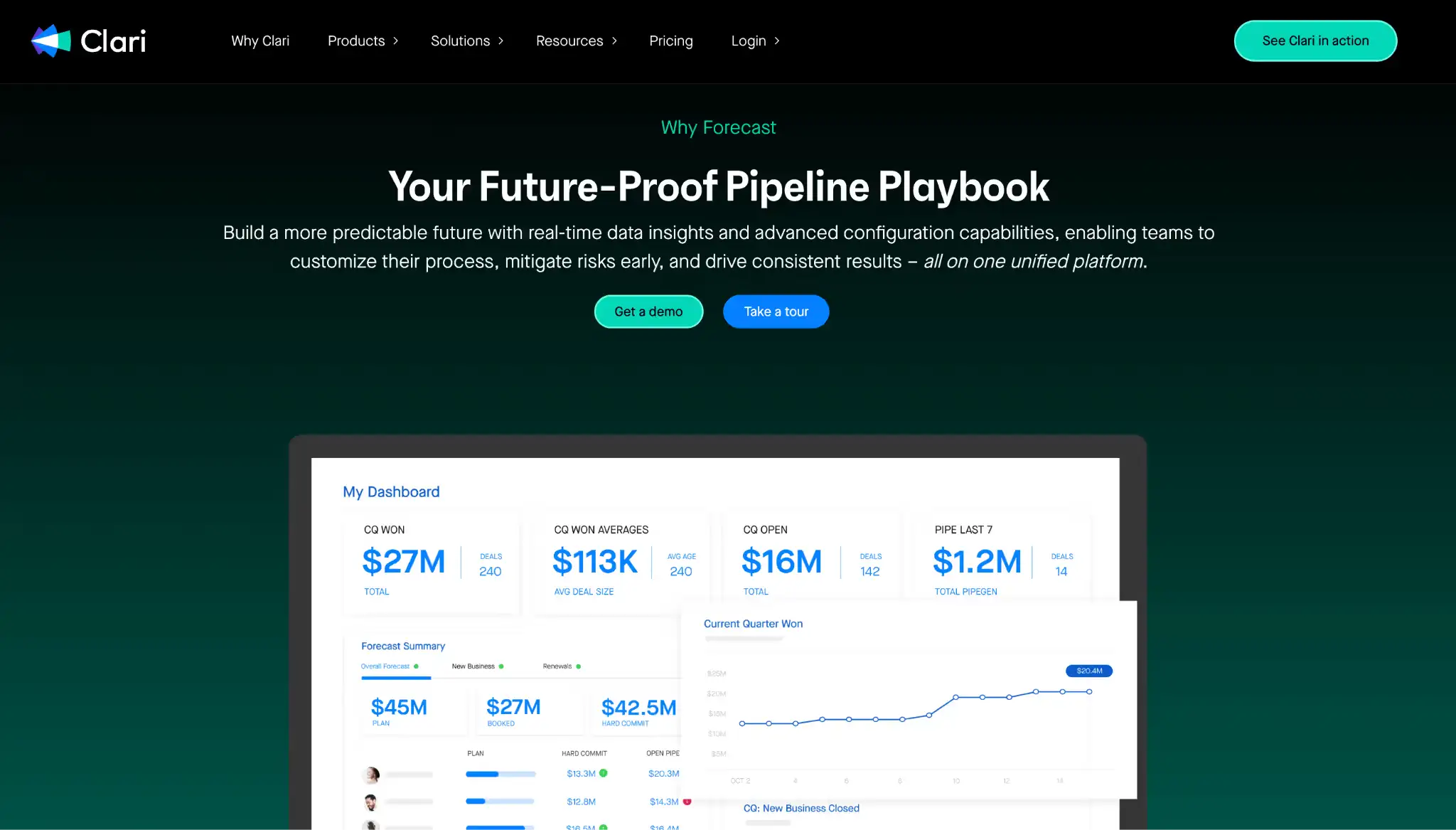
Clari is the category leader in pipeline visibility and revenue governance. The platform ingests CRM data, activity signals, and conversation intelligence (via the Wingman acquisition, now Copilot) to give CROs a real-time view of pipeline without chasing reps for updates. The 2025 Salesloft merger added sales engagement to the stack.
Core features:
- Predictive forecasting: Multi-dimensional roll-ups with commit categories (best case, commit, upside, pipeline).
- Pipeline inspection: Real-time visibility into deal-level changes, territory coverage, and gap-to-target.
- Scenario forecasting: Model multiple scenarios and pressure-test predictions against historical patterns.
- Segment forecasting: Break down forecasts by geography, vertical, product, or any custom segment.
- Copilot CI: Conversation intelligence module (formerly Wingman) with call recording and deal intelligence.
Trade-off: Implementation runs 8–16 weeks with professional services fees of $15K–$75K. Full-stack deployments (Core + Copilot + Groove) push per-user cost above $400/month.
Pricing: ~$100–$125/user/month for Core. Full stack $200–$400+/user/month. Quote-based.
Trial: None.
3. Gong Forecast
AI forecasting add-on to Gong's conversation intelligence platform.
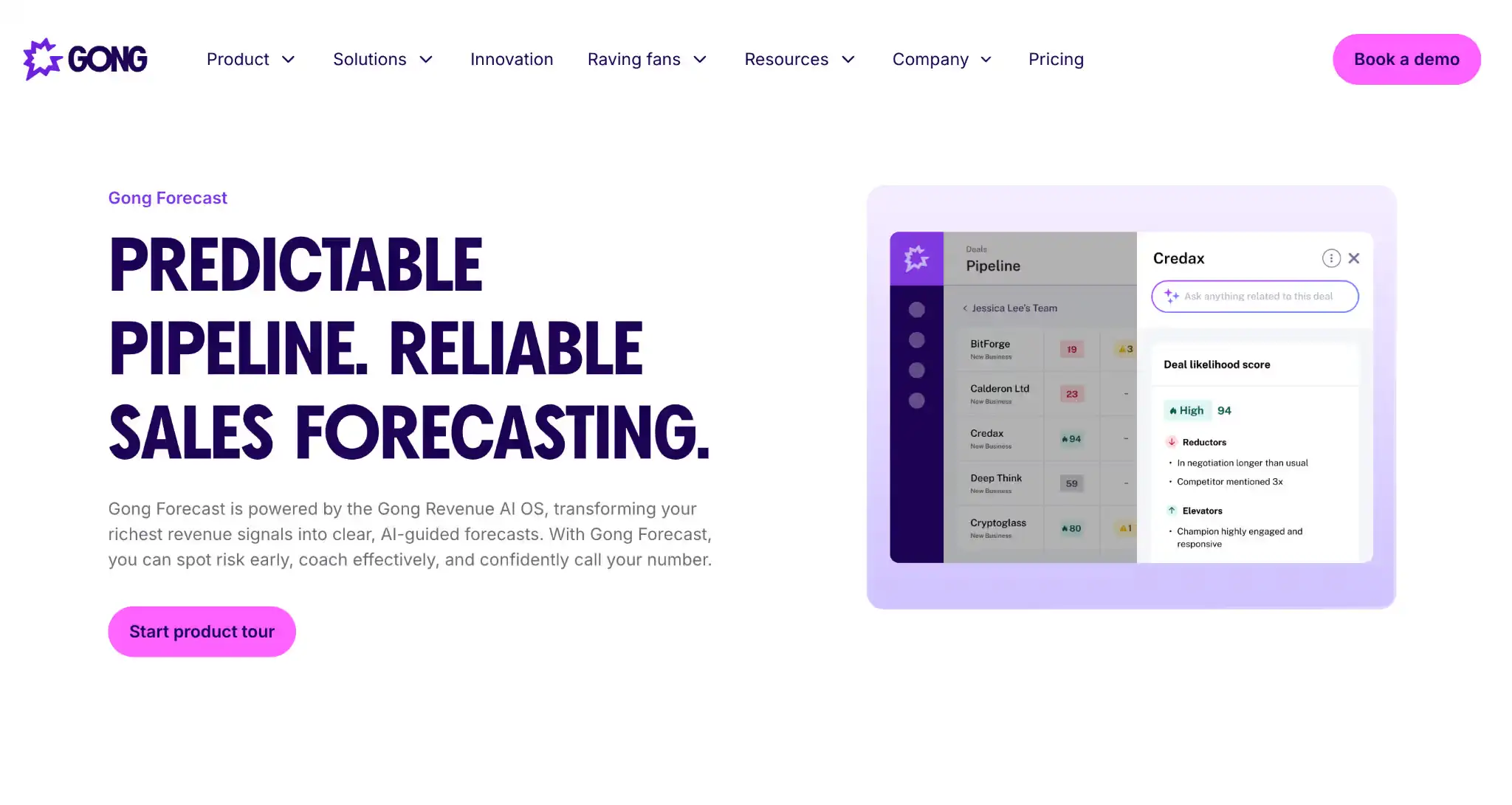
Gong Forecast ties conversation signals to forecast predictions, using the call data Gong captures to assess deal health, sentiment, and next-step likelihood. It works best for teams already running Gong Foundations, since Forecast cannot be purchased standalone.
Core features:
- Conversation-driven forecasting: Uses call recordings and buyer sentiment to score deal health.
- Deal boards: Consolidates forecast data and underlying conversations in one view.
- Pipeline comparisons: Flags mismatches between rep confidence and buyer engagement data.
- Likelihood scoring: AI assigns close probabilities based on conversation and activity patterns.
- Deal workflows: Routes risks and advancement actions through a unified Gong interface.
Trade-off: Third-party analyst ratings for the forecasting capability sit around 4 out of 10. Roughly 40% of mid-market Gong customers stack Clari on top for forecasting they can commit numbers against.
Pricing: ~$700/user/year add-on. Requires Gong Foundations ($1,300–$1,600/user/year).
Trial: None.
4. Aviso
AI-powered revenue intelligence platform for enterprise teams prioritizing forecast accuracy.
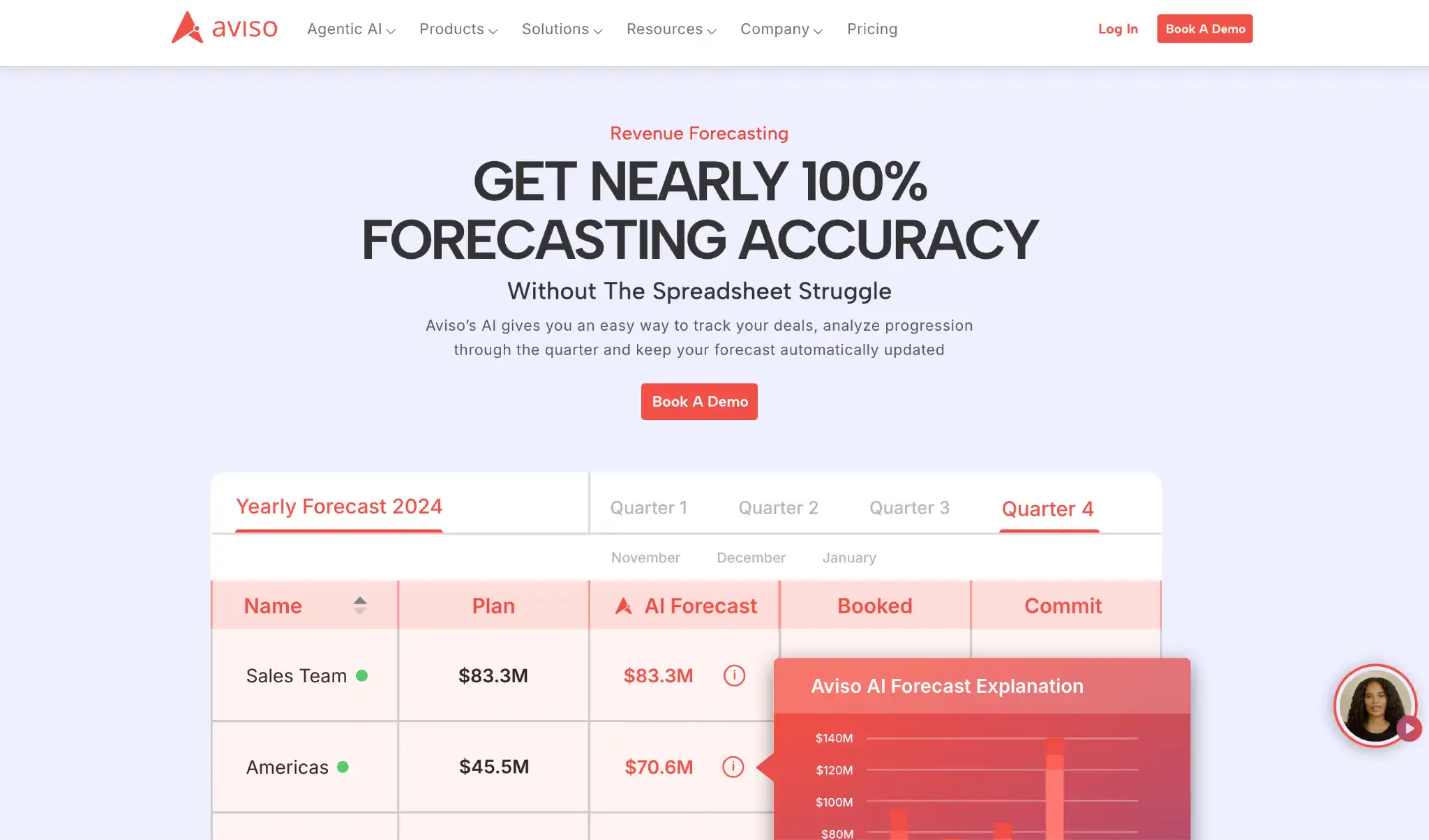
Aviso combines human input with predictive analytics to generate forecasts the vendor claims hit 98% accuracy. The platform automatically consolidates forecasts for each rep, category, and team, presenting best-case scenarios, most likely numbers, and pacing against target in real time.
Core features:
- WinScore insights: AI scoring that explains why a deal will or will not close, with transparent reasoning behind each prediction.
- Deal and pipeline inspection: 360-degree dashboards covering pipeline health, forecasting, and target fulfillment across the full sales organization.
- Multi-hierarchy rollups: Consolidates forecasts from rep to category to region automatically, with real-time refresh across all reports.
- MIKI agentic AI: Autonomous workflows that research accounts, summarize calls, and update CRM entries without rep involvement.
- Consumption forecasting: Built-in support for usage-based pricing businesses, which most forecasting platforms don't handle natively.
Trade-off: G2 reviews flag Salesforce sync lag and slow dashboard performance under large data volumes. Implementation is enterprise-scale, with $5K–$10K onboarding for SMB and $50K–$100K for large enterprises.
Pricing: Starts around $50/user/month. Enterprise deployments commonly quoted from $50,000/year. Quote-based.
Trial: 90-day free trial available on request.
5. Terret AI (Previously BoostUp)
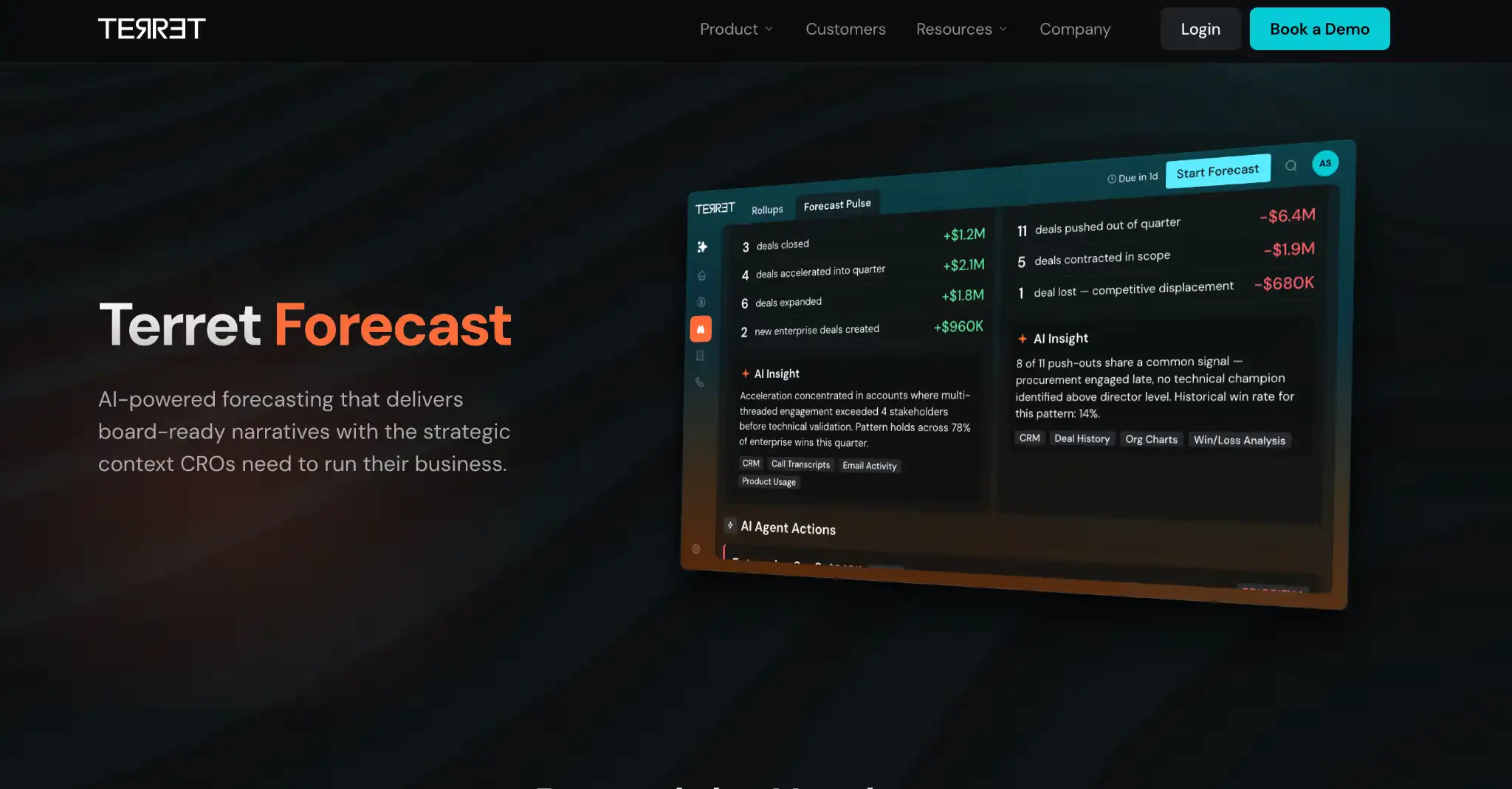
Revenue Operations and Intelligence platform combining forecasting, pipeline management, and deal intelligence.
BoostUp acts as a Revenue Command Center for CROs and RevOps leaders. The platform unifies CRM data with engagement and product-usage signals to deliver pipeline analytics, deal and account risk scoring, and machine-driven forecasting alongside a revenue BI layer.
Core features:
- Multi-dimensional forecasting: Flexible data model supporting subscription, usage-based, PLG, renewal, and expansion revenue in one view.
- Machine Forecast: AI-generated revenue projections that predict wins, losses, and slips based on historical trends and engagement data.
- BoostBot: AI agent that surfaces deal-level alerts, flags forecast risks, and drafts follow-up emails and scorecard entries.
- Deal inspection: Engagement risk scoring at the deal level, surfacing disengaged contacts and stalled pipelines before managers spot them.
- Conversation intelligence: Native CI with tight integrations to Gong, Chorus, Salesforce, Outreach, and Salesloft.
Used by: Cloudflare, Teradata, Udemy, Workato, MongoDB. G2 reviewers consistently highlight adoption quality, with one noting it as the only tool AEs rolled out to enthusiastically.
Pricing: Starts at ~$79/user/month. Typical deployments run $30,000–$80,000/year. Quote-based beyond base tier.
Trial: Free trial available.
6. Oliv AI
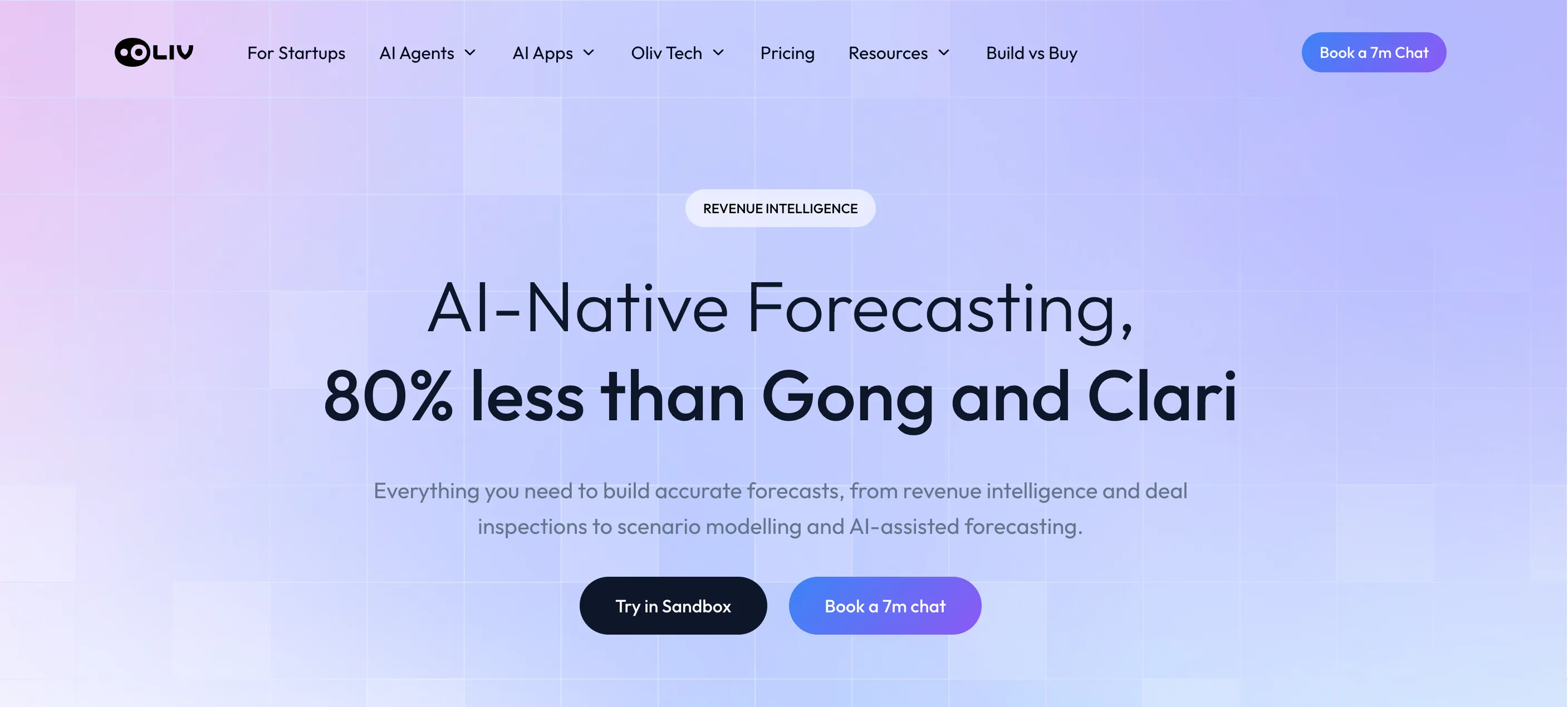
Agent OS for revenue teams, where the forecast is prepared for you instead of assembled by you.
Oliv is an agent layer that sits on top of your CRM rather than replacing it. It pulls Salesforce, HubSpot, transcripts and meeting notes into a GTM Context Graph, then runs agents on that context.
Most forecasting tools improve the view of a process that still runs on people. Oliv argues Clari and Gong added intelligence without removing the work. Forecaster drafts the roll-up before the call, so managers review a forecast instead of building one. Oliv reports submission time dropping from an hour to five minutes.
Core features:
- Forecaster: Drafts the forecast, flagging risky commits, sandbagged upside and dead deals.
- CRM Manager: Writes deal fields from conversations, so clean data is an output.
- Deal Driver: Raises the deals that moved, without anyone opening a dashboard.
- GTM Context Graph: Maps activity to the right opportunity across 100+ integrations.
- Multi-cadence roll-ups: Weekly, monthly and quarterly forecasts off one pipeline.
Trade-off: Accuracy settles over the first few weeks, and Oliv suggests five or more reps.
Pricing: Per seat, $0 platform fee, free view-only seats. Forecast from $29 per seat per month.
Trial: Free sandbox, or a seven minute chat with the founder at oliv.ai.
7. Salesforce Einstein
Native AI forecasting built into Sales Cloud for Salesforce-invested organizations.
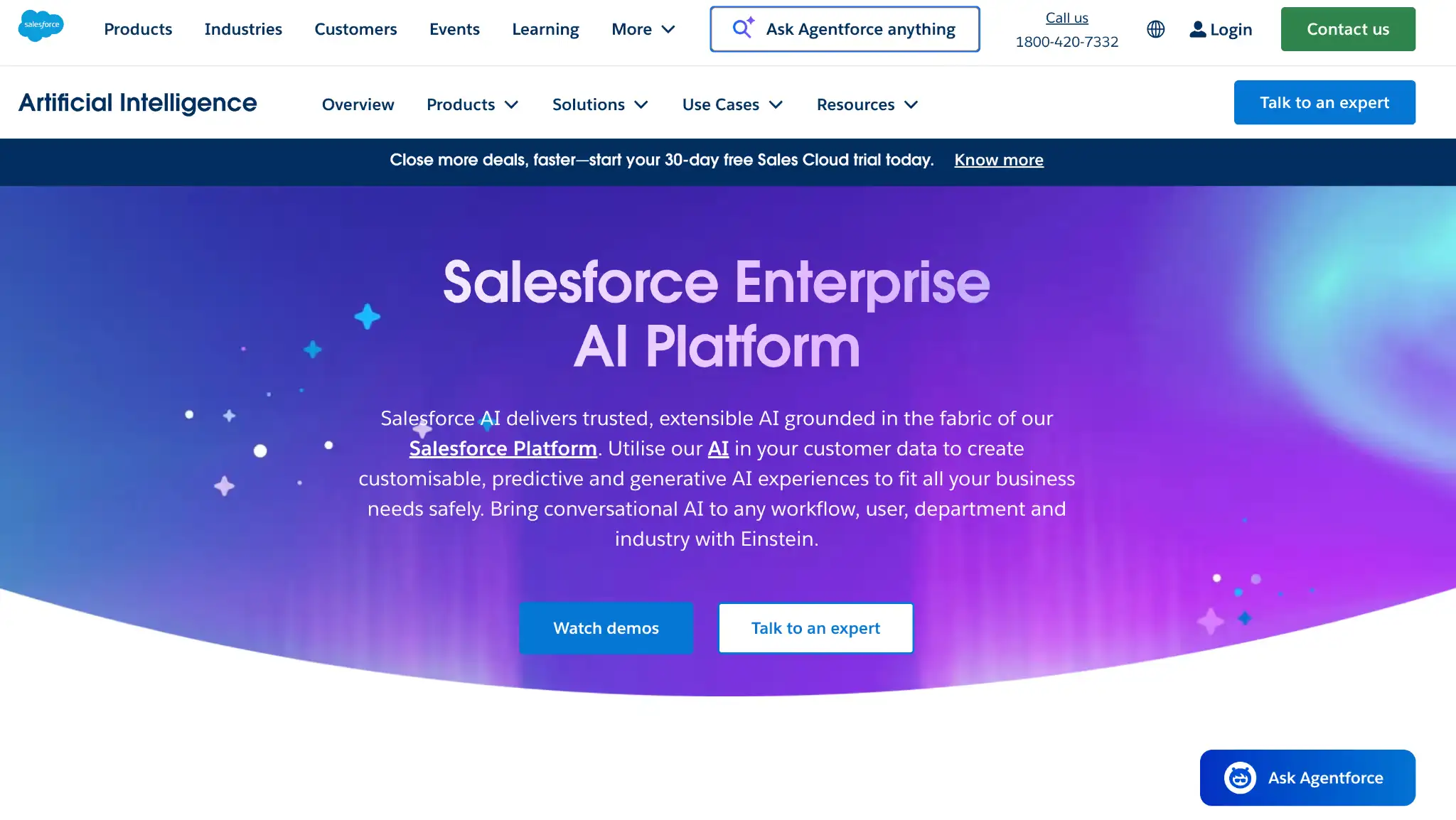
Salesforce Einstein layers predictive AI onto Sales Cloud, analyzing historical opportunity data to predict close probabilities and generate forecast numbers. For Salesforce-native companies, it's the path of least resistance: no integration, no separate vendor, no new data pipeline.
Core features:
- Einstein Forecasting: Predictive models that generate bottom-up forecasts by aggregating individual deal predictions across the org.
- Opportunity scoring: AI assigns close probability scores from 1–99 based on historical win and loss patterns.
- Explanatory insights: Surfaces the top factors driving each forecast prediction, supporting audit and pressure-testing.
- Collaborative forecasting: Roll-up workflows from rep to manager to VP inside the native Salesforce interface.
- Segment and territory forecasting: Filter forecasts by product family, territory, opportunity splits, and custom segments.
Trade-off: Accuracy depends entirely on Salesforce data quality. Gartner Peer Insights reviews flag that Einstein needs years of clean historical data to produce reliable scores, and implementation often takes several months with consultants. Teams with messy CRM data see limited accuracy improvement.
Pricing: $75/user/month on top of Sales Cloud Enterprise ($165/user/month). Included in Unlimited and Einstein 1 editions.
Trial: 30 days free through Salesforce.
8. HubSpot Sales Hub AI
AI-enhanced forecasting built into HubSpot CRM for mid-market teams already in the HubSpot ecosystem.
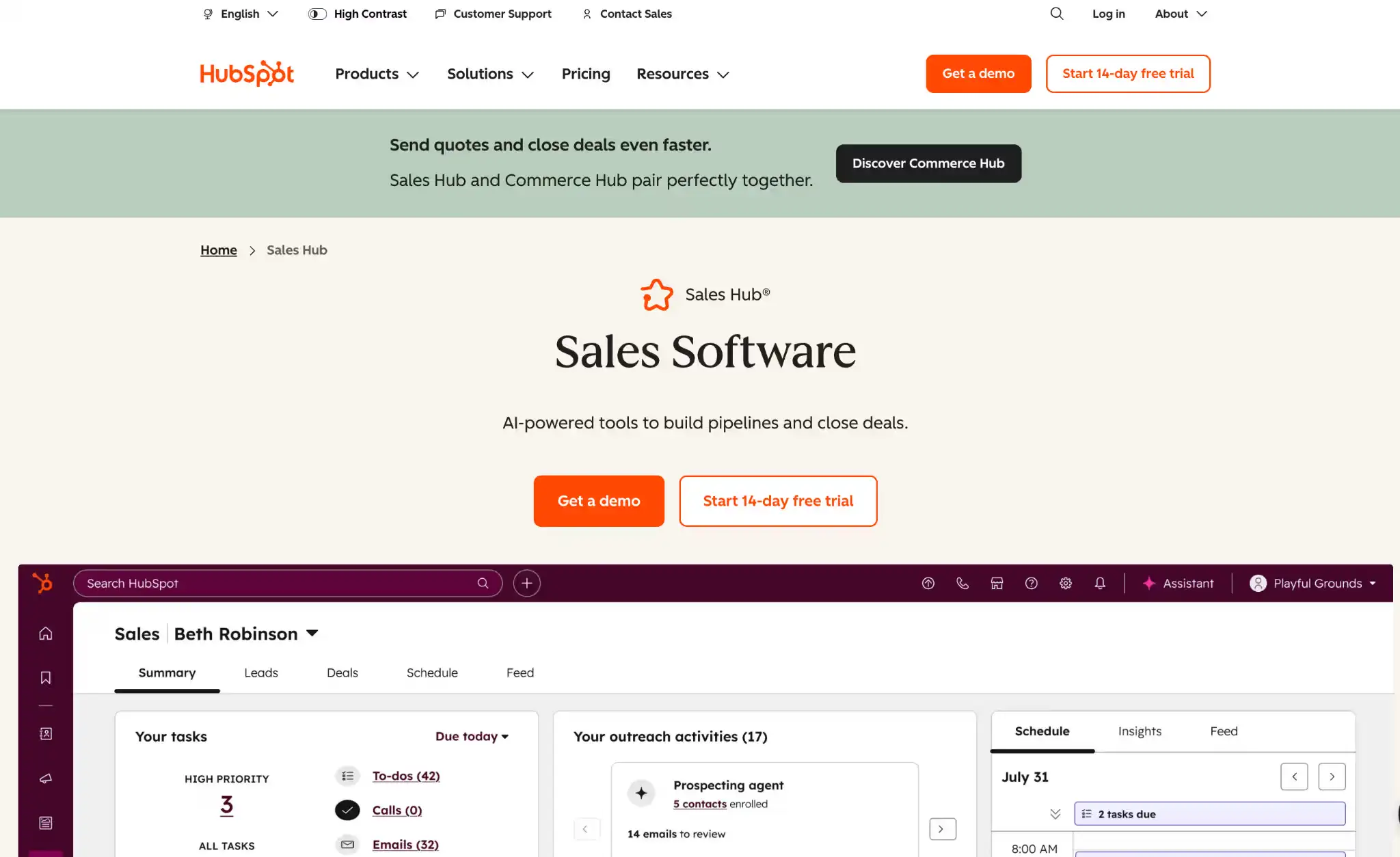
HubSpot's forecasting capability lives inside Sales Hub Professional and Enterprise tiers. The platform uses pipeline velocity, deal value, and rep performance to calculate forecast projections, with full integration into the HubSpot CRM so no separate connector or data pipeline is required.
Core features:
- Automated forecasting: Generates forecasts based on deal stage and AI-assigned close probability, updated continuously from CRM activity.
- Customizable forecast categories: Filter forecasts by deal type, region, time frame, or individual rep to match internal reporting structures.
- Pipeline velocity tracking: Measures how deals move through stages over time, surfacing slowdowns before they affect the forecast.
- Historical snapshots: Compares current forecast to past periods, helping managers spot trends and improve prediction discipline.
- Breeze AI: HubSpot's embedded AI layer, included at no extra cost, covering lead scoring, content generation, and email optimization.
Trade-off: Predictive scoring is gated behind the Enterprise tier, with a 7-seat minimum and a $3,500 onboarding fee. Teams under 7 reps or on the Professional tier lose access to the strongest forecasting features.
Pricing: Sales Hub Enterprise starts at $150/user/month, minimum 7 seats ($4,300/month starting commitment).
Trial: Free CRM tier available; Enterprise forecasting features require demo.
9. Outreach Commit
AI forecasting module tied to Outreach's sales engagement and execution platform.
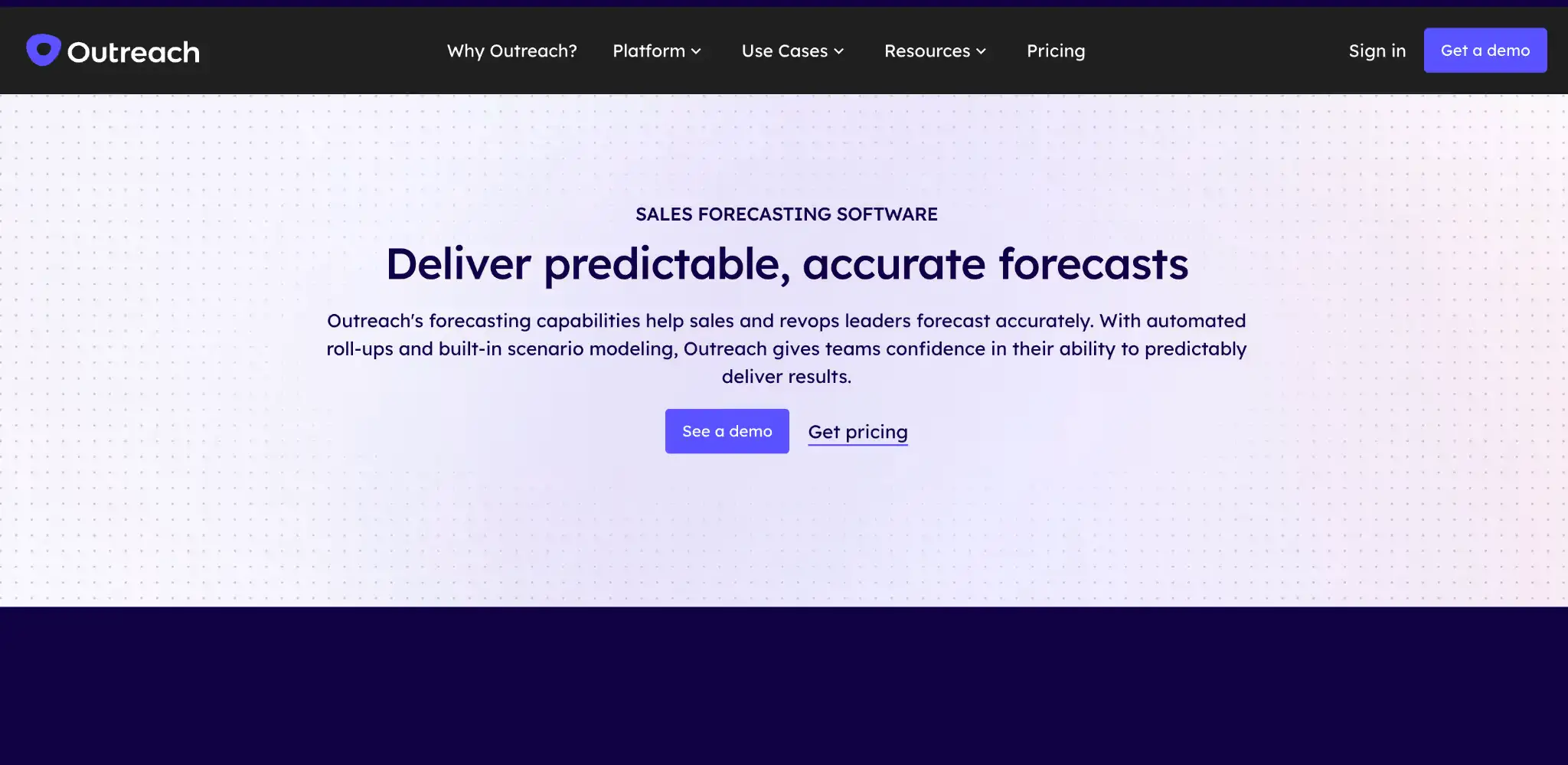
Outreach Commit uses the sales execution data captured by the Outreach platform (emails, calls, meetings, sequences) to feed forecast predictions. The value is in connecting engagement signals directly to deal outcomes, which most standalone forecasting tools cannot do natively.
Core features:
- Explainable AI: Shows reps and managers why a deal is flagged, which Outreach research identifies as a top driver of forecast trust and adoption.
- Engagement-informed forecasting: Pulls signal data from sequences, email opens, call outcomes, and meeting completions directly into predictions.
- Deal Management: Predictive forecasting module that Outreach reports improves forecast accuracy by up to 25% over manual methods.
- Kaia conversation intelligence: Records, transcribes, and analyzes calls in real time, surfacing competitor mentions and commitments.
- Unified execution layer: Forecast predictions sit in the same platform reps use for sequencing, reducing context-switching.
Trade-off: Buying Outreach solely for forecasting rarely makes sense. The module's value compounds when the team is already running sequences and deal management on the platform.
Pricing: Roughly $100–$200/user/month depending on package. Quote-based.
Trial: None.
10. People.ai (Now Backstory)
Activity capture and intelligence platform that structures the data other forecasting tools rely on.
People.ai is not a forecasting tool in the traditional sense. It captures and structures sales activity data (emails, meetings, calls, engagement signals) and maps it to accounts and opportunities, then feeds that structured data into forecasting, CRM, or revenue intelligence platforms. For teams whose biggest forecast problem is data quality, People.ai addresses the input layer directly.
Core features:
- Activity capture: Automatically logs emails, meetings, and calls into Salesforce without rep involvement.
- Account and opportunity mapping: Connects every activity to the right deal and account automatically, closing CRM data gaps.
- Relationship intelligence: Surfaces stakeholder maps, champion changes, and engagement patterns across the buying committee.
- Forecast enrichment: Feeds activity signals into Clari, Salesforce, or other forecasting platforms for sharper predictions.
- AI summaries: Generates account and deal summaries from captured activity, reducing manager prep time.
Trade-off: People.ai is typically deployed alongside a forecasting platform, not instead of one. Standalone ROI is hard to measure, which is why most buyers layer it under Clari or Salesforce rather than using it as the primary forecast tool.
Pricing: Typically $30,000–$80,000/year per Vendr benchmark data. Quote-based.
Trial: None.
11. Anaplan
Enterprise connected planning platform for finance-owned revenue forecasting at scale.
Anaplan is a multi-purpose planning platform used for finance, supply chain, workforce, and sales forecasting. It sits at the enterprise tier and is typically owned by finance, not sales, making it a fit when forecasting needs to integrate with broader company planning.
Core features:
- Multi-dimensional modeling: Build driver-based forecasts that connect sales, finance, and supply chain in one model.
- Scenario planning: Model unlimited what-if scenarios across products, geographies, and business units.
- Connected planning: Sales forecast integrates directly with financial plans, headcount, and capacity planning.
Trade-off: Complex to implement, requires dedicated admins, and often overkill for teams that only need sales forecasting.
Pricing: Starts around $30,000/year for entry deployments. Enterprise deployments commonly exceed $100,000/year.
Trial: None.
12. Revenue Grid
Salesforce-native revenue platform unifying forecasting, activity capture, and deal signals.
Revenue Grid runs inside Salesforce, which makes it a strong fit for Salesforce-first teams that want forecasting, engagement, and activity capture without leaving the CRM. Faster to adopt than Clari and lower operational friction.
Core features:
- In-Salesforce forecasting: Forecast submissions, roll-ups, and predictions live natively inside the CRM.
- Signal relay: Captures email and meeting signals to surface deal risks and stakeholder changes.
- Engagement sequencing: Outbound cadences and follow-up automation inside the same workflow.
Pricing: Quote-based. Positioned as a cost-effective alternative to Clari for mid-market deployments.
Trial: Available on request.
13. Forecastio
Purpose-built forecasting tool for HubSpot-native revenue teams.
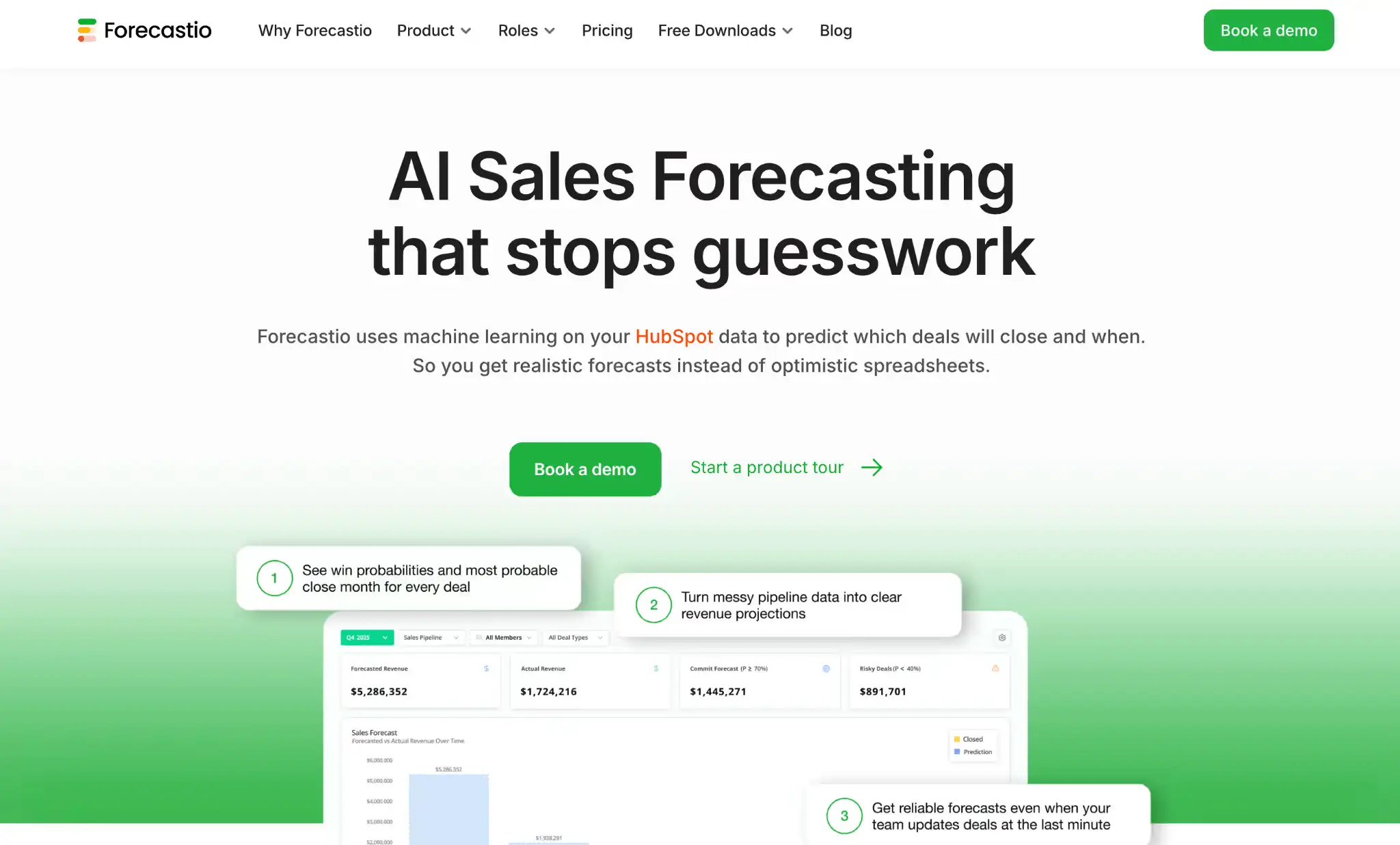
Forecastio is the rare standalone forecasting tool with published, flat-rate pricing. It connects to HubSpot (and Salesforce) and delivers AI predictions plus scenario modeling without requiring an enterprise contract. Best value for HubSpot customers who've outgrown HubSpot's native forecasting but aren't ready for Clari pricing.
Core features:
- AI forecast corridor: Predicts forecast ranges (best case, commit, worst case) based on historical deal patterns.
- Pipeline analytics: Deal velocity, conversion rates, and stage-level probability tracking.
- HubSpot-native sync: Deep, bi-directional integration with HubSpot CRM.
Pricing: Flat $199/month starting. Tiered plans published publicly.
Trial: Free trial available.
14. ZoomInfo Copilot
AI forecasting layered on ZoomInfo's GTM data and engagement platform.
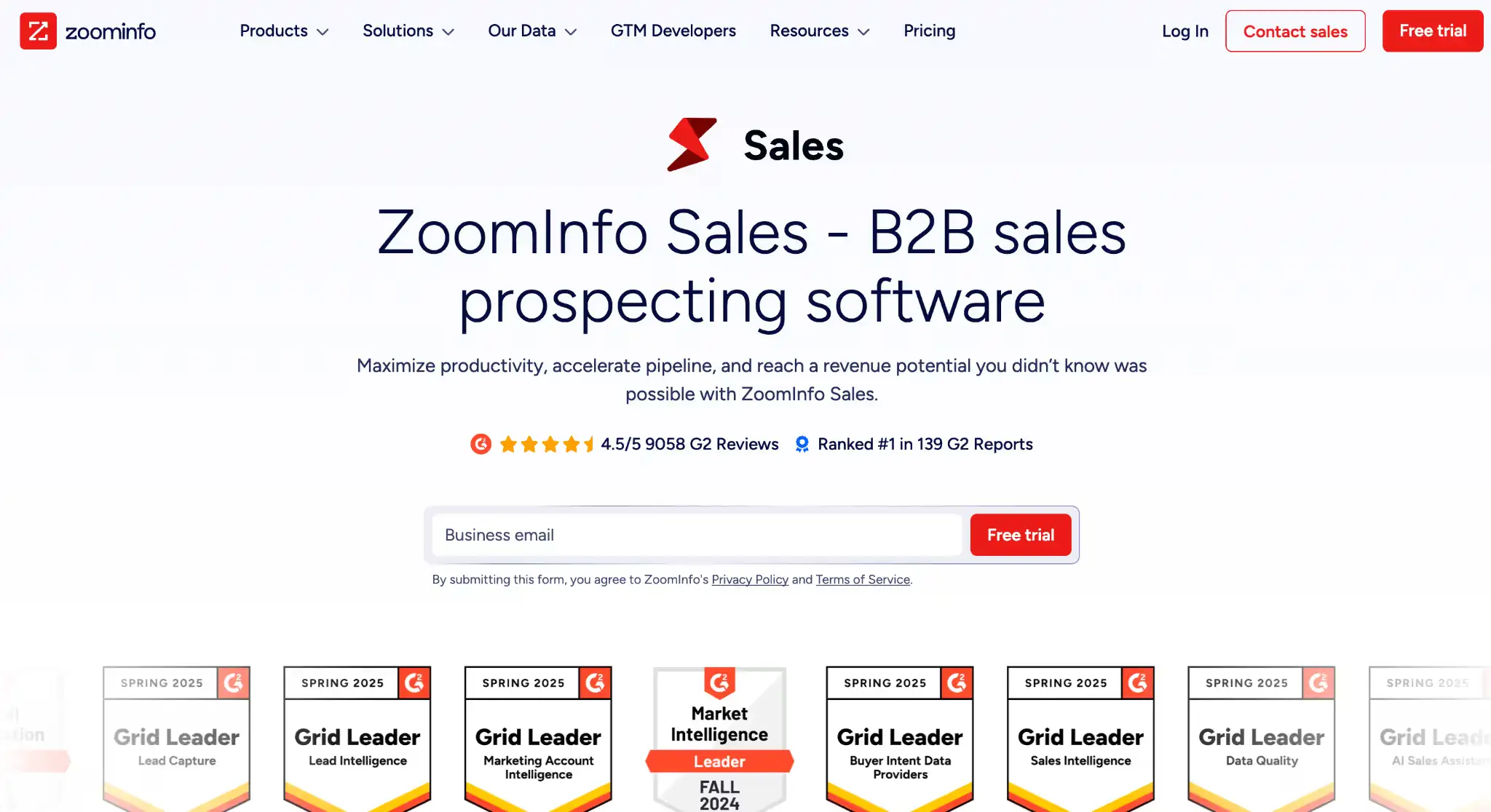
ZoomInfo Copilot uses the combination of ZoomInfo's B2B contact database and CRM engagement signals to generate pipeline predictions. It's positioned for teams already paying for ZoomInfo's GTM Workspace, where the forecasting layer comes bundled rather than as a standalone purchase.
Core features:
- GTM Context Graph: Combines B2B data, buyer intent signals, and CRM engagement into forecast signals.
- Pipeline analytics: Deal health scoring tied to account-level activity patterns.
- Multi-CRM sync: Native integration with Salesforce, HubSpot, and Microsoft Dynamics.
Pricing: Custom, bundled within ZoomInfo GTM Workspace. Typically requires a broader ZoomInfo contract.
Trial: Demo only.
15. Chorus by ZoomInfo
Conversation intelligence platform with forecasting signals, now part of ZoomInfo.
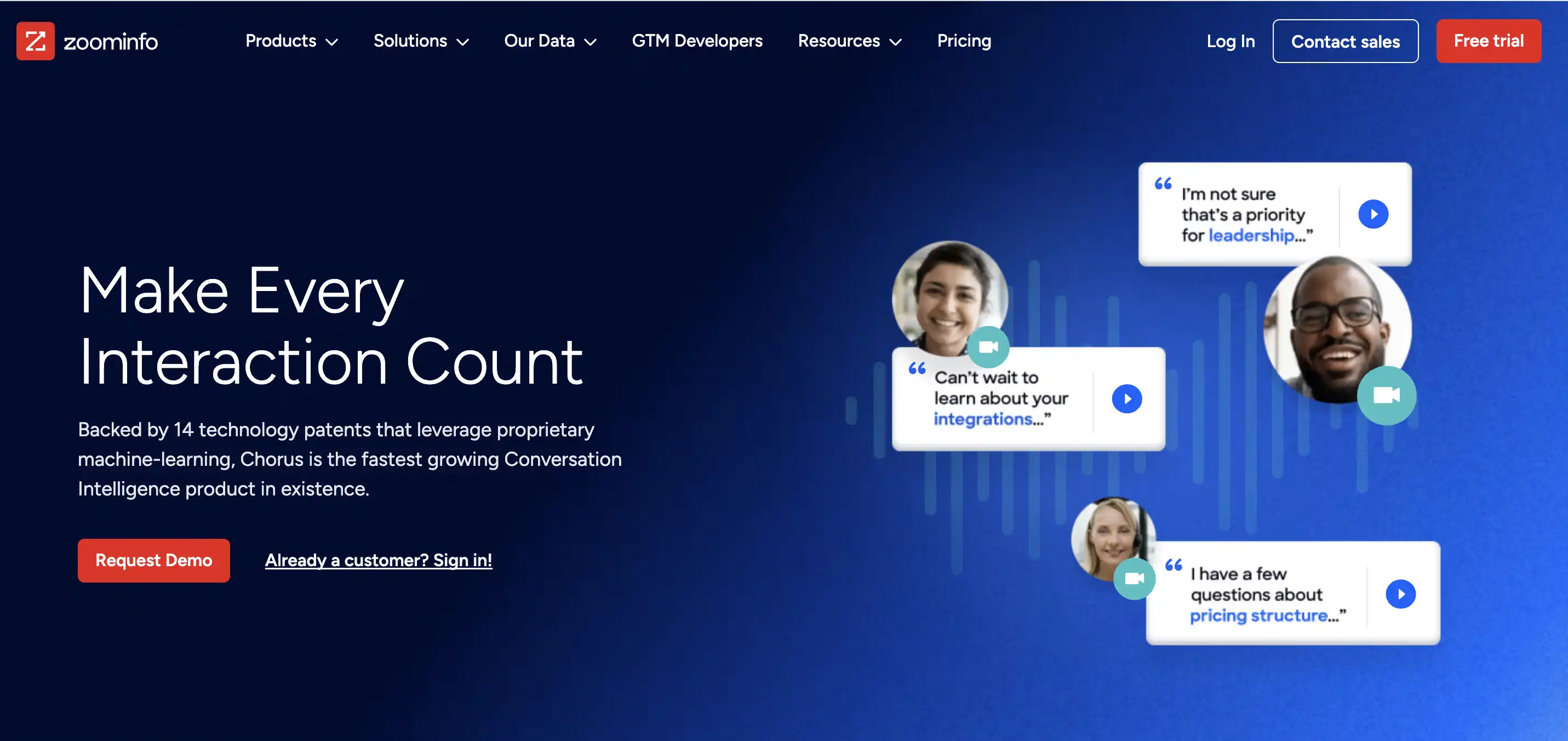
Chorus is primarily a conversation intelligence tool, but its integration with ZoomInfo Copilot makes it part of the forecasting conversation in 2026. Works best for mid-market sales teams already in the ZoomInfo ecosystem who want call recording plus forecast signals without paying Gong pricing.
Core features:
- Conversation capture: Records, transcribes, and analyzes sales calls with speaker separation and moment flagging.
- Deal intelligence: Connects call signals to deal progression, flagging risks and next steps.
- Forecast inputs: Feeds conversation signals into Copilot's forecasting layer.
Pricing: Per-user, bundled with ZoomInfo or purchased standalone. Typically lower than Gong.
Trial: Demo only.
How to choose the right sales forecasting tool for your team?
Choosing a sales forecasting tool gets easier when you stop comparing every feature side by side and look at what is actually making your forecast hard to trust.
For some teams, the problem is the CRM. Deals are missing next steps, close dates are old, stages do not match reality, and managers spend too much time cleaning the forecast before every call. In that case, look for a tool with strong CRM sync, activity capture, deal inspection, and forecast change tracking.
For other teams, the risk is not sitting in the CRM at all. It is in the conversations. The buyer went quiet. Pricing came up late. The champion changed. A senior stakeholder was missing. If that is where your forecast breaks, choose a tool that connects conversation intelligence with pipeline and forecast reviews.
This is where platforms like MaxIQ fit best, because the forecast is not treated as a separate report. It is connected to pipeline movement, customer conversations, deal risk, renewals, and expansion signals.
Team size matters too. A small sales team with clean CRM data may be fine with Salesforce, HubSpot, Forecastio, or another lighter forecasting setup. But once you have multiple segments, larger deals, more managers, renewals, expansion, and Finance asking for a number they can trust, you probably need a deeper revenue intelligence platform.
Some tools are easy to turn on. Some need cleanup, admin time, and a real RevOps owner. That is fine, but you should know which one you are buying before the contract is signed.
In the end, the best choice is the tool that fits the way your team sells, the way your CRM actually looks today, and the part of the forecast that keeps breaking.
Common mistakes when choosing a sales forecasting software
Most teams do not buy the wrong sales forecasting software because they are careless.
They buy it because the demo looks good.
The dashboard is clean. The forecast view is better than the spreadsheet. The AI score looks useful. For a minute, it feels like the forecast problem is solved.
But then the same problems show up again.
The CRM data is still stale. Close dates still sit there too long. Reps still forget to update next steps. Managers still ask the same questions every week because the tool is showing the number, not explaining what is really happening behind it.
That is the first mistake: buying a better-looking forecast instead of fixing the reason the forecast is hard to trust.
The second mistake is trusting the word “AI” too quickly. Ask what the tool is actually reading. If it is mostly stage, amount, close date, and commit, then the forecast may not be much different from what you already have.
The third mistake is forgetting the people who use it every week. A tool can look great for leadership and still be painful for managers and reps. If it adds more admin, people will avoid it. Then RevOps is back to chasing updates before the forecast call.
And for SaaS teams, closed-won is not the end of the forecast. A customer can sign and still miss onboarding. Usage can slow down. Expansion can disappear. A renewal that looked safe can suddenly become the number everyone is worried about.
If that is part of your revenue motion, your forecasting tool needs to see it.
How to implement sales forecasting software?
Implementation is where a lot of forecasting tools either earn trust or become another tab people ignore.
Before you connect anything, get the basics in order. You do not need a perfect CRM. You do need the fields the forecast depends on to mean the same thing across the team: close date, stage, amount, owner, next step, and forecast category.
Then add the signals that explain the deal. Meetings, emails, call notes, buyer activity, renewal risk, expansion signals, and anything else your team already checks before a forecast call.
Keep the first rollout small. One team. One forecast motion. One clear problem to fix.
Maybe commit deals are slipping too late. Maybe managers are spending too much time prepping for the forecast call. Maybe leadership keeps asking why the number changed and no one has a clean answer.
Start there.
Once the team trusts what the tool is showing, expand it. Do not try to rebuild the whole revenue process on day one. That is how forecasting software turns into shelfware.
The first win should be simple: fewer surprises, cleaner calls, and a forecast people can actually explain.
The bottom line
Forecasting software is no longer about reporting. It's about predicting revenue with enough confidence to run the business on the number.
The right choice depends on what you need the system to do. If you just need a better view inside the CRM, start there. If you need deep forecasting structure at enterprise scale, the heavier platforms still make sense. But if you want forecasting tied to real deal signals, faster deployment, and pricing that scales with usage instead of seats, AI-native revenue platforms like MaxIQ are where the category is moving.
Every capability walked through one by one, with screenshots from real calls.
.avif)