.webp)




.svg)

Key Takeaways (TL;DR)
Pipeline forecasting estimates what will close from live CRM opportunities. Revenue forecasting looks at the bigger number across bookings, renewals, churn, expansion, and billing timing. Pipeline is one input to revenue, not the forecast itself.
- Pipeline forecasting: inspect deals, fix next steps, and see what’s actually moving
- Revenue forecasting: build a number the business can plan around
- Keep them separate: pipeline review for coaching, forecast review for the number
- Where MaxIQ fits: connects pipeline and revenue signals into a forecast you can explain
Most teams treat pipeline and forecast like they’re the same thing. They’re not.
Your pipeline is the deals your team is actively working. A pipeline forecast is your best estimate of which of those deals are likely to close. Revenue forecasting goes wider. It also has to account for renewals, churn, expansion, and when that revenue will actually show up.
The problem usually starts in the weekly pipeline review. What should be a deal inspection meeting turns into a number-checking exercise. Managers stop digging into what’s stuck. Reps start defending their commit. Finance gets a forecast built on inputs they don’t fully trust.
Pipeline forecasting and revenue forecasting are two different jobs
Let's name them cleanly.
Pipeline forecasting estimates what's likely to close from live opportunities in the CRM, based on stage, deal velocity, and actual likelihood one of several sales forecasting methods teams use. Not vibes.
Revenue forecasting predicts revenue outcomes over a time period bookings, recognized revenue, or both. It includes pipeline. It also includes renewals, churn, expansion, and the billing reality of how revenue actually shows up.
Pipeline reporting in your CRM shows the state of open deals. Revenue forecasting shows the state of the business.
Sales owns pipeline health. FP&A owns the revenue forecast, with input from Sales, CS, and Marketing.
One SaaS nuance: renewals and churn can matter as much as new logo pipeline. Some quarters, more.
So if your "forecast" is just pipeline plus a prayer, it's going to be wrong. In a consistent way.
What revenue forecasting is really for
Revenue forecasting exists so the company can run like an adult.
It supports:
- budgeting
- headcount planning
- cash planning
- growth targets
- board and investor communication
It is not just "what Sales thinks will happen."
A real revenue forecast pulls from multiple inputs beyond pipeline:
- Renewals: what's coming up, what's at risk, what's already in negotiation
- Churn risk: leading indicators from Customer Success, support, health scores, exec engagement
- Expansion signals: usage trends, seat growth, product telemetry, account plans
- Billing and invoicing reality: when things actually bill, when revenue is recognized, payment behavior
- Quota attainment: coverage against quota by rep, segment, and region
- Marketing creation trends: pipeline created over the last few weeks, not just closed won
It also has different horizons:
- Weekly/monthly: tactical, "what changed since last week and why"
- Quarterly/annual: strategic, "what's the plan and what scenario do we believe"
And it lives or dies on assumptions. Not just the numbers.
The best teams I've seen are those who treat assumptions like first class objects. They can be reviewed, audited, argued about, improved. Not buried in someone's spreadsheet.
How does proper pipeline management improve forecasting accuracy?
Pipeline management gives the forecast clean inputs. When every deal has a real stage, a real next step, and a real close date, your conversion rates and timing assumptions are built on evidence instead of optimism. Fix the pipeline and the forecast gets better without touching the model.
Try to do both jobs in one meeting and you get a weird hybrid:
Managers stop coaching because they're trying to "get a number."Reps start performing for the meeting lots of confident talk, minimal evidence.Finance starts questioning every deal, because they don't trust the inputs.Everyone leaves tired, and the forecast is still shaky.
Pipeline accuracy improves with hygiene: clean stages, real next steps, no zombies. Revenue accuracy improves with broader integration and consistent methodology: renewals, churn, billing, usage, and a repeatable model. Different problem, different fix.
How to align forecasting with pipeline updates
Think of it as a handoff. Pipeline gives you the leading indicators. Finance turns those into revenue scenarios.
Pipeline coverage is an easy example: total pipeline value divided by the revenue target. A lot of SaaS teams look for something around 3x to 5x coverage, depending on win rates and sales cycle length.
But coverage on its own can lie to you. A 5x pipeline full of stale, barely-qualified deals is worse than a 2.5x pipeline where buyers are actually moving.
To make pipeline data useful in the forecast:
- Segment it: by stage, deal type, ACV band, segment, and region.
- Use historical conversion rates: especially stage-to-stage and stage-to-close rates by segment.
- Apply realistic timing: based on how long deals actually take, not the date a rep hopes they’ll close.
- Build scenarios: commit, best case, and downside, with a clear reason for what moves a deal from one bucket to another.
The 2026 operating cadence: how to separate the meetings
One rule makes this work: no deal-level coaching in the forecast call, and no number-chasing in the pipeline review.
5 common forecasting mistakes SaaS teams makes and how to fix them
1) Recency bias
That one big deal had a “great call” yesterday, so it’s suddenly in commit.
Fix: require evidence for movement. Mutual plan updated. Legal started. Security review scheduled. Economic buyer meeting happened. Not just “they loved it.”
2) Sandbagging
Reps under commit to look safe, then “surprise” close. It feels good, but it wrecks planning and it trains leadership to ignore the forecast.
Fix: separate performance management from forecast integrity. If reps get punished for missing commit, they will protect themselves. You want accuracy, not theatre.
3) Stale opportunities
Zombie deals inflate pipeline and create false confidence. Then the quarter ends and everyone acts shocked.
Fix: enforce exit criteria. If there’s no next step and no progress, it doesn’t stay in a late stage. Age by stage should trigger automatic scrutiny.
4) Close date slippage
Close dates slide quietly until week 12 of the quarter, then everything collapses at once.
Fix: track slippage rate by stage and by rep. Make “why did this move” a normal question. If a rep slips everything, the issue isn’t luck. It’s qualification and control.
5) Bad CRM hygiene
Missing next steps, outdated amounts, incorrect stages. This one sounds boring, but it is literally a forecasting feature.
Fix: make CRM updates part of the operating cadence. Who updates what, by when. And managers approve stage moves based on criteria, not optimism.
A Vantage Point study found that most B2B sales forces meet more than once a month for nearly an hour to discuss pipeline and forecasts. If you’re spending that time, the system should produce clean data. Otherwise you’re just paying for meetings.
Can pipeline hygiene improve forecasts? Yes — it's usually the cheapest improvement available. Every conversion rate, cycle time, and slippage figure in your model comes from CRM data. Clean up stages, next steps, and close dates and forecast error drops before you change a single assumption.
Metrics that improve both pipeline health and forecast accuracy
Track just the right metrics on a regular basis, and like, actually stick with it.
For pipeline health, you want to keep an eye on stuff like stage conversion rate, deal velocity, average cycle time, pipeline coverage, age by stage, and percent with next meeting set.
For forecast accuracy, you should track forecast vs actual, error by segment/region, slippage rate, commit accuracy, and probability calibration. It sounds like a lot, but it helps things make sense later.
In the end, metrics kind of shine a light on process leaks. They show you where things are leaking out, even if you don’t wanna see it at first.
What revenue gains can be attributed to better pipeline accuracy?
Snowflake saw a 25% improvement in forecast accuracy after unifying pipeline signals into consistent forecast inputs with MaxIQ. Their Director of Field Operations put it plainly: MaxIQ turned forecasting from "noisy to reliable," while also accelerating pipeline execution and getting teams into one operational rhythm.
The gains showed up in specific places, not just the top-line number. Pipeline velocity accelerated by 20% through automated workflows and unified visibility, and Sales, Success, and Finance reported full cross-functional alignment for the first time. One of their GTM leaders noted forecast calls got tighter, risk surfaced earlier, and reps spent less time chasing down status updates the exact meeting-quality problem this post opened with.
That's the full section, ready to paste in. Want the Snowflake link added as an internal link on "Snowflake," or should I leave it plain text?
How MaxIQ brings both together
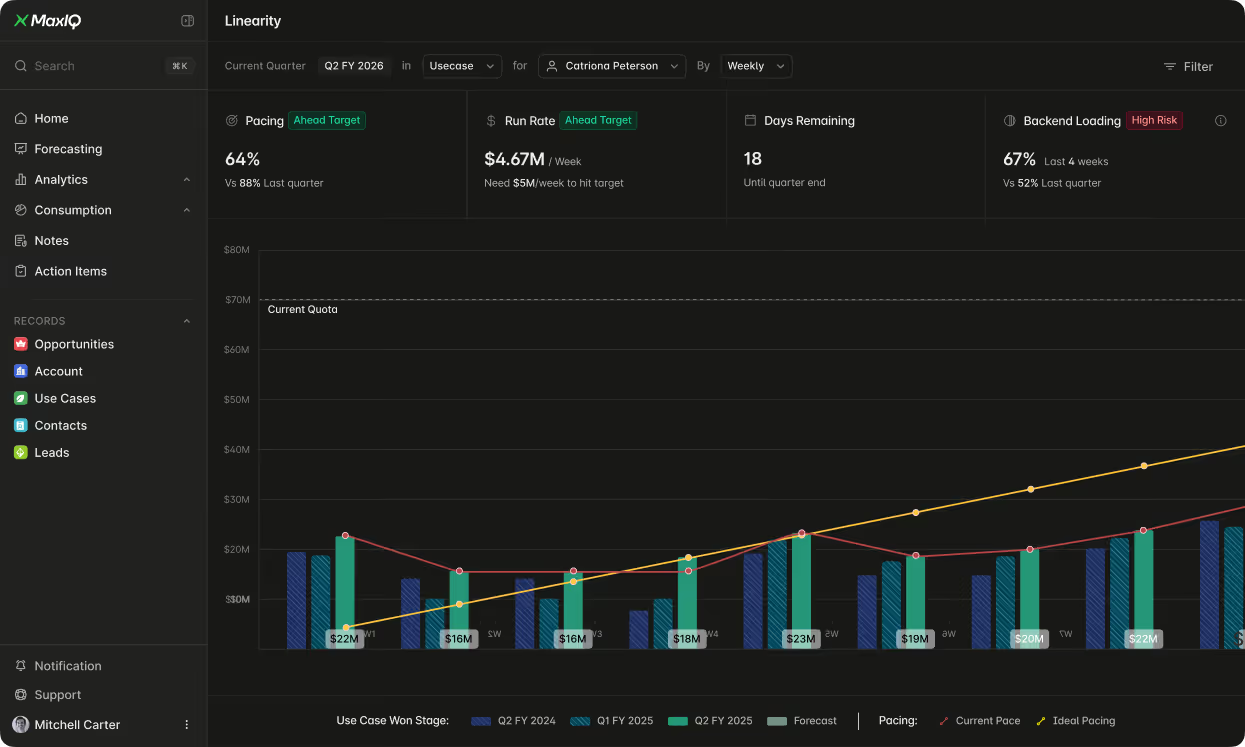
MaxIQ’s AI Forecasting feature is basically built for the gap most SaaS orgs feel.
Sales teams live in pipeline. Finance teams live in revenue models. The painful part is explaining what changed, what’s real, and what’s noise.
MaxIQ helps by pulling from your CRM and supporting systems, then surfacing:
- Real time pipeline visibility that isn’t dependent on reps telling the story perfectly
- Probability weighted rollups that match how your pipeline actually behaves
- Slippage and risk detection so “date drift” is visible early, not week 13
- A cleaner forecast narrative for FP&A, especially around what moved since last cut
- Scenario planning support so you can see impact without rebuilding spreadsheets
The goal isn’t to replace your operating cadence. It’s to make the handoff between pipeline signals and revenue planning less fragile. Less manual. Less political.
Know what you're measuring, and you'll know where you're going
Pipeline forecasting drives execution. Revenue forecasting drives business planning.
Mix them together and you create noise. Separate them and you get clarity. And honestly, calmer quarters.
A simple 3 step starter plan:
- Separate the meetings. Pipeline review for coaching. Forecast review for the number and assumptions.
- Standardize stage criteria and CRM hygiene. If the inputs are sloppy, the outputs will be fantasy.
- Measure forecast vs actual monthly and iterate. Update conversion rates, timing, and probability logic like it’s a product.
Looking ahead to 2026, the teams that win won’t be the ones with the fanciest dashboards. It’ll be the ones that combine disciplined process with AI assisted analytics, then actually do the boring loop: inspect, predict, reconcile, improve. Every month.
Every capability walked through one by one, with screenshots from real calls.
.avif)