.webp)




.svg)

Key Takeaways (TL;DR)
Seven platforms, seven different strengths pick the one that matches how your revenue actually moves.
- Best overall : MaxIQ
- Best for enterprise RevOps: Clari
- Best for conversation-led insight: Gong
- Best for consumption and renewals: Terret
- Best for activity capture: Backstory
- Best for CRM hygiene: Scratchpad
- Best for Salesforce-native teams: Weflow
Deal intelligence is what you reach for when the CRM says one thing and the deal is doing another.
It reads the actual activity on an opportunity, the calls, the emails, the meetings, the field edits, and puts a number on how likely that deal is to close. That makes it one part of the broader revenue intelligence layer, connecting deal-level signals to pipeline and forecasting. It also tells you why the number moved, which is the part that decides whether anyone acts on it.
Platforms differ on all of that. What they can actually see, how far past a score the inspection goes, and what they cost once the platform fee lands on the quote.
Below are the seven deal intelligence platforms I think are the best in the market right now, each held to those same questions.
What deal intelligence software actually does?
Four jobs sit under the label. It captures activity without asking reps to log it. It scores each open opportunity on something more reliable than the stage field. It flags deals that are drifting. And it puts a next step somewhere the rep already works.
Most platforms do the first two well. The gap between them opens on the last two, because flagging a deal is easy and telling someone what to do about it means the tool has to understand your process, not just your data.
Where it sits next to what you already own?
Conversation intelligence listens to calls. Forecasting rolls a number up to the board. Deal intelligence works at the level in between, on the single opportunity, and it borrows from both.
The category lines have blurred anyway. Clari and Salesloft merged in December 2025, so buyers comparing them as separate vendors are working from old information. Gong sells forecasting. Clari sells conversation intelligence through Copilot. What you're really buying is a center of gravity, and every platform below has a different one.
The 7 deal intelligence platform compared
1. MaxIQ
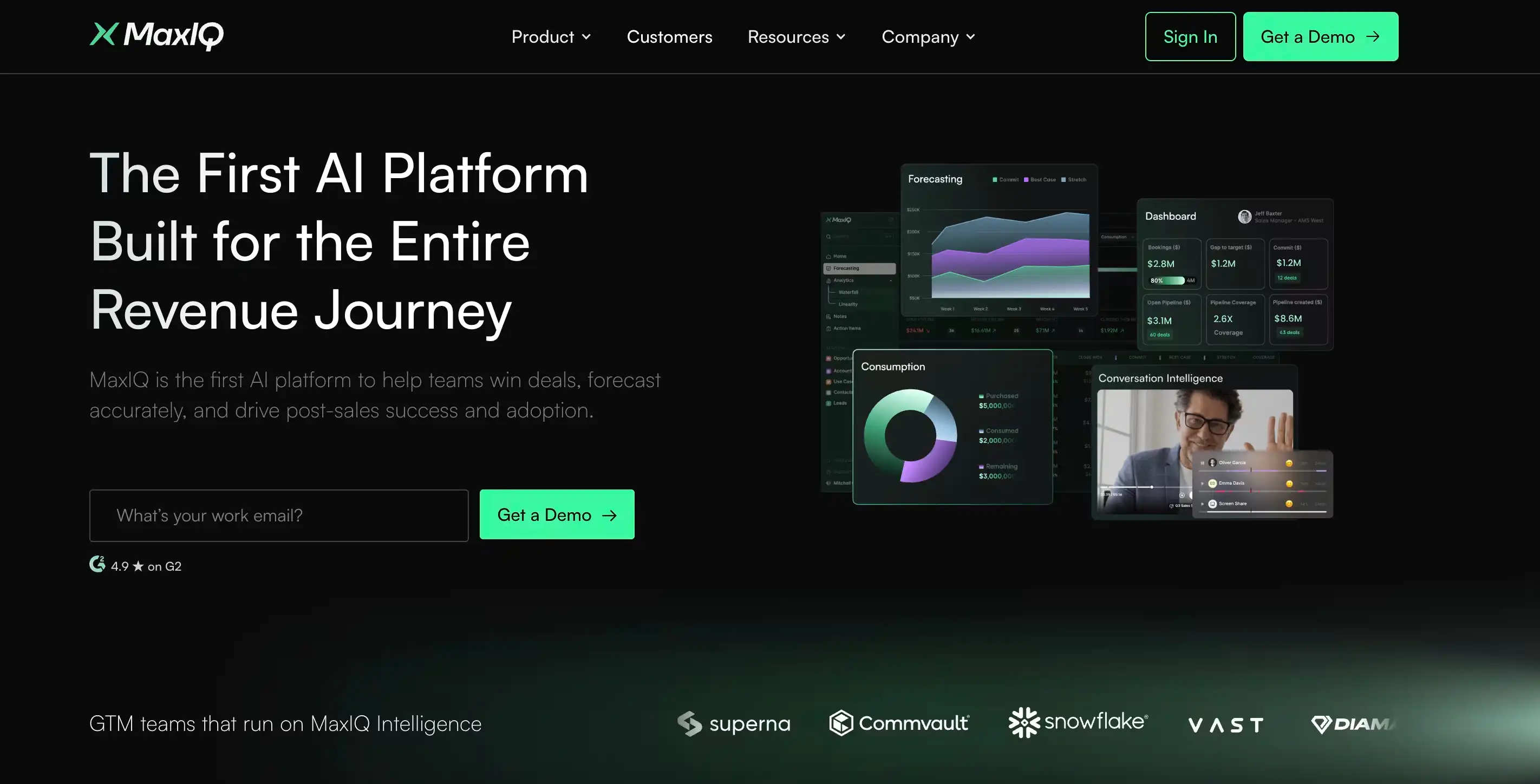
Worth saying plainly: this is my company, and it's first on a list I wrote. Judge the entry on the same fields as the rest.
MaxIQ runs deal inspection (InspectIQ), forecasting (ForecastIQ), conversation intelligence (EchoIQ), and post-sale (SuccessIQ) on one platform, so a deal that closes doesn't drop out of view at signature. That matters most when your revenue keeps moving afterward through consumption, expansion, and renewal.
Pricing is a usage-based annual subscription that scales with platform usage rather than headcount. EchoIQ charges for conversations captured instead of seats, and reported adoption sits above 95% against an industry norm closer to 60 to 70%. Snowflake, Commvault, and VAST Data are customers, reporting around 15% improvements in forecast accuracy and a Salesforce connection that takes roughly five minutes. Early-stage startups get the first year free.
Where it's thin: we're a small team founded in 2022, and the G2 review volume is nowhere near Gong's or Clari's. If your buying process weights review count heavily, that's a real gap.
Best for: Enterprise and B2B SaaS on usage-based or hybrid pricing where renewals and expansion carry as much weight as new business. Salesforce native.
2. Clari
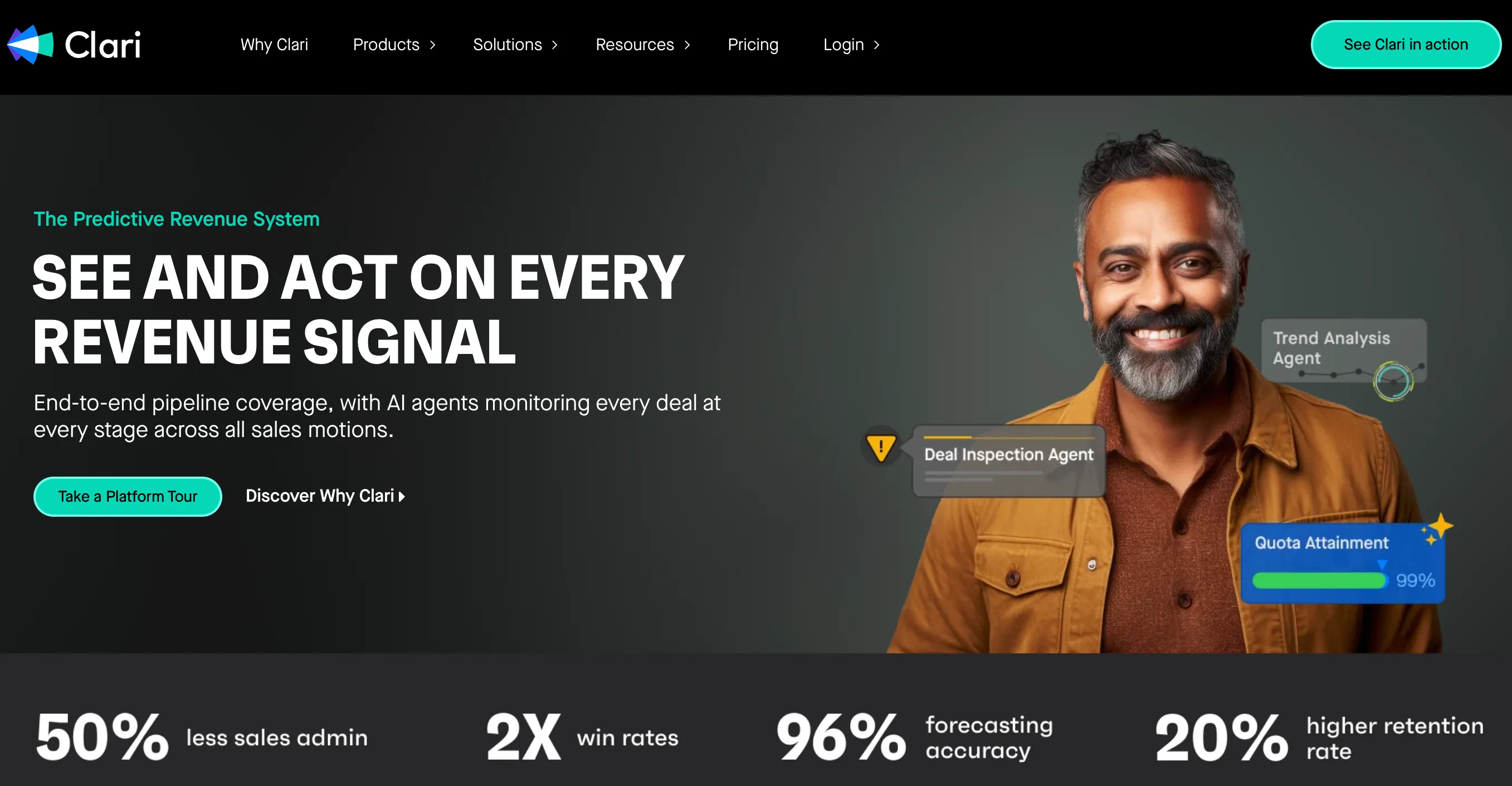
Clari is the enterprise reference point. It carries a 4.6 out of 5 on G2 across 5,587 reviews and was named a Leader in Gartner's MQ for Revenue Action Orchestration in December 2025, with Inspect handling opportunity management on top of its own revenue database.
The strength is structure. Reviewers credit the inspection tools, activity tracking, and snapshot history with making deal progression and rep behavior legible over time, which is what a weekly forecast call needs.
The recurring complaint is cost and complexity. Reported pricing sits between $100 and $400 per user per month depending on modules, and the average enterprise contract lands near $160,000 a year. One reviewer noted that Clari's features often overlap with other tools already in the stack.
Best for: 50 or more reps, Salesforce, a real RevOps function.
3. Gong
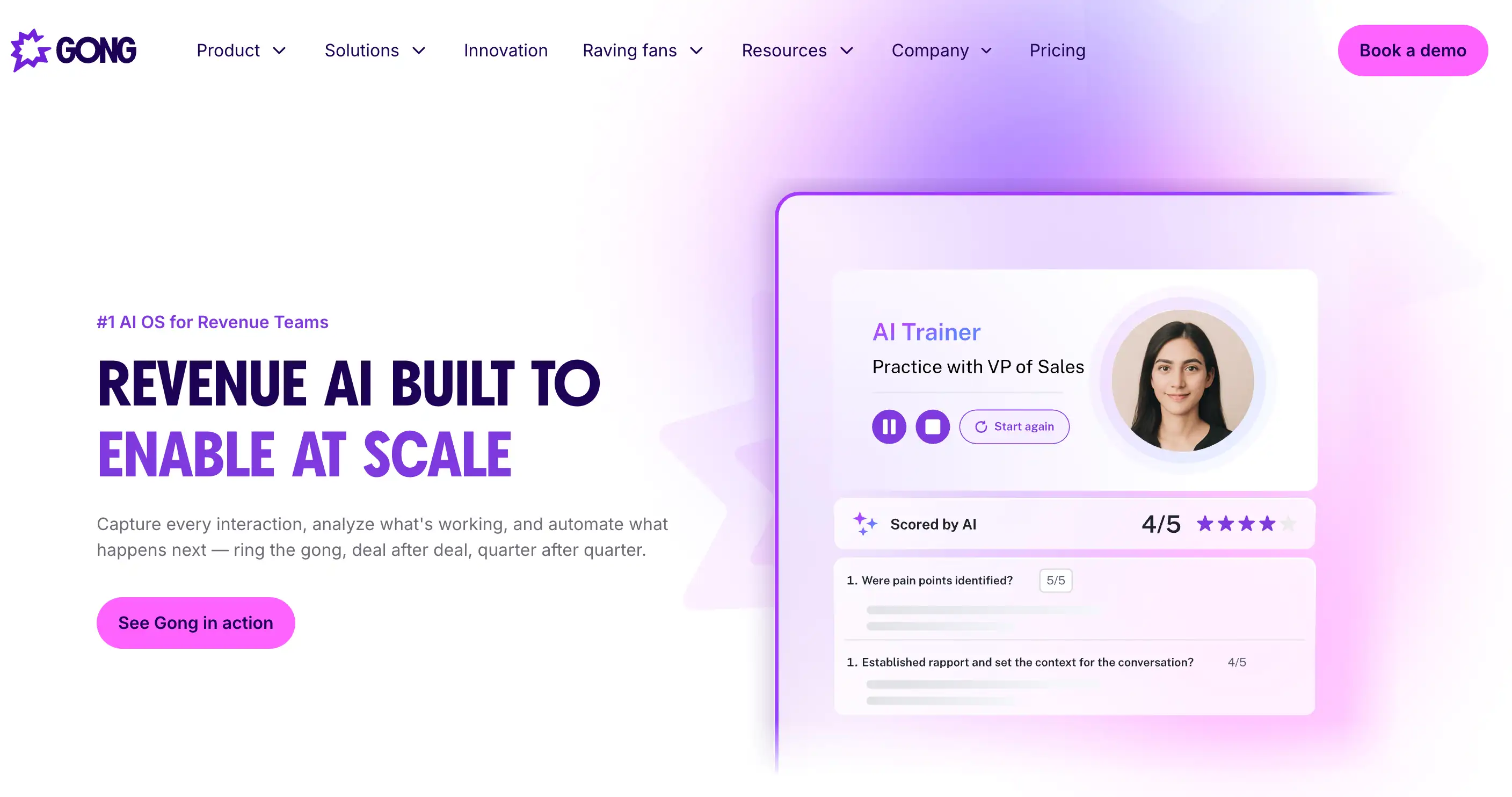
Gong holds 4.7 out of 5 across roughly 6,678 G2 reviews, and its conversation depth is still the benchmark. If your question is what buyers are actually saying across the whole team this quarter, nothing else answers it as well.
Deal intelligence is layered on top of that rather than built as the core. It shows in the bill. Gong charges a platform fee of $5,000 to $50,000 a year plus $1,300 to $1,920 per user per year before implementation, and Forecast and Engage were unbundled out of the base plan, with a usage meter added on top in 2026. Roughly 40% of teams stack Clari on Gong, pushing combined spend toward $400 to $550 per user.
Best for: 50+ rep teams with an enablement function and the budget to match.
4. Terret
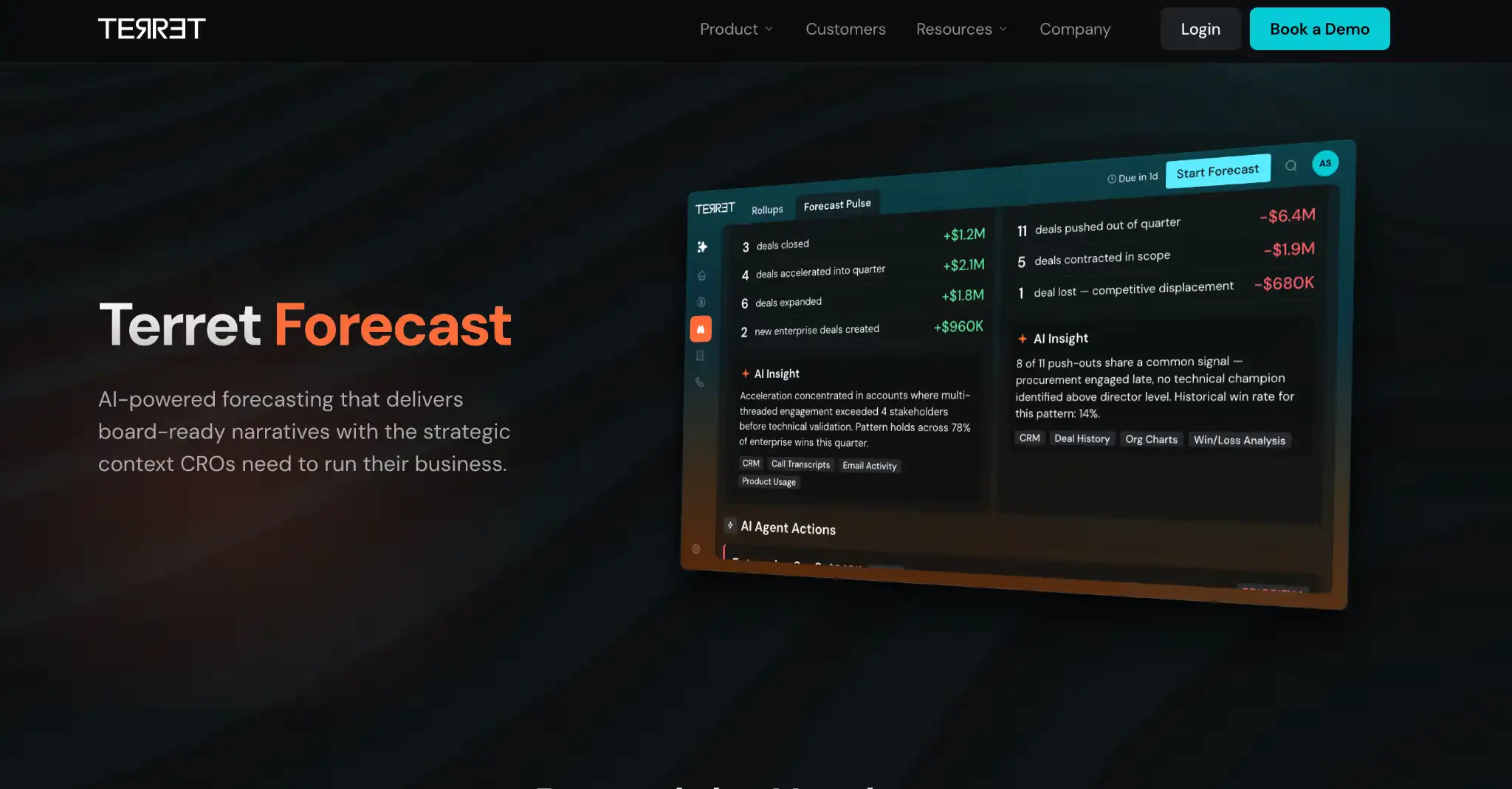
Most roundups still list this one as BoostUp. It rebranded to Terret in September 2025, moving from forecasting toward a set of connected revenue agents.
What makes it relevant here is forecast coverage. It handles SaaS, consumption, PLG, and renewal models, with deal and engagement risk scoring plus AI-guided deal inspection, which is a shorter list of vendors than you'd expect. MongoDB, Cloudflare, Carta, and Mistral are named customers.
G2 reviewers describe real forecast confidence gains alongside a learning curve, noting the breadth of features can overwhelm first-time users, the mobile experience trails the desktop one, and pricing runs high for small teams. Pricing is quote-only.
Best for: consumption and renewal-heavy revenue at mid-market scale and up.
5.backstory (formaly People.ai)
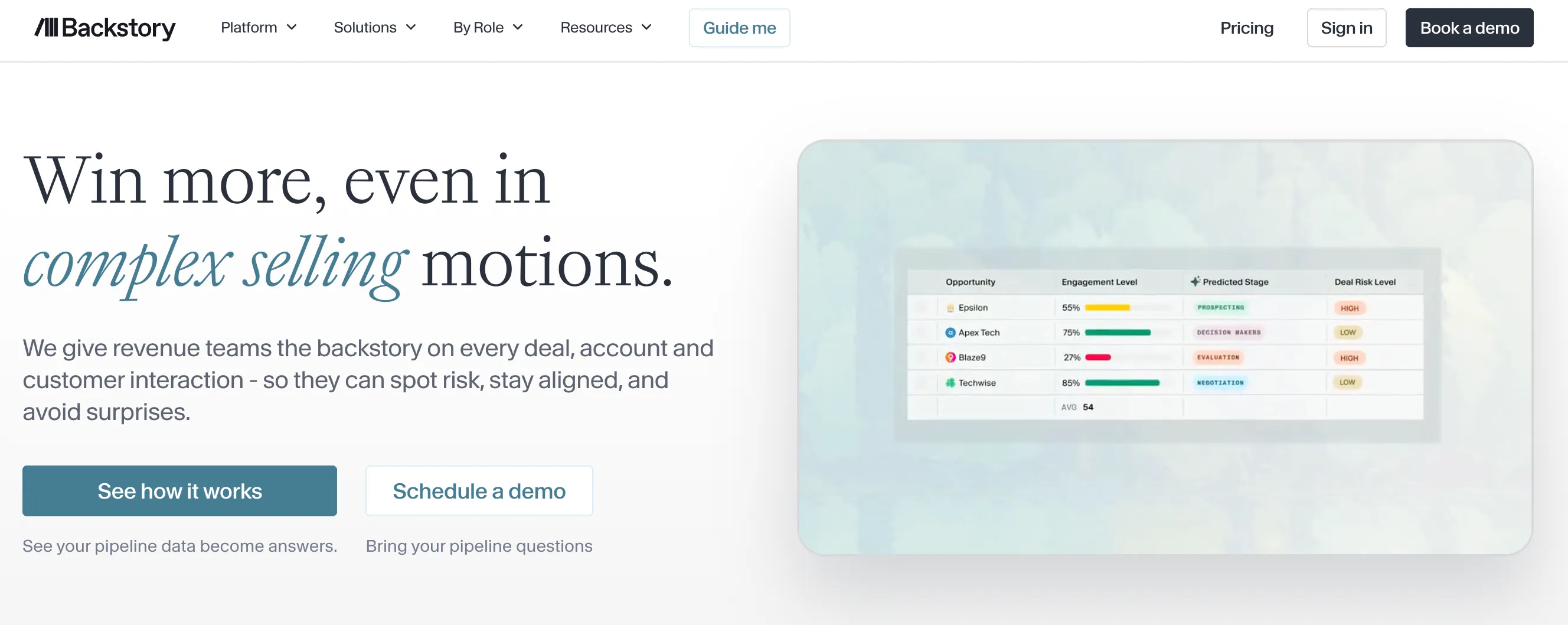
People.ai sits at 4.5 out of 5 across 629 G2 reviews, with enterprise buyers making up 54% of them. Capture is the product. It pulls activity from email, calendar, and meetings, matches it to accounts and opportunities, then scores health on that foundation.
It maps stakeholders across an account and flags where a deal has gone single-threaded, and its SalesAI assistant answers plain-language questions about deal status and risk. The 2026 move to Backstory pushed further into that layer with open APIs and MCP support.
Criticism clusters on cost and data synchronization. Entry pricing is reported around $50 per user per month, with 50-user deployments running $30,000 to $60,000 or more per year.
Best for: 50+ reps on Salesforce with admin resources to spare.
6. Scratchpad
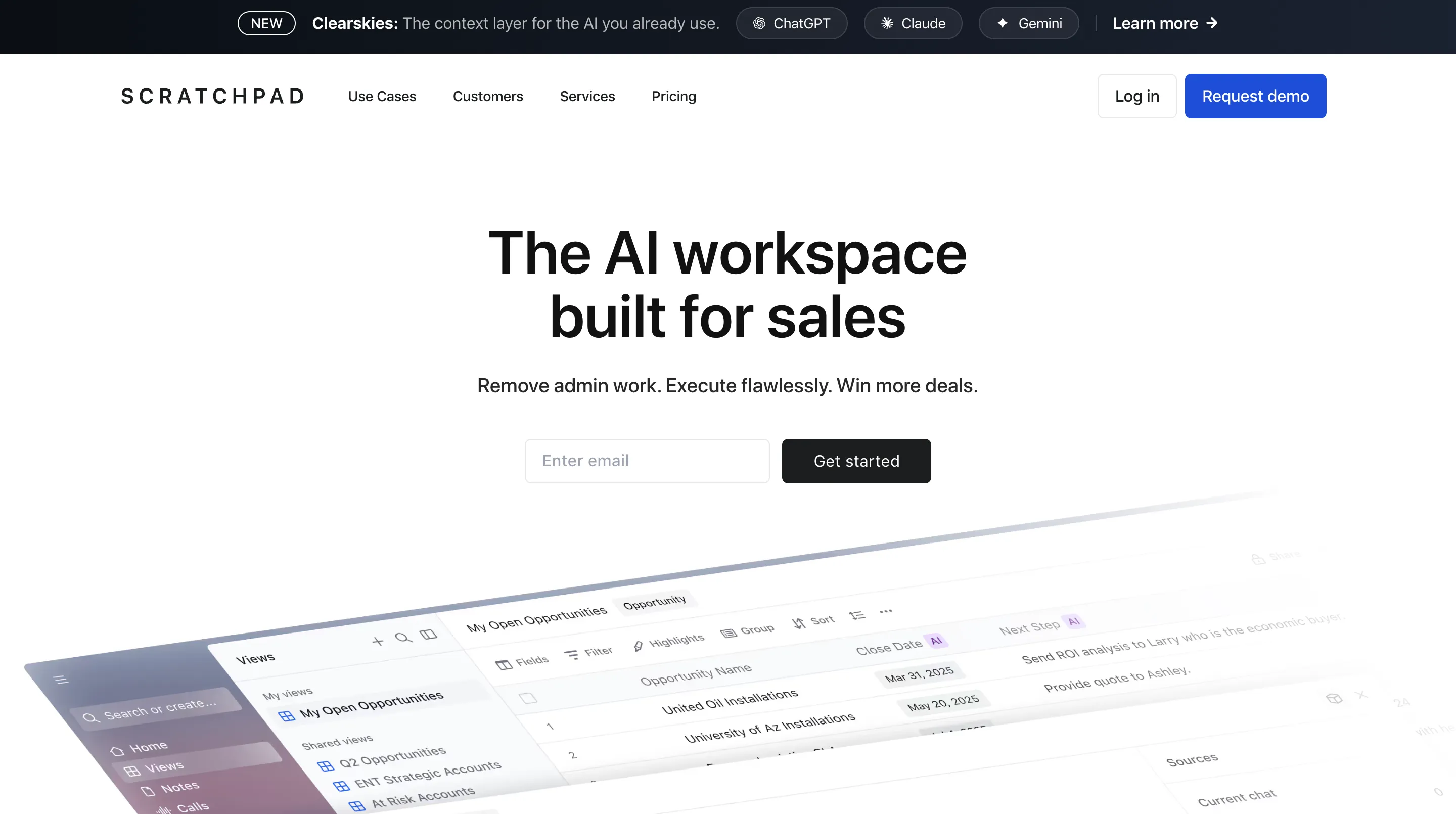
Scratchpad earns 4.8 out of 5 from more than 1,494 G2 reviews, the highest satisfaction in this group, and it earns it by getting out of the way. Reps get a spreadsheet-style layer over Salesforce, AI that fills fields from calls and notes, hygiene monitoring for managers, and Slack deal alerts.
There's a free tier, which no other platform here offers outright.
The limits are honest ones. One reviewer with a complex Salesforce instance found certain workflows, including opportunity creation, couldn't be done inside Scratchpad, and another reported that org-level license pricing didn't clear internal approval.
Best for: teams under 50 reps where the constraint is CRM hygiene rather than analysis.
7. Weflow
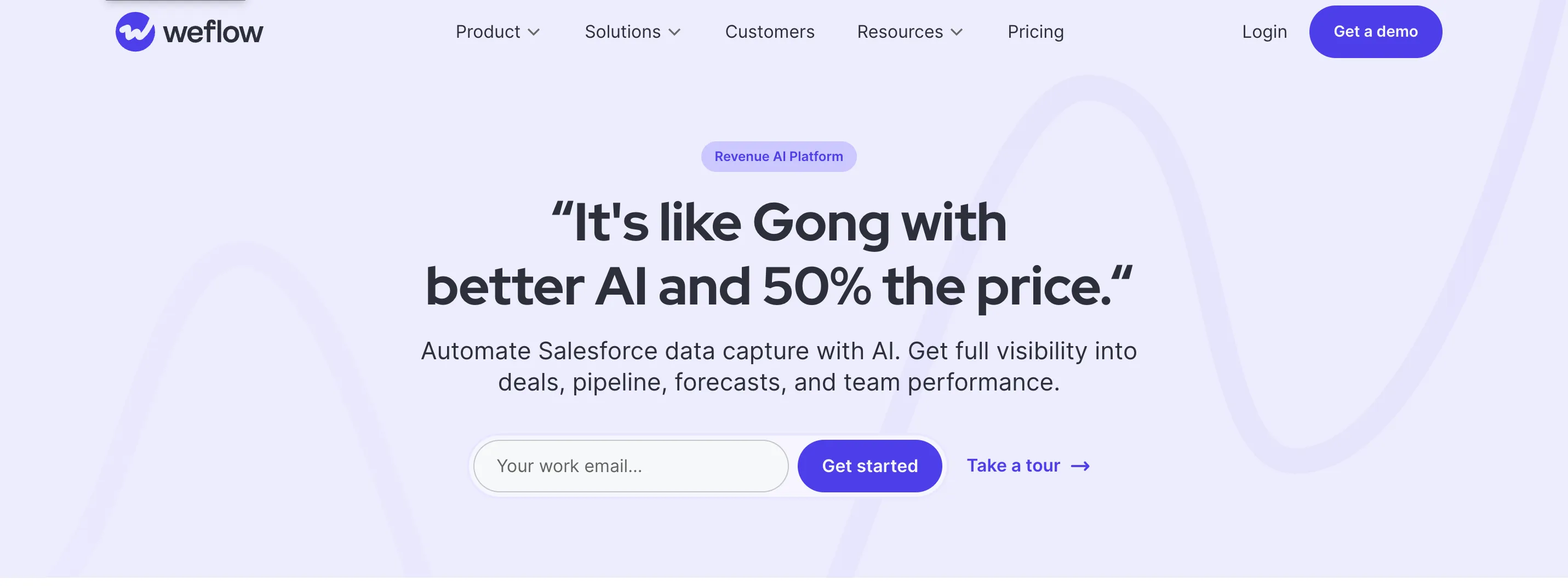
Weflow publishes its prices, which by itself puts it in a small group. Three standalone products at $19, $39, and $39 per user per month, three bundles at $49, $59, and $79, billed annually with a 10-user minimum, and unlimited view-only licenses so anyone who only reads doesn't burn a seat.
It's Salesforce-native in a specific sense. Data lands in standard Salesforce objects, it's SOC 2 Type II certified with zero data retention on AI processing, and activity capture goes live in 20 to 45 minutes with full onboarding in one to three weeks. Deal scoring runs on 50-plus signals.
Best for: Salesforce-centric teams between roughly 200 and 5,000 employees.
7 questions for the demo
Ask what percentage of email and calendar activity gets captured, and how they measure it. Ask where the data lives, in their platform or in your CRM's standard objects. Ask to see the signals behind one score on one real deal. Ask who can change the scoring logic without filing a ticket.
Ask for the platform fee, the onboarding fee, and the renewal uplift language in writing. Ask what happens to your data if you leave. And ask how deals already in flight get handled on go-live day.
What tends to break after you sign
Seats go idle. One review analysis found companies buying 110 licenses with only 50 active users, which quietly doubles the real per-user rate.
Scores inherit whatever your CRM already contains. Forecasting accuracy runs 85% to 95% on clean, milestone-based pipelines and falls to 50% to 60% on messy data. Buying the model before fixing the stage definitions puts a confidence number on the same guesswork.
And configuration drifts. Clari reviewers have reported custom views resetting after platform updates, which costs admin time nobody scoped.
Pick the platform whose center of gravity matches yours, then spend the first month on capture coverage rather than dashboards. If usage-based revenue and renewals are where your number actually lives, book a MaxIQ demo.
Every capability walked through one by one, with screenshots from real calls.
.avif)