.webp)




.svg)

I'll say the part most founders won't. Choosing usage-based pricing is the easy decision. Living with it is the hard one, and it's the part nobody prepares your revenue team for.
We run MaxIQ on a consumption model, and we build software for revenue teams who run on one too. So I get to watch this from both chairs, and the same thing happens almost every time.
A company flips the model, congratulates itself, and keeps running the exact playbook it built for contracts. Then the forecast drifts, comp gets strange, and CS hears about churn a quarter late.
Nobody traces it back to the pricing change, because the pricing change felt finished months ago.
It wasn't finished. Usage-based pricing isn't a pricing decision. It's an operating-model decision wearing a pricing decision's clothes. And it isn't optional anymore: pure per-seat pricing fell from 21% of companies to 15% in twelve months. The model already won. The operating model is the part still lagging.
Table of contents
- The shift from contracts to usage model
- Forecasting and paying reps gets harder
- There's no close and no renewal date
- Running on consumption, not contracts
The shift from contracts to usage model
Here's the shift worth drawing on a whiteboard.
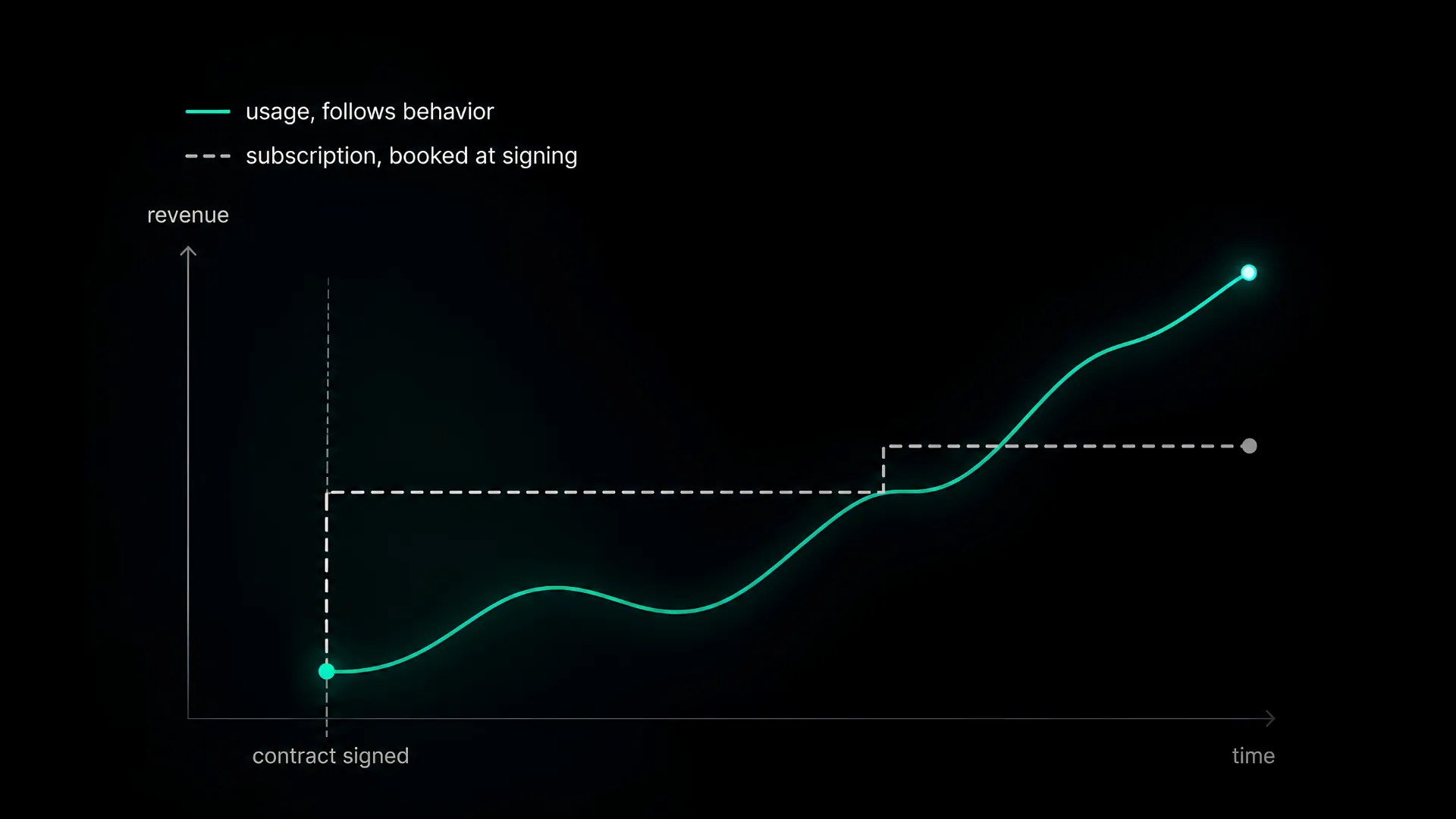
Under subscriptions, the contract was the number. You signed, you booked the ARR, and everything downstream keyed off that signature. Forecast was multiplication. Renewal sat on the calendar. Reps got paid for closing. The whole machine ran off one moment: the signature.
Usage pricing removes the event.
Now revenue doesn't show up because a contract says so. It shows up when a customer runs the query, processes the data, makes the call. You land small, and the money grows later. Expansion can happen with no sales conversation at all, because the customer simply consumes more.
That's the whole thing. Once consumption drives revenue instead of the contract, four parts of your operation come unglued: the forecast, the comp plan, the pipeline, and the renewal. Not because anyone failed. Because all four were built around a moment that no longer controls the money.
Forecasting and paying reps gets harder
Forecasting goes first, and it goes hard.
When revenue tracks behavior instead of signatures, your roll-up becomes a bet on how much customers will use. I don't say that loosely. Around 73% of usage-based companies now forecast variable revenue deliberately just to stay credible with their board, and the teams who've practiced for years still only hit 10 to 15% accuracy a quarter out. That's the best case.
You don't fix that with a tidier spreadsheet. You fix it by changing the method. Separate committed from variable. Track a run rate, not a frozen contract value. Forecast by cohort instead of multiplying MRR. And I'll be blunt about why most teams can't: the CRM holds the contract and has no idea what the customer did yesterday.
Comp cracks the same way, from the other side.
Subscriptions pay on signature. Usage makes the revenue trail the signature by months while consumption ramps. So your rep closes a real deal and the money isn't there yet. Pay early and you're guessing. Pay only on realized usage and your best closer feels punished for doing the job right.
We wrestled with this ourselves. The honest answer is that the rep's job changed. The close is the opening move now, and the best ones operate like portfolio managers who own the account long after signing.
There's no close and no renewal date
Pipeline goes next.
Closed-won used to be the finish line. Now it's the starting gun, because most of the revenue is created after the deal as usage climbs. Keep subscription-era stages and you'll celebrate the signature while the real win, the ramp, happens somewhere your funnel can't see.
Retention is the part I care about most.
The renewal date was a gift we never appreciated. It forced a decision on a known day. Usage gives you no such day. Churn stops being an event and becomes a slope. Customers don't cancel. They use less, then less, until the revenue from that account has halved and not one cancellation ever reached you.
So usage decline is your early warning, and churn is just the autopsy. CS can't wait for a renewal call. The job moves from managing renewals to driving adoption, and health has to be measured in real consumption, not a survey score and a date.
I want to be fair about the upside, because it's the reason we all do this. Consumption models retain better, since expansion is built in rather than sold. Snowflake held net revenue retention near 127% for years on this exact motion. The growth compounds on its own. The catch is that the shrinkage compounds on its own too, silently, and you tend to notice only once it's already in the number.
Running on consumption, not contracts
So what does a team that has adjusted look like? I'll tell you what we learned building toward it.
It runs on one view of consumption, not four.
Today most teams hand-stitch it, finance pulls billing, product pulls usage, CS keeps a side spreadsheet, and the CRM sits in the middle describing none of it. That fragmentation is the whole problem.
It's why the forecast is a guess, the comp plan argues with itself, and churn arrives as a surprise.
The teams who win give sales, RevOps, CS, and finance the same live usage data, and then they show it to the customer too. That last part matters more than it looks. 78% of IT leaders ate a surprise charge from consumption or AI features last year. A shock invoice is a churn event on a timer. Visibility on both sides isn't a nice-to-have. It's retention.
That's the gap we set out to close at MaxIQ. Read consumption across the whole lifecycle, pipeline to renewal, instead of bolting a CRM onto a billing system and hoping the two agree at quarter-end.
And it gets steeper from here.
Outcome-based pricing is already arriving, where customers pay per result instead of per use. Intercom charges 99 cents a resolved conversation, and HubSpot moved to 50 cents in April 2026. Now you're forecasting outcomes, not just usage. Same problem, one level deeper.
I'll leave you with what I actually believe.
The pricing model changed years ago. The operating model is the work that's left. The teams that win the next few years won't be the ones with the cleverest pricing page. They'll be the ones who stopped managing contracts and started managing consumption, in real time, across the entire revenue org.
We're building for that world because we're already living in it.
Every capability walked through one by one, with screenshots from real calls.
.avif)


.webp)