.webp)




.svg)

Key Takeaways (TL;DR)
Revenue orchestration platforms solve different problems, so the right choice depends on where your revenue process is breaking.
- MaxIQ: Best for pipeline, forecasting, conversations, and renewals in one system.
- Clari + Salesloft: Best for enterprise forecast management.
- Gong: Best for conversation intelligence.
- Outreach: Best for outbound sales execution.
- Aviso: Best for complex revenue models.
- Terret: Best for simpler, lower-cost forecasting.
The revenue orchestration market rearranged itself at the end of 2025. Clari and Salesloft merged into one company on December 3. BoostUp changed its name to Terret. Twelve days after the merger closed, Gartner published its first Magic Quadrant for the category. A lot of vendor research from before that stretch is now wrong in ways that matter during a negotiation.
One thing to clear up before the list. Forrester calls this category revenue orchestration platforms (ROP). Gartner calls it revenue action orchestration (RAO). Same market, two names. Vendors quote whichever report ranked them higher.
The best revenue orchestration platforms
- MaxIQ for revenue intelligence from pipeline to renewal
- Clari + Salesloft for enterprise forecasting
- Gong for conversation intelligence
- Outreach for outbound
- Aviso for predictive forecasting on complex revenue models
- Terret for mid-market forecasting on a smaller budget
What actually separates these platforms
Every vendor here says the same three things: we connect your signals, we guide your reps, we unify your stack. The pitch tells you nothing. These questions do.
Where does the product stop? Forrester's definition of the category includes renewals and expansion. Almost no product does. In a demo, ask to see a renewal 120 days out with the same depth as a mid-stage deal. The screen share gets quiet fast.
Was it built or assembled? A few of these platforms got to broad coverage by buying companies. Nothing wrong with that, but you inherit the seams. Ask which modules share one data model today. Not on the roadmap. Today.
Can it explain the forecast, or just total it? Adding up pipeline is arithmetic. The useful question is why the number moved since last week and which deals moved it.
What's the real price? Nobody publishes list pricing. The per-seat quote is one of three or four line items. Platform fees and implementation routinely add 40 to 60 percent to year one.
Can your own AI reach the data? New question, and it matters now. Gartner expects 40 percent of enterprise apps to ship with task-specific AI agents by the end of 2026, up from under 5 percent in 2025. If your revenue data only talks to the vendor's own assistant, that's a wall you'll hit soon.
Comparison at a glance
1. MaxIQ
Best for revenue intelligence from pipeline to renewal
Pros:
- Pipeline, forecasting, calls, and renewals run on one data model
- Renewal risk uses the same signals as deal risk, because it's the same system
- Your own AI can query the data directly through MCP
Cons:
- Smaller company than Clari, Gong, or Outreach. Smaller ecosystem, fewer people who already know the tool
- Not built for heavy outbound. SDR teams will still want a sequencing tool
- Fewer public enterprise logos than the incumbents
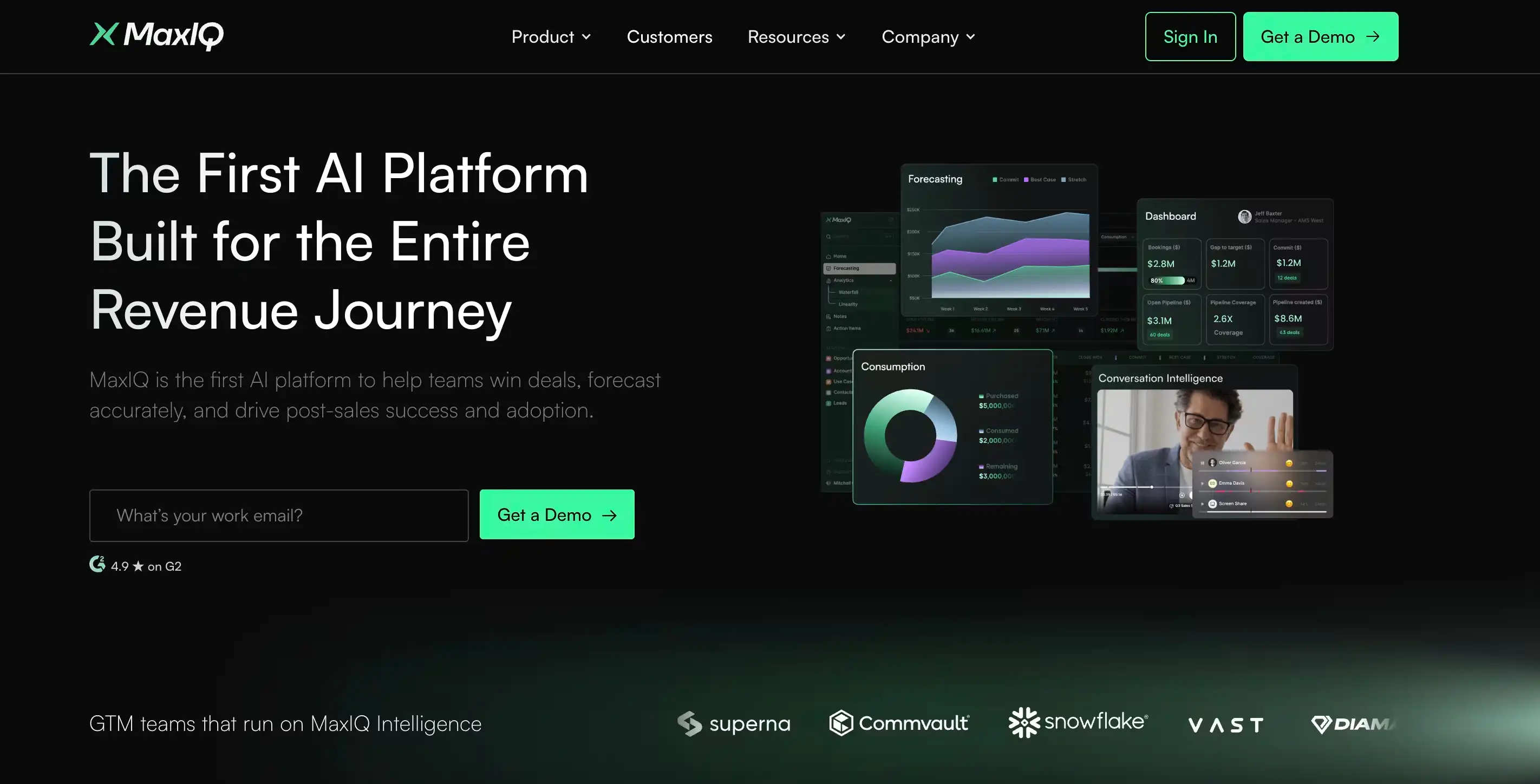
MaxIQ is an AI revenue intelligence platform. Deal inspection, forecasting, and conversation intelligence in one product, which in most stacks means it replaces a Gong seat and a Clari seat at the same time. The difference is that it doesn't stop at closed-won.
That matters because of where growth moved. Expansion went from about 25 percent of new ARR in 2022 to 40 percent in 2024, and above $50M ARR it's roughly 58 to 67 percent. Median NRR for private B2B SaaS sat around 101 percent in 2024. Most of the revenue now happens after the close, in the part of the pipeline these tools don't watch.
Four modules, one data model. InspectIQ for pipeline and deal health. ForecastIQ for submissions and rollups. EchoIQ for calls. SuccessIQ for onboarding, renewals, and expansion. When product usage drops in an account, that feeds renewal risk the same way a stalled stakeholder feeds deal risk. No integration, no sync job.
The proof point: Snowflake improved forecast accuracy by more than 25 percent after moving to MaxIQ. Commvault, VAST Data, Superna, Oxide, and Diamanti also run on it. 4.9 on G2, backed by Dell Technologies Capital and Intel Capital.
One capability nobody else on this list has: MaxIQ exposes revenue data through MCP. Claude, or whatever model your team runs, can query live pipeline directly instead of going through a vendor assistant. Ask every vendor below the same question and note the answers.
The honest tradeoff is scale. If your checklist weights analyst placement and a deep partner bench, the three companies below win that today.
MaxIQ pricing: Published tiers. No sales call needed to see a number.
2. Clari + Salesloft
Best for enterprise forecast governance
Pros:
- The most mature forecast rollup and inspection workflow in the category
- Deep Salesforce integration, and RevOps people who know Clari are easy to hire
- Salesloft's cadence engine is genuinely good
Cons:
- The combined company now owns two conversation intelligence products and two engagement products
- Reps use it because leadership says so, not because it helps them personally
- The joint roadmap is still being written
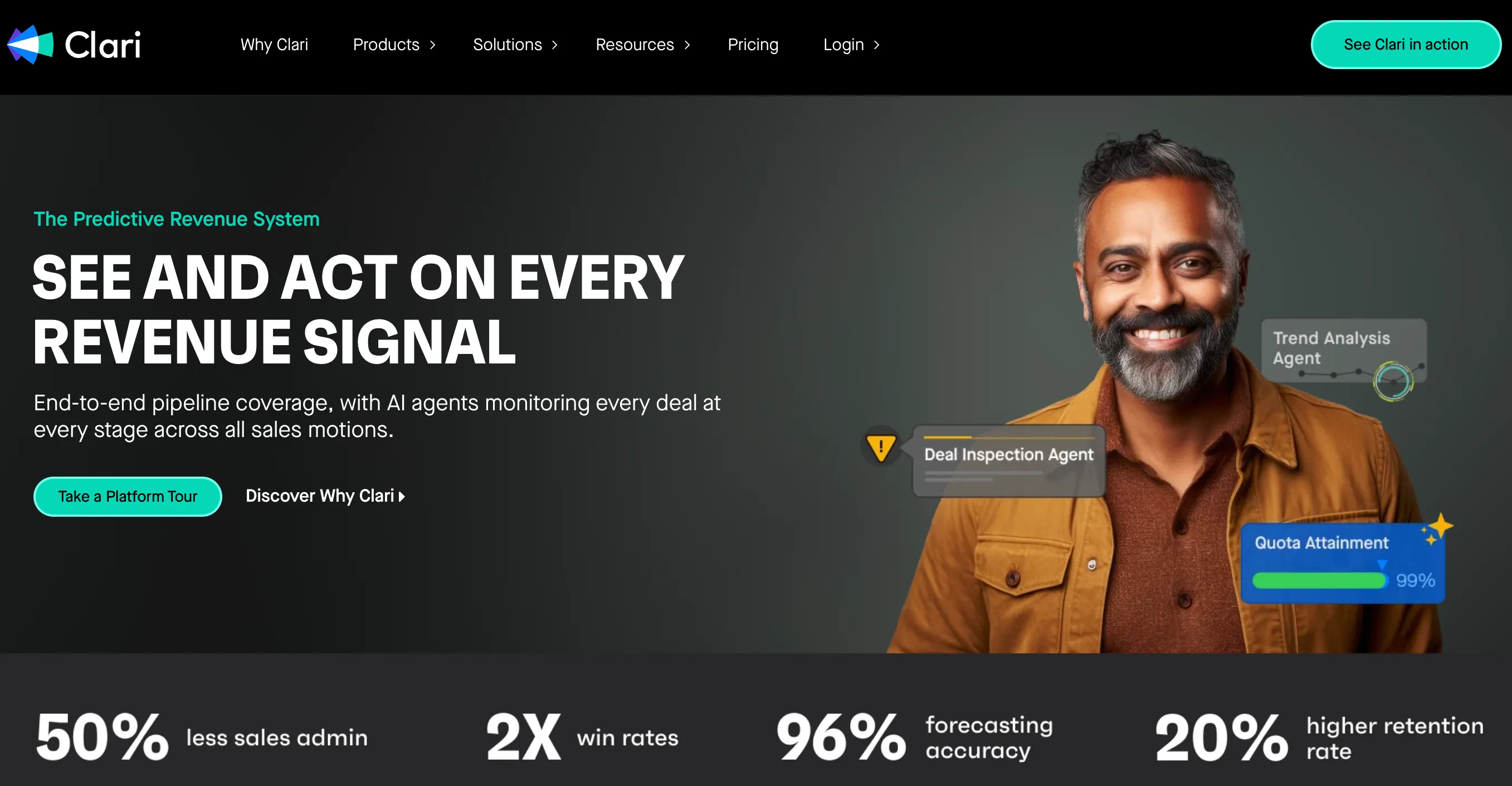
If your forecast call is where the trust broke, Clari is still the first evaluation to book. Commit, upside, risk, week-over-week snapshots, and inspection views that go from a regional rollup down to the one deal dragging it. Nobody does that part better.
But know what you're buying. The merger closed December 3, 2025, Steve Cox took over as CEO, and the combined company reports over 5,000 customers and about $450M in ARR. The first real joint release, Clari's forecasting inside Salesloft's execution layer, shipped in April 2026. Everything else is roadmap.
And the overlap is not small. Clari bought Wingman in 2022 for conversation intelligence and Groove in 2023 for engagement. Salesloft brought both of those capabilities again. Forrester's own analysts wrote that the deal doesn't close the gap to Gong on conversation intelligence and produces no major new AI capability. That's the firm that named Clari a Leader, hedging in public.
Gartner's timing was stranger: its first RAO Magic Quadrant named Clari a Leader and Salesloft a Visionary, as two separate vendors, twelve days after they legally became one.
If you're renewing soon, get pricing in writing. Bundled pricing has moved up for new deals and renewals since the merger.
Clari + Salesloft pricing: Contact sales. Buyers report $144 to $1,080 per user per year by tier, plus platform fees, with minimum contracts often quoted at $40K to $75K.
3. Gong
Best for conversation intelligence
Pros:
- Call capture, transcription, and search are the standard everyone else gets measured against
- Smart trackers catch intent, not just keywords, so "this is getting expensive" registers as a budget objection
- Reps actually like it, which is rare in this category
Cons:
- The most expensive stack on this list once the platform fee lands
- Engage, the sequencing module, gets consistently rough reviews
- Forecasting is the weak spot
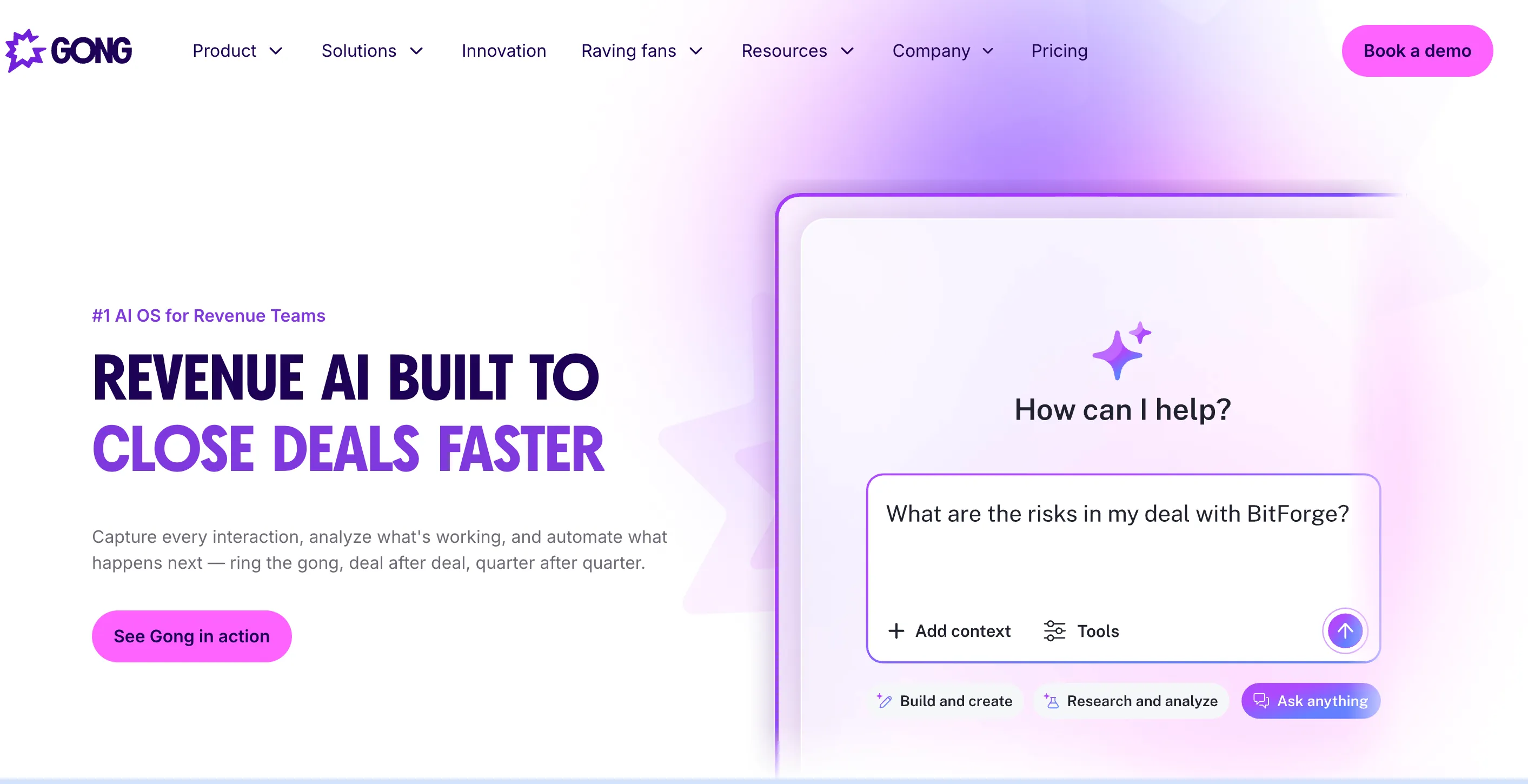
Gong owns one thing completely: knowing what actually happened in a sales conversation, at scale, searchably. 4.7 on G2 across more than 6,500 reviews. In Gartner's first RAO Magic Quadrant it placed highest on Ability to Execute and furthest on Completeness of Vision out of 12 vendors.
If your deals die in conversations and nobody finds out until the CRM says closed-lost, this is your tool. Which objections are rising this quarter, which competitor keeps showing up in late-stage calls, whether discovery is actually happening. Gong answers those.
The expansion beyond calls is where it thins out. Engage is the most criticized module in the lineup, and several analyses report that a real share of mid-market customers add a separate forecasting tool on top. Verify that on your own reference calls, but ask about it.
Now the money, because this is where budgets die. Gong unbundled its pricing in March 2025. Buyers report Foundation at roughly $1,298 to $1,426 per user per year, and the bundle with Engage and Forecast at $2,880 to $3,000. Then a platform fee on top: about $5K for small teams, up to $50K or more at enterprise scale. Then implementation. Reported effective per-user cost rose 25 to 56 percent between 2023 and 2026.
Stack Gong with a separate forecasting tool for a 200-rep team and reported combined costs land around $450 to $500 per user per month. Bring that number to your consolidation conversation.
Gong pricing: Contact sales. Reported $1,298 to $3,000 per user per year by module, plus the $5K to $50K platform fee, plus implementation from about $7,500.
4. Outreach
Best for outbound
Pros:
- The deepest cadence and sequencing engine here
- A Leader in both the Forrester Wave (Q3 2024) and Gartner's RAO Magic Quadrant (2025)
- Strong enterprise data integrations: Salesforce, Snowflake, Databricks
Cons:
- Forecasting and deal inspection trail Clari
- Zero post-sale coverage
- Needs real ops support to run well
Outreach started in sales engagement and has spent years arguing it grew into something bigger. The analysts mostly agree. Forrester gave it top scores in prospecting workflows, buyer collaboration, opportunity management, and account planning.
If pipeline creation is your bottleneck, this is the right shape of product. Chained, automated, multi-user sequences that advance prospects based on what they do. Built for volume in a way forecasting-first platforms simply aren't.
The flip side is the same as every engagement-led platform. If the problem is that the number is wrong rather than that the pipeline is thin, you're buying the second-best tool for your problem. And there's no post-sale layer at all, so renewals live somewhere else entirely.
Outreach pricing: Contact sales.
5. Aviso
Best for predictive forecasting on complex revenue models
Pros:
- The deepest predictive math here: scenarios, what-ifs, multi-quarter time series
- Handles consumption and hybrid revenue models better than seat-based tools
- Broader surface than its reputation suggests, including CS intelligence
Cons:
- Reviewers report bugs, slow performance, and dashboards that reset themselves
- Separate login from Salesforce, which reps feel every single day
- Smaller ecosystem than Clari or Gong
Aviso is the pick when forecast accuracy is the entire problem and your revenue model is weird. Consumption pricing, multi-CRM, hybrid subscription plus usage. It was built around predictive modeling rather than calls or cadences, and that focus shows in the scenario tooling.
The recurring complaint is polish, not capability. Performance issues, settings that don't stick, deal scores whose reasoning you can't inspect. And the separate login sounds minor until you remember that anything outside the daily workflow gets used less every week.
Right buyer: a RevOps team with patience to configure it and a leadership team that will actually use the what-if modeling.
Aviso pricing: Contact sales. Annual or multi-year contracts, onboarding usually included.
6. Terret (formerly BoostUp)
Best for mid-market forecasting on a smaller budget
Pros:
- Automatic pipeline snapshots that show what moved the forecast and why
- Faster and cheaper to deploy than anything above it on this list
- Deal scoring without full-platform complexity
Cons:
- The rebrand is recent, so half your research will surface the old name
- Narrow product surface
- Fewer reference customers to call
Quick housekeeping: BoostUp became Terret in September 2025. Brief your team before they research, or half of them come back with material on a company that doesn't exist anymore.
The product itself does one thing well. It snapshots your pipeline automatically and tracks how the forecast changes through the quarter, comparing what reps submit against history and engagement. For a mid-market team that wants to answer "why did the number move" without an enterprise rollout, that's most of the value of a much bigger platform.
The tradeoff is everything else. No engagement, no post-sale, limited coaching. You'll add tools around it.
Terret pricing: Contact sales.
Which one should you pick?
Match the tool to the problem currently costing you money.
Forecast trust is broken: Clari + Salesloft, evaluated on what ships today. Deals die in conversations: Gong, with the platform fee in the budget from day one. Pipeline is thin: Outreach. Revenue leaks after the close: MaxIQ, and hold us to the demo test above. Weird revenue model: Aviso. Forecast discipline on a real budget: Terret.
And whichever direction you go, ask the AI question. Can a model we control query this data directly, or only through your assistant? Two years from now, that answer decides how much of your own revenue data you can actually use.
If you want to see MaxIQ against your own deals, book a demo and run it on real pipeline and real renewals.
Every capability walked through one by one, with screenshots from real calls.
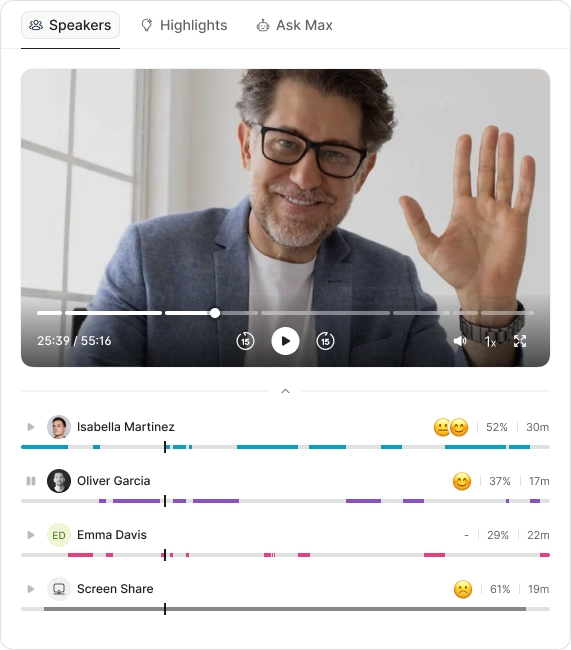
- Call summaries
- Sentiment analysis
- Next steps
- Search any call in seconds
.avif)