Key Takeaways (TL;DR)
AI sales forecasting predicts your quarter from what each deal is actually doing, not just the stage it’s in.
- What it reads: close date changes, time in stage, next steps, and what buyers say on calls.
- Forecast calls: start with deals where the signals and the stage disagree.
- Before you start: you need a history of closed deals and stage definitions everyone uses the same way.
- Accuracy: AI forecasts land 8–15% off actuals, compared with 18–25% for stage-based ones.
- Renewals: forecast new business, renewals, and expansion in one rollup.
AI sales forecasting predicts where your quarter will land from the activity inside each deal, instead of from the stage the deal is sitting in.
The standard forecast runs on stage probabilities. A deal in Negotiation counts at, say, 60%. A deal in Discovery counts at 10%. You add it all up.
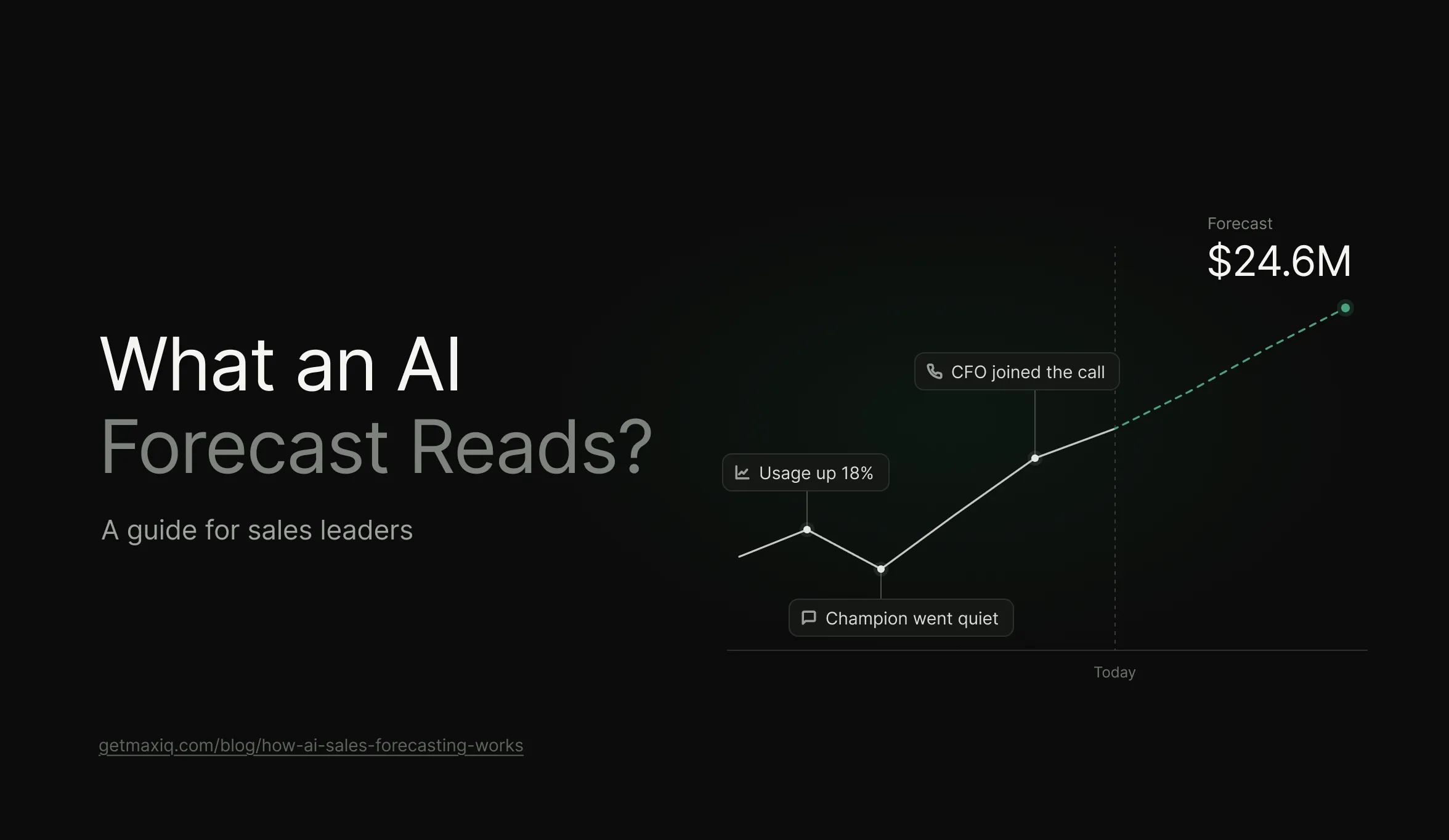
An AI forecast still uses your CRM. It just weighs what the deal has actually been doing: close date changes, time in stage, next steps, and what buyers say on calls.
Below is how that works in practice, what it changes in your forecast call, and what you need in place before it's worth turning on.
What an AI forecast actually reads
Four signals do most of the work:
- Close date changes. How many times the date has moved, and how recently.
- Time in stage. How long the deal has sat without progressing.
- Next steps. Whether there's a dated, owned next step or just an old note.
- What buyers said. Pricing objections and new stakeholders, pulled from call recordings. (Here's what a forecast built on that looks like.)
Reps don't have to enter anything new. All of it comes from CRM history and calls.
Here's what that looks like on one deal. In the demo workspace we use for walkthroughs, the biggest deal in the forecast is $3.9M, sitting in Proposal/Price Quote. By stage alone, you'd commit it.
Its history says otherwise. The close date has been pushed 7 times in 90 days, and the deal hasn't changed stage in three months. That's exactly the kind of deal a signal-based forecast flags, while stage math keeps counting it at full weight.
How it changes the forecast call
The manager still makes the call and still owns Commit. What changes is the order you go through deals.
Start with the deals where the signals and the stage disagree. That's where the forecast is most likely wrong, and where a conversation can actually move the number.
In practice, that usually means two things:
- Pulling flagged late-stage deals out of Commit, or asking for a real next step before keeping them in.
- Moving up deals that are progressing faster than their stage shows.
You spend less of the call walking through deals that are fine, and the manager leaves with reasons they can repeat to the CRO.
What you need before it's useful
Two things matter more than which tool you pick:
- A history of closed deals. The model learns from what you've already won and lost.
- Stage definitions everyone uses the same way. If Stage 3 means something different on every team, no model will fix that.
With those in place, the accuracy difference is real. Optifai's benchmark puts rep roll-ups (adding up what each rep commits) at 25 to 35% off actuals, and stage-weighted forecasts at 18 to 25%. AI-assisted forecasts land at 8 to 15%.
On a $10M quarter, that's roughly a $2M miss versus a $1M one.
Forecast renewals in the same rollup
Many teams forecast new business in the CRM and renewals somewhere else, often a customer success spreadsheet. So the CRO ends up reading two forecasts built two different ways.
The same signal approach works after the sale. For a renewal, product usage and how recent calls went tell you more than the renewal date does. If you sell on usage, that goes double (more on what usage-based pricing changes for revenue teams).
My recommendation: forecast Net New, Renewals and Expansion in one rollup, each with its own Commit, Most Likely and Stretch. Each revenue type stays separately accountable, and nobody has to merge two forecasts the night before the board meeting.
How we do this in ForecastIQ
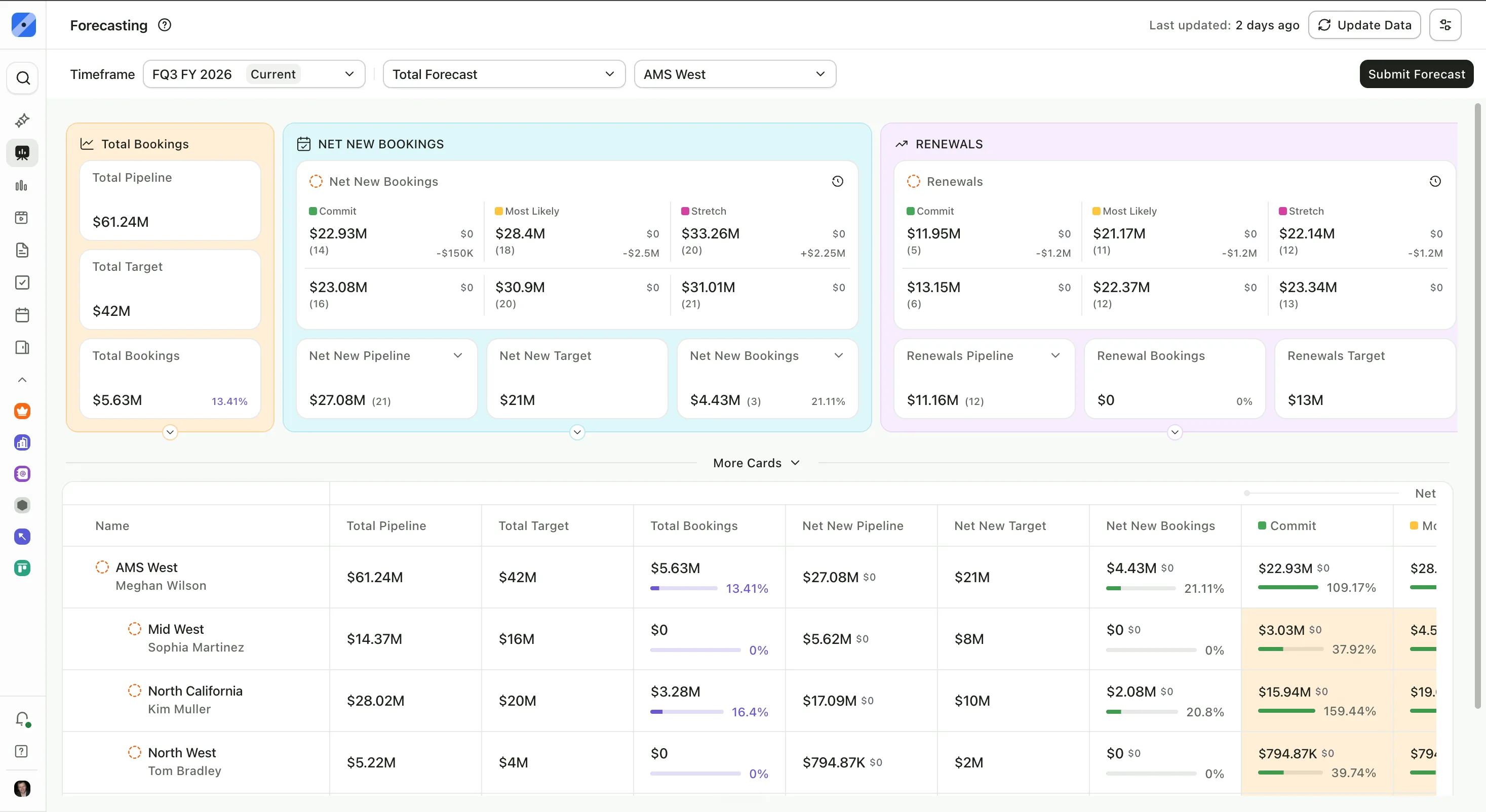
ForecastIQ is MaxIQ's forecasting product. Here's how it handles each piece:
- Deal flags. Every deal in the forecast shows a flag count, sorted into Critical, Attention and On Track. That $3.9M demo deal has nine.
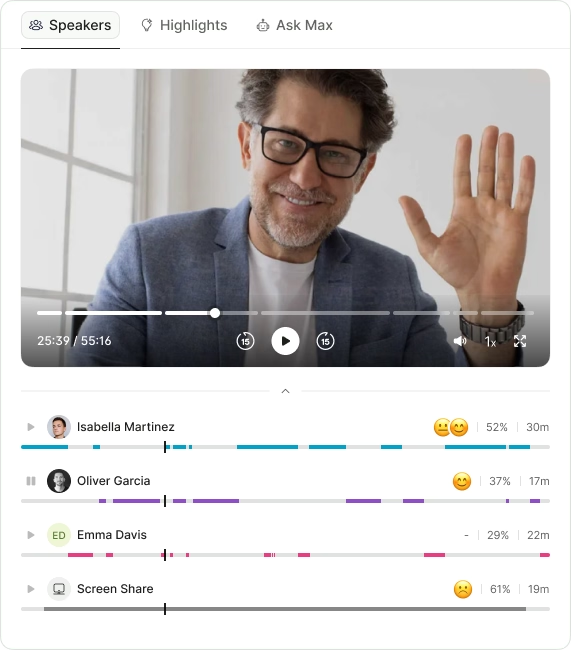
- Call insights. EchoIQ feeds what buyers say on calls into the same deals.
- One rollup. Net New, Renewals and Expansion sit side by side against target.
- Salesforce. It runs on the Salesforce data your team already keeps.
VAST Data's president says the team improved forecast accuracy by 15% with MaxIQ.
Every capability walked through one by one, with screenshots from real calls.
- Call summaries
- Sentiment analysis
- Next steps
- Search any call in seconds