


Key Takeaways (TL;DR)
B2B selling is harder in 2026. Buyers avoid sales reps, fewer reps hit quota, and forecasts keep missing because CRM data can’t be trusted.
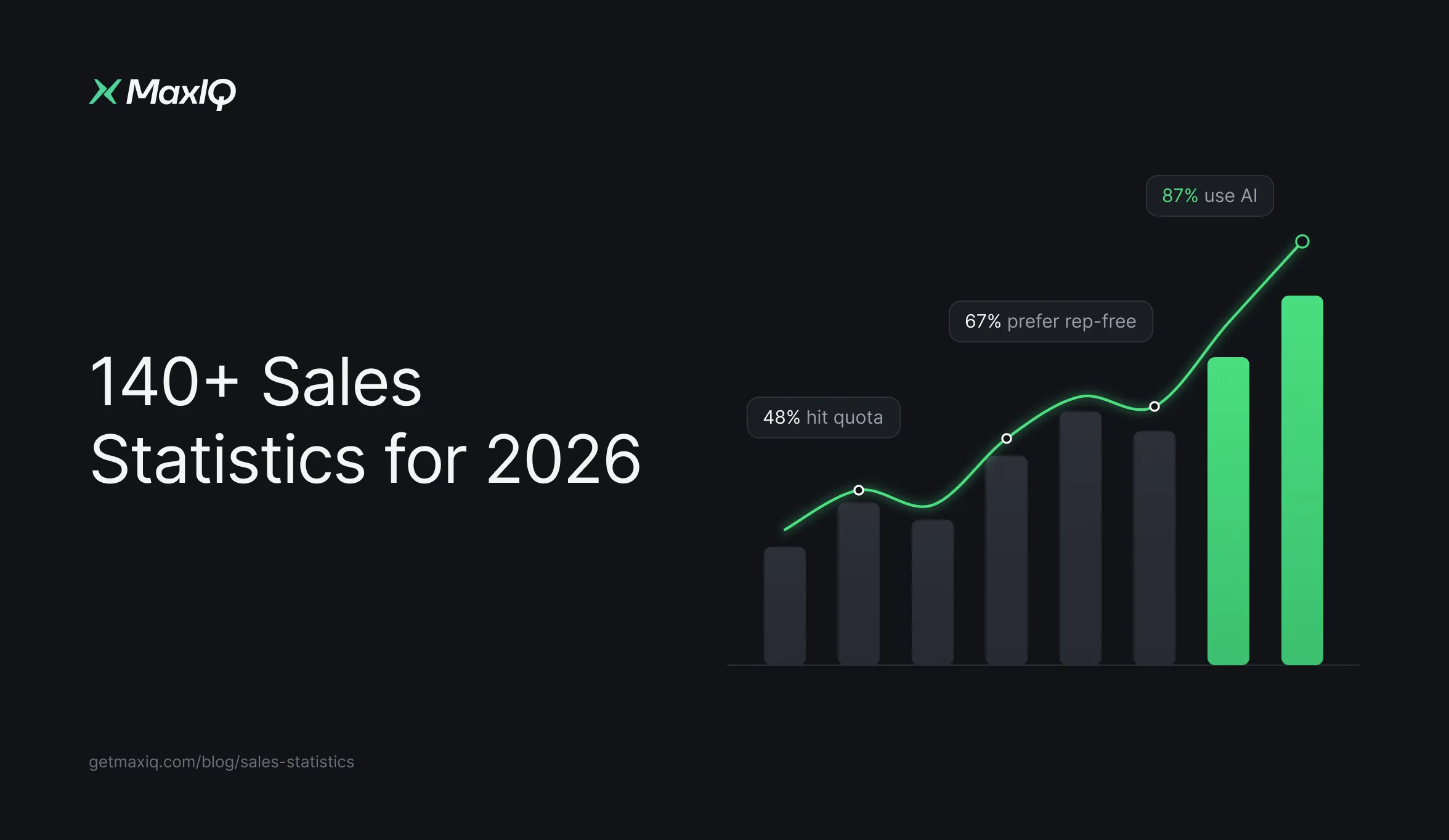
- Buyers: 67% prefer to buy without a sales rep (Gartner, 2026).
- Quota: only 48% of account executives hit quota (The Bridge Group, 2026).
- Forecasts: 4 in 5 sales leaders missed a quarterly forecast in the past year (Xactly).
- CRM data: 76% of CRM users say most of their data is inaccurate or incomplete (Validity).
- AI: 87% of sales teams use AI, but most don’t turn the time it saves into more selling (Salesforce; Gartner).
This page collects 140+ sales statistics for 2026 on B2B and enterprise selling, from buyer behavior and quota attainment to forecasting, CRM data, AI adoption and retention.
Two-thirds of buyers would rather skip the sales rep entirely, fewer than half of account executives hit quota, four in five sales and finance leaders have missed a quarterly forecast within a single year, and 87% of sales organizations now use AI in some form.
Each figure comes from published research by Gartner, Forrester, Salesforce, The Bridge Group, Ebsta and Pavilion, RepVue, 6sense, SaaS Capital, Aleph and Benchmarkit, Validity, Xactly, Clari Labs or Gong, and we checked it against its original source. Each number links to that source and shows when it was published.
Below, the statistics are grouped by topic, followed by what the numbers mean for revenue teams and how we sourced them.
Key takeaways
- 67% of B2B buyers prefer a rep-free buying experience, up from 61% a year earlier (Gartner, March 2026)
- 48% of account executives hit quota in 2026, down from 51% in 2024 (The Bridge Group, June 2026)
- 4 in 5 sales and finance leaders missed a quarterly forecast in the past year (Xactly, July 2024)
- The average seller spends 40% of their time actually selling (Salesforce, February 2026)
- 76% of CRM users say less than half of their CRM data is accurate and complete (Validity, July 2025)
- AI saves sellers 4.8 hours a week, but 72% of sales organizations don't reinvest that time in high-value selling (Gartner, May 2026)
- Median B2B SaaS gross revenue retention fell from 88% to 84% in 2025 (Aleph and Benchmarkit, June 2026)
Sales quota attainment and win rate statistics
Ebsta and Pavilion's 2025 GTM Benchmarks analyzed 655,000 B2B opportunities worth $48 billion across 387 companies, plus a survey of more than 2,000 revenue leaders. RepVue's Cloud Sales Index aggregates ratings from roughly 47,000 to 50,000 quota-carrying sellers at about 250 software companies.
- 78% of sellers missed quota in 2024, up from 69% the year before (Ebsta and Pavilion, March 2025)
- Just 14% of sellers generated 80% of new revenue in 2024, the widest gap between top sellers and the rest that Ebsta has recorded (Ebsta and Pavilion, March 2025)
- Top performers generated 11x more revenue per day than low performers in 2024, up from 8.9x a year earlier (Ebsta and Pavilion, March 2025)
- The average new-logo win rate was 19% in 2024, compared with 45% for expansion deals (Ebsta and Pavilion, March 2025)
- Top performers' win rates were 43% higher than other sellers' in 2024, and their average contract values were 76% higher (Ebsta and Pavilion, March 2025)
- 52% of new revenue came from existing accounts in 2024, as more companies moved sellers to a full-cycle model (Ebsta and Pavilion, March 2025)
- Quota attainment across RepVue's Cloud Sales Index was 43.24% in Q3 2025, the highest level since Q2 2023 (RepVue, Q3 2025)
- Quota attainment stayed in the low 40s for eight straight quarters through Q4 2024, down from 53% in Q1 2022 (RepVue, Q4 2024)
- In Q2 2025, sellers with average deal sizes above $100K beat the index average on quota attainment, while sellers below $100K fell short of it (RepVue, Q2 2025)
When fewer than half of reps hit quota, comp plans get questioned too. See this guide to value-driven sales compensation.
B2B buyer behavior statistics
Gartner's buyer data comes from surveys of about 630 to 650 B2B buyers each year. 6sense's 2025 Buyer Experience Report surveyed nearly 4,000 buyers across North America, EMEA and APAC.
- 67% of B2B buyers prefer a rep-free buying experience, based on a survey of 646 buyers in August and September 2025 (Gartner, March 2026)
- One year earlier, 61% of B2B buyers said they preferred a rep-free experience, in a survey of 632 buyers (Gartner, June 2025)
- 70% of B2B buyers prefer a completely digital, self-service buying experience (Gartner, May 2026)
- 45% of B2B buyers used generative AI during a recent purchase, mainly to gather information on vendors and products (Gartner, May 2026)
- 69% of B2B buyers prefer to validate AI-generated insights with a sales rep (Gartner, May 2026)
- B2B buyers used an average of seven information sources during a recent purchase (Gartner, May 2026)
- 51% of buyers say they are more likely to get misleading information from generative AI, while 49% say the same about sales reps (Gartner, May 2026)
- Buyers were 39 percentage points more likely to say a sales rep understood their needs than to say the same of generative AI (Gartner, May 2026)
- Buying groups with low dysfunction were 13x more likely to report a high-quality deal (Gartner, May 2026)
- 73% of B2B buyers actively avoid suppliers that send irrelevant outreach (Gartner, June 2025)
- 69% of B2B buyers report inconsistencies between what a supplier's website says and what its sellers tell them (Gartner, June 2025)
- The split between independent research and seller engagement in the B2B buying journey moved from 70/30 to 60/40 in 2025 (6sense, November 2025)
- 94% of buying groups ranked their preferred vendors before first contact with a seller in 2025 (6sense, November 2025)
- Buyers ultimately purchased from their pre-contact favorite 77% of the time in 2025 (6sense, November 2025)
- 89% of B2B purchases included AI features in 2025, and 58% of buyers engaged sellers earlier to fill in missing AI details (6sense, November 2025)
- 94% of buyers used LLMs to summarize reviews or analyze data, yet they still averaged 16 interactions per person with the vendor they chose (6sense, November 2025)
- 70% of buyers said economic anxiety directly influenced their vendor choice, often in favor of incumbents (6sense, November 2025)
Buyers who research on their own still need one place to share files and next steps with the seller, which is where a digital sales room helps.
Sales productivity statistics: how reps spend their time
Salesforce's State of Sales, 7th edition, surveyed 4,050 sales professionals in 22 countries in August and September 2025.
- The average seller spends 40% of their time selling, and Gen Z reps spend just 35% (Salesforce, February 2026)
- Gen Z reps lose about two hours a week to manual data entry that senior reps spend researching prospects and building relationships (Salesforce, February 2026)
- 48% of sales reps say they lack the bandwidth for adequate cold outreach, despite spending nearly a full day each week on prospecting (Salesforce, February 2026)
- 46% of Gen Z sellers rarely get feedback on their sales conversations, and 47% don't get enough roleplay before customer calls (Salesforce, February 2026)
- Sellers spent less than two hours a day actively selling in 2024, while top performers spent about four (Ebsta and Pavilion, March 2025)
- The average seller spent 21% of their day engaging with customers in 2024, compared with 43% for top performers at AI-enabled companies (Ebsta and Pavilion, March 2025)
- AI tools save sellers an average of 4.8 hours per week (Gartner, May 2026)
- 72% of sales organizations report low reinvestment of AI time savings into high-value sales activities (Gartner, May 2026)
- Sales organizations that reinvest AI time savings are 2.2x more likely to exceed customer growth goals and 3.1x more likely to exceed lead-to-opportunity conversion goals, based on a survey of 210 chief sales officers and senior sales leaders in January and February 2026 (Gartner, May 2026)
- Only 25% of enterprise sellers complete their assigned sales tasks, based on 10 million opportunities at more than 100 US enterprises from Q1 2023 to Q4 2024 (Clari Labs, March 2025)
- 40% of enterprise revenue leaders say their reps spend time on the wrong accounts and activities (Clari Labs, May 2025)
Much of the lost selling time goes on call notes and CRM updates. Compare AI note takers for sales that handle both.
Sales forecasting statistics
Xactly's 2024 benchmark surveyed 405 sales, finance and RevOps professionals in North America in March 2024. Clari Labs surveyed 400 revenue and IT leaders at North American enterprises with 1,000+ employees in each of its 2025 and 2026 studies.
- 4 in 5 sales and finance leaders missed a quarterly sales forecast in the past year (Xactly, July 2024)
- More than half of revenue leaders missed their forecast two or more times in the same year (Xactly, July 2024)
- 52% of sales leaders say their forecasts are off by 10% or more when they miss (Xactly, July 2024)
- 97% of sales and finance leaders agree the right data would make delivering an accurate forecast a lot easier (Xactly, July 2024)
- Only 45% of sales leaders and sellers have high confidence in their organization's forecasting accuracy (Gartner, February 2020)
- 87% of enterprises missed their 2025 revenue targets, according to a survey that excluded Clari + Salesloft customers (Clari Labs, January 2026)
- 67% of North American enterprises missed their 2024 revenue target, yet 91% of revenue leaders said they were confident about hitting 2025 goals (Clari Labs, May 2025)
- 49% of enterprise revenue leaders only discover revenue risk after missing their number (Clari Labs, May 2025)
- 43% of enterprise leaders say missed revenue targets will lead to job cuts (Clari Labs, May 2025)
- 39% of enterprises recalibrate their forecast models only weekly or monthly (Clari Labs, January 2026)
- 55% of enterprises report conflicting pipeline signals from disconnected data sources (Clari Labs, January 2026)
- The number of US companies using AI to forecast and measure strategic success grew 50% year over year in 2025 (Gong, December 2025)
- Teams using revenue-specific AI were twice as likely to use AI for forecasting and predictive modeling as teams using general-purpose tools (Gong, December 2025)
For practical fixes, see how to improve sales forecast accuracy.
Sales pipeline and deal slippage statistics
Ebsta reports most changes as relative figures. A win rate moving from 20% to 30%, for example, is reported as +50%.
- 36% of B2B deals slipped in 2024, down from 44% the year before (Ebsta and Pavilion, March 2025)
- Low performers' deals were 217% more likely to slip at a late stage than top performers' deals (Ebsta and Pavilion, March 2025)
- 76% of deals run by lower-performing sellers lacked a critical event (Ebsta and Pavilion, March 2025)
- Top performers were 24% more likely to disqualify non-ICP deals early in the sales process (Ebsta and Pavilion, March 2025)
- MQL-to-SQL conversion rose 32% in 2024, while lead volume rose 20% (Ebsta and Pavilion, March 2025)
- Partner referrals were the most efficient new-business channel at 1.3x the average, compared with 0.68x for paid channels (Ebsta and Pavilion, March 2025)
- 64% of enterprise revenue leaders report losing up to 30% of pipeline to handoff gaps, organizational silos and missed opportunities (Clari Labs, May 2025)
- 98% of companies fail to track closed-lost reasons consistently (Clari Labs, March 2025)
- Pipeline sourced per SDR reached $3.78M a year, up from $2.83M in 2022, driven by higher deal sizes rather than more meetings (The Bridge Group, February 2025)
A weekly deal inspection checklist helps catch slipping deals before the forecast call.
Enterprise sales statistics: buying groups, deal size and sales cycles
Forrester's State of Business Buying, 2026 is based on its 2025 Buyers' Journey Survey. Clari Labs analyzed 10 million opportunities at more than 100 US enterprises from Q1 2023 to Q4 2024.
- The typical B2B buying decision now includes 13 internal stakeholders and 9 external influencers (Forrester, January 2026)
- Procurement professionals are decision-makers in 53% of business buying cycles (Forrester, January 2026)
- More than 60% of business buyers use a trial before purchasing, rising to 78% for purchases of $10 million or more (Forrester, January 2026)
- 94% of buyers in groups of six or more report clear benefits from the larger group, including a better ability to secure budget (Forrester, January 2026)
- Sellers engaged an average of 8 stakeholders on new business deals and 5 on expansion deals in 2024 (Ebsta and Pavilion, March 2025)
- Involving decision-makers in the first two stages of the sales process raised win rates by 55% (Ebsta and Pavilion, March 2025)
- When a seller's engagement score with the decision-maker stayed above 40 for the whole cycle, the win rate quadrupled (Ebsta and Pavilion, March 2025)
- New business deals took 91 days to close on average, compared with 52 days for expansion deals (Ebsta and Pavilion, March 2025)
- The average B2B buying cycle shortened from about 11 months in 2024 to about 10 months in 2025 (6sense, November 2025)
- 49% of buyers said financial pressure shortened their buying cycles, and 62% engaged sellers earlier as a result (6sense, November 2025)
- Enterprise deals worth $500,000 take only 15 days longer to close than deals worth $50,000 to $100,000 (Clari Labs, March 2025)
- The top 10% of enterprise sellers generate 65% of revenue, while the bottom 50% contribute less than 8% (Clari Labs, March 2025)
- The top 2% of enterprise sellers alone drive 37% of total revenue (Clari Labs, March 2025)
- Enterprises using AI-assisted selling and automation close new-logo deals 20% faster than they did two years earlier (Clari Labs, March 2025)
- Average sales cycles lengthened across every deal size in RepVue's Cloud Sales Index in Q3 2025 (RepVue, Q3 2025)
With 13 or more stakeholders per deal, single-threaded deals are a real risk. See this opportunity health scoring playbook.
CRM data quality statistics
Validity's State of CRM Data Management in 2025 surveyed 602 CRM users and administrators in the US, UK and Australia.
- 76% of CRM users say less than half of their organization's CRM data is accurate and complete (Validity, July 2025)
- 37% of organizations lose revenue as a direct result of poor data quality (Validity, July 2025)
- 1 in 4 companies see a drop of 20% or more in annual revenue as a consequence of poor data quality (Validity, July 2025)
- Companies lose an average of 16 sales deals per quarter because of poor-quality data (Validity, July 2025)
- Workers spend an average of 13 hours a week hunting for basic information in the CRM (Validity, July 2025)
- 37% of staff regularly fabricate data to tell leaders what they want to hear (Validity, July 2025)
- 45% of companies' CRM data isn't prepared for AI, even though 54% of organizations already deploy generative AI tools (Validity, July 2025)
- 44% of the contacts sellers interact with are never recorded in the CRM, and 26% of those missing contacts are decision-makers (Ebsta and Pavilion, March 2025)
- 17% of CRM contacts have out-of-date job titles or phone numbers (Ebsta and Pavilion, March 2025)
- 74% of sales professionals are focusing on data cleansing to get more out of AI (Salesforce, February 2026)
- 79% of high-performing sales teams prioritize data hygiene, compared with 54% of underperformers (Salesforce, February 2026)
- 51% of sales leaders using AI say disconnected systems are slowing down their AI initiatives (Salesforce, February 2026)
- 48% of enterprises say their revenue data isn't AI-ready, and 42% lack formal data governance frameworks (Clari Labs, January 2026)
- 67% of enterprise revenue leaders don't trust their revenue data (Clari Labs, May 2025)
- Only 47% of sales leaders and sellers believe their organization has high-quality data, and 13% call their data quality poor (Gartner, February 2020)
Conversation intelligence software can fill CRM fields from calls, so data quality depends less on reps’ memory.
AI in sales statistics
Gong's State of Revenue AI 2026 combines a survey of 3,048 revenue leaders in the US, UK, Australia and Germany with an analysis of 7.1 million opportunities across 3,613 companies.
- 87% of sales organizations use some form of AI for tasks like prospecting, forecasting, lead scoring or drafting emails (Salesforce, February 2026)
- 89% of sellers using AI say it deepens their understanding of customers, and 87% say it makes their job less stressful (Salesforce, February 2026)
- 55% of sales professionals use AI for prospecting, and another 38% plan to (Salesforce, February 2026)
- Sellers who effectively partner with AI tools are 3.7x more likely to meet quota, based on a survey of 1,026 B2B sellers from January to March 2024 (Gartner, September 2024)
- 50% of sellers feel overwhelmed by the amount of technology their job requires, and 72% feel overwhelmed by the number of skills required (Gartner, September 2024)
- Overwhelmed sellers are 45% less likely to attain quota (Gartner, September 2024)
- Organizations with the highest AI engagement reported 57% of AEs at quota, compared with 39% at organizations with the lowest AI engagement (The Bridge Group, June 2026)
- 7 in 10 enterprise revenue leaders trust AI to regularly make business decisions (Gong, December 2025)
- Organizations that use AI as a core driver of their go-to-market strategy are 65% more likely to increase win rates (Gong, December 2025)
- Revenue teams that deeply use AI generate 77% more revenue per rep than teams that don't (Gong, December 2025)
- 87% of US companies in Gong's survey use AI, compared with 70% in the UK (Gong, December 2025)
- 25% of sales organizations report a return of 50% or more on AI investments, while 20% report a negative return of 50% or more (Gartner, May 2026)
- Sales organizations that prioritize upskilling sellers on AI are 2.4x more likely to achieve strong revenue growth, based on a survey of 227 chief sales officers (Gartner, May 2026)
- Sales organizations that give sellers AI-enabled next best actions are 2.6x more likely to achieve commercial growth (Gartner, May 2026)
- Gartner predicts that by 2027, 95% of sellers' research workflows will begin with AI, up from less than 20% in 2024 (Gartner, May 2026)
- 78% of enterprises are still in the early stages of AI adoption for revenue, and frontline seller distrust of AI outputs is the top barrier (Clari Labs, May 2025)
- Automating manual tasks is the top AI use case for revenue teams, cited by 88% of CROs surveyed (Ebsta and Pavilion, March 2025)
AI agents in sales statistics
- 54% of sellers have used AI agents, and nearly 9 in 10 plan to by 2027 (Salesforce, February 2026)
- Once agents are fully implemented, sellers expect them to cut prospect research time by 34% and email drafting time by 36% (Salesforce, February 2026)
- 94% of sales leaders with AI agents say agents are critical for meeting business demands (Salesforce, February 2026)
- High-performing sellers are 1.7x more likely to use AI agents for prospecting than underperformers (Salesforce, February 2026)
- 92% of sellers with AI agents say agents benefit their prospecting (Salesforce, February 2026)
- Salesforce's own sales agents contacted 130,000 untouched leads and created 3,200 opportunities in four months (Salesforce, February 2026)
- Gartner predicts that by 2028, AI agents will outnumber human sellers 10 to 1 (Gartner, November 2025)
- Gartner also predicts that by 2028, fewer than 40% of sellers will report that AI agents improved their productivity (Gartner, November 2025)
- 57% of enterprises say AI agents still aren't fully deployed across their revenue operations (Clari Labs, January 2026)
- 2025 was the first year "AI SDRs" appeared as a distinct category in The Bridge Group's SDR research, at 1% of respondents (The Bridge Group, February 2025)
Here’s how AI agents are used in sales forecasting today.
Revenue intelligence and sales technology market statistics
- The CRM sales software market grew 13.9% to $22.9 billion in 2023 (Gartner, September 2024)
- The worldwide CRM software market grew 13.4% to $107.5 billion in 2023 (Gartner, May 2024)
- Gong's annual recurring revenue passed $500 million, with growth above 55% year over year in its most recent quarter (Gong, May 2026)
- 50% of Gong's customers now run multiple products on its platform, which the company attributes to sales tech stack consolidation (Gong, May 2026)
- Gartner's 2026 Magic Quadrant for Revenue Action Orchestration evaluated 13 vendors and named four Leaders (Gong, October 2026)
- 64% of enterprise revenue leaders say CIO teams now lead the selection and implementation of forecasting and revenue tools (Clari Labs, January 2026)
- 96% of enterprise revenue leaders say CIO involvement improves forecast accuracy (Clari Labs, January 2026)
Compare the main tools in this guide to the best revenue intelligence platforms.
Customer retention, churn and net revenue retention statistics
The two main retention benchmarks below use different samples. Aleph and Benchmarkit cover 342 B2B SaaS and AI-native companies with full-year 2025 data. SaaS Capital surveyed more than 1,000 private B2B SaaS companies in Q1 2025.
- Median gross revenue retention for B2B SaaS fell to 84% in 2025, down from 88% the year before (Aleph and Benchmarkit, June 2026)
- Median net revenue retention for B2B SaaS was 102% in 2025 (Aleph and Benchmarkit, June 2026)
- Top-quartile SaaS companies held 91% gross revenue retention in 2025, while the bottom quartile sat at 76% (Aleph and Benchmarkit, June 2026)
- Sales-led SaaS companies posted 88% median gross revenue retention in 2025, compared with 80% for hybrid and 79% for product-led companies (Aleph and Benchmarkit, June 2026)
- Deals with $50K to $100K ACV posted 91% median gross revenue retention in 2025, compared with 80% for deals under $5K (Aleph and Benchmarkit, June 2026)
- Across private B2B SaaS companies, median net revenue retention was 101% and median gross revenue retention was 91% in 2025 (SaaS Capital, September 2025)
- SaaS companies with ACVs above $250,000 show 95% median gross revenue retention, compared with about 91% below that level (SaaS Capital, September 2025)
- SaaS companies with the highest net revenue retention report median growth double the population median (SaaS Capital, September 2025)
- Moving net revenue retention from the 100% to 110% band into the 110% to 120% band lifts the growth rate by 9 percentage points (SaaS Capital, September 2025)
- Multi-year contracts show 103% median net revenue retention and 94% gross revenue retention, compared with 100% and 89% for month-to-month contracts (SaaS Capital, September 2025)
- Ongoing engagement with a customer's C-suite generates 189% more expansion opportunities (Ebsta and Pavilion, March 2025)
- Expansion deals make up just 5% of enterprise pipeline but drive 13% of won revenue each quarter, and close 20% faster than new-logo deals (Clari Labs, March 2025)
- 38% of account executives now own renewal and expansion, alone or shared, nearly double the share in 2024 (The Bridge Group, June 2026)
Spot accounts at risk earlier with these renewal risk indicators.
Sales hiring, ramp time and turnover statistics
The Bridge Group's 2026 AE study surveyed 158 B2B companies in the first half of 2026. Its 2025 SDR study surveyed 351 B2B companies, 83% of them SaaS.
- 48% of account executives hit quota in 2026, down from 51% in 2024 (The Bridge Group, June 2026)
- AE ramp time to full productivity reached 6.2 months, the highest in the study's history (The Bridge Group, June 2026)
- Median AE on-target earnings rose to $200K in 2026, while the median AE quota was $960K, a 4.6x quota-to-OTE ratio (The Bridge Group, June 2026)
- Companies now require 3.7 years of experience for a new AE hire, up from 2.7 years in 2022 (The Bridge Group, June 2026)
- 60% of SDRs are at quota, the lowest share in the study's history (The Bridge Group, February 2025)
- Average SDR ramp time fell to 3.0 months, the lowest since 2010 (The Bridge Group, February 2025)
- Average SDR tenure rose to 1.9 years, the highest since the early 2010s, while median annual SDR attrition was 40% in 2024 (The Bridge Group, February 2025)
- Median SDR on-target earnings have stayed at $80K since 2022 (The Bridge Group, February 2025)
- B2B companies run 1 SDR for every 2.4 AEs, a ratio that has held steady since 2018 (The Bridge Group, February 2025)
- 43% of revenue leaders expect AI to transform jobs without reducing headcount over the next three years, while 28% expect job eliminations and 21% expect new roles (Gong, December 2025)
- 52% of enterprise revenue leaders plan to hire sales consultants with AI expertise, and 46% are expanding RevOps teams with AI skills (Clari Labs, May 2025)
What these numbers mean for revenue teams in 2026
A few patterns show up across almost every dataset on this page.
Buyers choose vendors before talking to sellers
Two-thirds of B2B buyers would rather not deal with a rep at all (Gartner, March 2026), and 94% of buying groups rank their preferred vendors before the first conversation (6sense, November 2025). Sellers still matter at the moments buyers need confidence, which is why 69% of buyers want a rep to validate what AI told them (Gartner, May 2026).
Revenue comes from fewer sellers
Just 14% of sellers produced 80% of new revenue in Ebsta's dataset (March 2025), and the top 10% of enterprise sellers produced 65% of revenue in Clari Labs' data (March 2025). With fewer than half of AEs hitting quota, leaders learn more from rep-level and deal-level data than from a team average, which is also where stalled deals show up first (here's how to spot stuck deals in Salesforce).
Forecasts depend on CRM data teams don't trust
Four in five sales and finance leaders missed a quarterly forecast in the past year (Xactly, July 2024), and 76% of CRM users say most of their CRM data is incomplete or inaccurate (Validity, July 2025). Reading deal activity instead of rep-entered stages is one way teams work around that gap (how AI sales forecasting works).
AI time savings depend on how teams reinvest them
Sellers save about 4.8 hours a week with AI, yet 72% of sales organizations don't reinvest that time in high-value work. The ones that do are 2.2x more likely to beat customer growth goals (Gartner, May 2026). We pulled more of this research together in AI adoption for revenue teams.
Retention carries more of the growth
Existing accounts produced 52% of new revenue in 2024 (Ebsta, March 2025), but median gross revenue retention fell from 88% to 84% in 2025 (Aleph and Benchmarkit, June 2026). Expansion now has to cover more churn before a company grows at all.
Methodology
Every statistic on this page was checked against its original source in October 2026. Each entry shows when the source was published, and the intro note above each section gives survey sizes and data periods where the publisher shared them.
We used primary sources only: analyst firm research, benchmarking studies, vendor research reports and official company announcements. We did not use figures that only appear in secondary roundups or that we could not trace back to the organization that produced them. A few older figures, such as Gartner's 2020 forecasting survey, are included because no newer primary research covers the same question, and their dates are shown.
Several studies here come from companies that sell sales and revenue software, including Salesforce, Gong, Clari, Ebsta, Xactly and Validity. Each one is labeled with the company that published it. Where a source reports relative changes rather than percentage points, the section note says so.
This page is maintained by MaxIQ, an AI-native revenue intelligence platform, and is updated as new research is published.
Every capability walked through one by one, with screenshots from real calls.
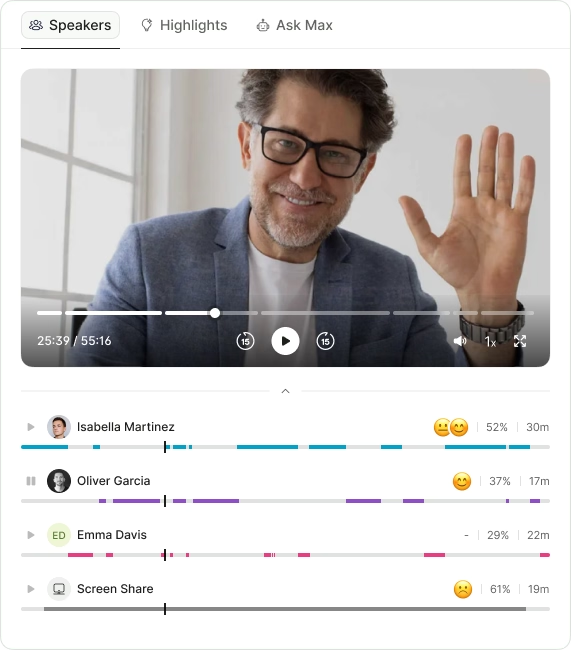
- Call summaries
- Sentiment analysis
- Next steps
- Search any call in seconds

